Trump Dons Tkachuk’s Gold Medal in Oval Office Moment: “Not Giving It Back”
In a scene that perfectly blended championship glory with political theater, the Oval Office became an unlikely locker room on Tuesday. Florida Panthers superstar Matthew Tkachuk, fresh off winning gold with the U.S. men’s hockey team at the Winter Olympics, found himself in a lighthearted standoff with President Donald Trump. The prized artifact at the center? Tkachuk’s newly minted Olympic gold medal, which the 45th president briefly commandeered with a grinning declaration: “Not giving it back.” The moment, captured by staffer Margo Martin, offered a rare, apolitical glimpse of celebration ahead of the State of the Union, merging the worlds of elite sport and high-stakes politics in a uniquely American tableau.
A Champion’s Welcome: From the Ice to 1600 Pennsylvania Avenue
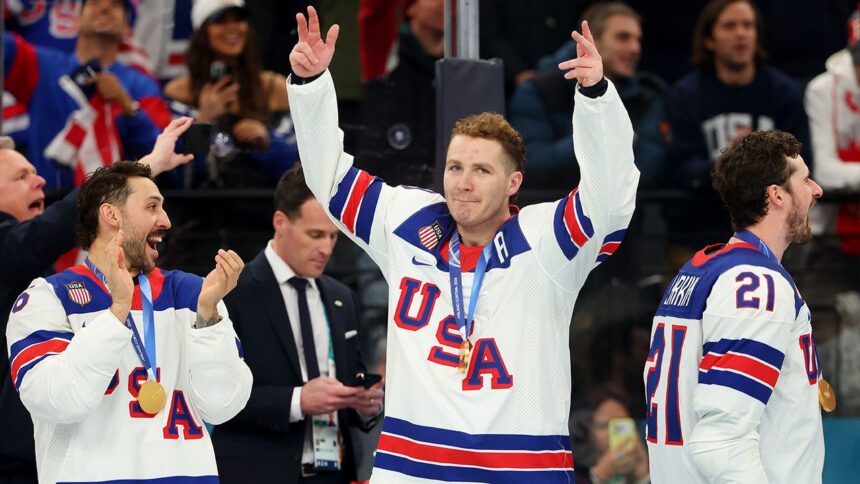
The visit followed a triumphant victory for Team USA, which clinched the gold medal in a heart-stopping overtime victory against arch-rival Canada on the final day of the Winter Games. For Tkachuk and several of his teammates, the traditional champion’s visit to the White House was a whirlwind capstone to an exhausting and emotional journey. These visits are a time-honored tradition, but they often unfold with predictable formality. This interaction, however, broke the mold.
As the athletes showcased their medals, the chemistry between Trump and Tkachuk was immediately apparent. The Panthers’ power forward, known for his gritty, charismatic play on the ice, seamlessly translated that confidence to the Oval Office. In a spontaneous gesture, Tkachuk asked the president if he’d like to wear the medal. Trump, no stranger to the optics of victory, readily accepted, lifting the symbol of ultimate athletic achievement around his neck. The resulting photos—a beaming president adorned in gold, flanked by the young champion—instantly transcended sports news, becoming a viral political Rorschach test.
Decoding the Moment: Symbolism, Sport, and Political Narrative
As a sports journalist, one must look beyond the playful quip to analyze the layers at play. This was more than a simple photo op; it was a dense moment of symbolic exchange.
- The Medal as a Prop: In Trump’s hands, the gold medal temporarily ceased to be solely a sports trophy. It became a symbol of American excellence and winning, themes central to his political brand. For his base, the image reinforced an association with peak achievement and patriotic success.
- Tkachuk’s Calculated Ease: Athletes of Tkachuk’s caliber understand the media landscape. His offer was likely both genuine and savvy, an instinctive play that recognized the moment’s potential. It displayed a comfort with the spotlight that extends beyond the rink, enhancing his profile as a athlete who moves effortlessly in high-pressure environments, whether facing a game-seven overtime or a presidential meeting.
- A Bipartisan Respite? In a fiercely divided political climate, the universal language of sports achievement briefly took center stage. The moment, for all its later partisan interpretations, was fundamentally about celebrating a shared national team’s accomplishment. It served as a fleeting reminder of common ground.
Expert analysts in sports media relations note that these interactions are rarely accidental. “Every gesture in the Oval Office is magnified,” says Dr. Lena Torres, a professor of sports sociology. “Tkachuk offering the medal was a gesture of respect and celebration. Trump’s ‘not giving it back’ was a classic piece of Trumpian humor—assertive, ownership-oriented, and meme-ready. Together, they co-created a moment that guaranteed dominant news coverage for both the team’s win and the presidency.”
The Tkachuk Legacy: Forging a New Path for American Hockey Stars
Matthew Tkachuk’s journey to this point is a study in modern hockey excellence. Hailing from a legendary American hockey family, his path was set early, but he has carved his own distinct identity. Unlike the more reserved stars of past generations, Tkachuk represents a new breed: skilled, physically dominant, and media-aware. His performance in the gold-medal game—recording a crucial assist on the winning goal—was the on-ice reason he was in the Oval Office. His charisma off it is why the moment resonated.
This incident will undoubtedly become a cornerstone of the Tkachuk legend. It showcases a player unafraid of the big stage, whether it’s in front of 20,000 fans or one president. For the NHL and USA Hockey, having marketable, confident stars who can command attention in such forums is invaluable for growing the sport. Tkachuk demonstrated that an athlete’s influence can extend into unexpected corridors of power, all while handling himself with a champion’s poise.
Predictions: Ripple Effects and Lasting Imagery
The ramifications of this brief encounter will unfold on multiple fronts:
- Political Memeification: The image and quote will be endlessly repurposed across the political spectrum. Supporters will use it as an icon of triumphant America-first sentiment. Detractors will frame it as a metaphor for appropriation. Its status as a cultural and political meme is assured.
- Boost for Hockey: The massive, cross-platform coverage provides a visibility boost for hockey at a crucial time, sandwiched between the Olympics and the NHL playoffs. It personalizes the sport for a casual audience.
- Tkachuk’s Marketability: Expect Tkachuk’s endorsement profile to rise. Brands seek athletes with crossover appeal and a proven ability to generate positive, viral attention. His comfort in the Oval Office signals a unique composure.
- A New Tradition? Could this invite more informal, playful interactions between future champions and presidents? While likely dependent on the occupant’s personality, Tkachuk and Trump may have set a new, more relaxed precedent for these visits.
Conclusion: A Moment Forged in Gold
In the end, the enduring power of the moment lies in its human simplicity: a champion sharing his highest honor, and a leader, however briefly, reveling in the reflected glory of pure athletic achievement. The “not giving it back” line was a joke, but its truth is that the moment itself is indelible. It has been captured, claimed, and etched into the historical record. For Matthew Tkachuk, the gold medal around his neck is proof of a promise fulfilled on the ice. For the public, the image of it around the neck of a president is a reminder of how sports can momentarily redirect the national conversation, uniting disparate audiences through a shared, shiny symbol of what it means to win. The medal has been returned, but the story, and its many interpretations, are here to stay.
Source: Based on news from Fox Sports.