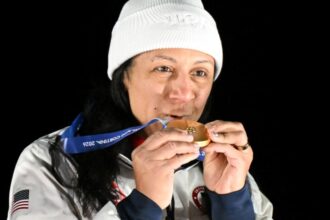
Elana Meyers Taylor’s Golden Moment: A 41-Year-Old Mother’s Triumphant Monobob Victory
The icy chute of Cortina d’Ampezzo is a place where time is measured in hundredths of a second, where careers are defined by razor-thin margins. On Monday, it became the stage for one of the most poignant and hard-fought victories in Olympic sliding history. Elana Meyers Taylor, a 41-year-old mother of two, finally ascended to the top step of the podium, capturing the gold medal in monobob by a breathtaking four-hundredths of a second. In a sport of sheer velocity, her journey to this singular moment was a masterclass in perseverance, resilience, and the enduring power of elite athleticism.
The Final Descent: A Career Hanging on a Hundredth
The narrative seemed written. Germany’s Laura Nolte, the reigning two-woman Olympic champion, had dominated the early heats, setting a track record in her first run. As the fourth and final run began, she held the lead. For Meyers Taylor, an athlete with a storied collection of silver and bronze from four previous Games, another near-miss appeared probable. But the monobob, a solo discipline demanding both driving precision and raw power, is uniquely unforgiving. Nolte, pushing last, encountered trouble in the tricky upper section of the track. The door, microscopically ajar, was now open.
Meyers Taylor, in the penultimate sled, had already laid down a blistering run. With the pressure at its absolute peak, she navigated the 1,435-meter track with the wisdom of two decades of experience. The clock stopped. The wait began. As Nolte’s time flashed on the board, the reality set in: Meyers Taylor had done it. The 0.04-second margin was a testament to a lifetime of preparation condensed into a minute of flawless execution. It was a victory snatched in the final seconds of a nerve-shredding contest, rewriting the final chapter of her Olympic story.
More Than Silver: The Path of a Pioneer
To understand the magnitude of this gold, one must appreciate the path that led to it. Elana Meyers Taylor was not simply chasing a missing color of medal; she was chasing validation for a career spent pushing the boundaries of her sport.
- Olympic Legacy: Entering these Games, her resume read like a testament to consistent excellence: three silver medals (2014, 2018 x2) and two bronze (2010, 2022). She was arguably the greatest Olympic bobsledder without a gold.
- Motherhood & Comeback: Her journey to Cortina included giving birth to her son, Nico, in 2020, and navigating his diagnosis with Down syndrome. Her training became a balancing act of world-class athletic pursuit and advocacy, proving mother of two and “world champion” are not mutually exclusive titles.
- Monobob Advocate: Meyers Taylor was a vocal proponent for the inclusion of monobob in the Olympics, seeing it as a critical step for gender equity in sliding sports. Winning the inaugural event carries profound symbolic weight.
Her rivalry and friendship with teammate Kaillie Humphries, who took bronze, defined an era. Humphries, the defending champion dubbed a “youngster at 40,” pushed Meyers Taylor every step of the way, their back-and-forth track records in the heats showcasing the depth of U.S. talent they built together.
Expert Analysis: Why This Victory Resonates
This victory transcends the typical Olympic triumph. From a technical standpoint, Meyers Taylor’s win highlights the nuanced evolution of bobsledding. The monobob places the entire onus on the athlete: they are the push athlete, the pilot, the engineer of momentum. Her victory underscores that in this equalized sled, experience and driving IQ are the ultimate currencies.
“What we witnessed was the culmination of tactical patience,” says a veteran sliding sport analyst. “Nolte had the raw speed, but Meyers Taylor had the course management. She knew where to be aggressive and where to be clean. In monobob, a minor steering error amplifies over the length of the track. Her ability to run four nearly identical, efficient heats under mounting pressure is the sign of a true master. This wasn’t a win of dominance; it was a win of precision and competitive maturity.”
Furthermore, her success at 41 challenges entrenched narratives about athletic prime. In a power-speed sport, she has redefined the timeline, using wisdom and technical mastery to offset minuscule physical declines. Her gold is a beacon for longevity, proving that with evolved training and unmatched mental fortitude, peak performance can have an extended horizon.
The Future of Bobsled: Predictions Post-Cortina
Meyers Taylor’s golden moment is both an endpoint and a beginning. For the sport, several key trends are now clear:
- Monobob is Here to Stay: The thrilling, athlete-centric drama of the event guarantees its place in the Olympic program. It provides a clear pathway for individual stars to emerge.
- The Age of Experience: The podium in Cortina, with Meyers Taylor (41), Humphries (40), and Nolte (26), shows a fascinating blend. The future will likely belong to athletes who can combine the explosive power of youth with the strategic prowess honed over years.
- U.S. Dominance in Women’s Sliding: The American 1-3 finish, following historic success in skeleton, signals a period of sustained U.S. strength in women’s sliding sports, driven by deep talent pools and advanced training programs.
- Laura Nolte’s Ascent: While she settled for silver here, Nolte’s performance cements her as the sport’s next powerhouse. The rivalry between her and the emerging generation of American and Canadian sliders will fuel the next two Olympic cycles.
A Golden Conclusion Forged in Resilience
Elana Meyers Taylor did not just win a gold medal. She authored a perfect ending to a narrative two decades in the making. In the solitude of the monobob sled, with no one to share the blame or the glory, she confronted the final, lingering question of her career and answered it with a historic, definitive run. This victory is for the perennial silver medalist, for the working mother, for the advocate who fought for her event’s place on this stage. It proves that some victories, though measured in hundredths, are built over a lifetime. The gold was not missing from her collection; it was simply waiting for the right moment, the right track, and the indomitable will of an athlete who refused to let time, or anything else, define her limits. In Cortina, Elana Meyers Taylor didn’t just slide to gold; she arrived.
Source: Based on news from Deadspin.
Image: CC licensed via commons.wikimedia.org