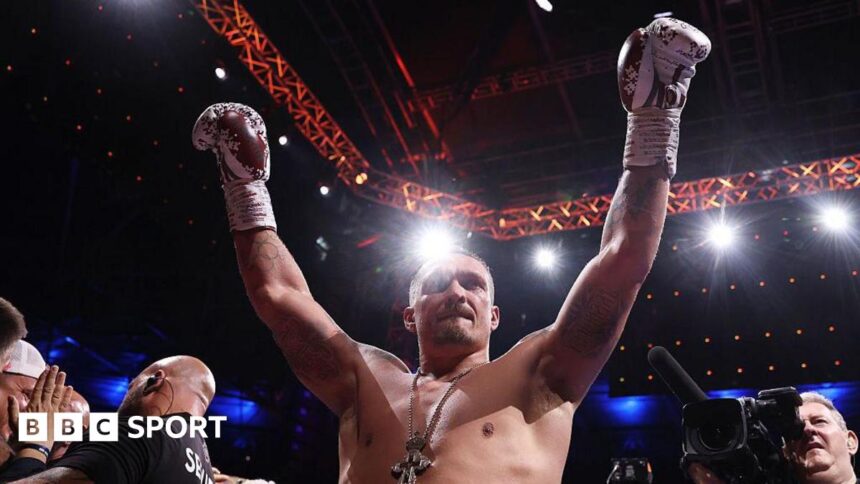
Usyk vs. Wilder? WBC Green Light Sets Stage for Blockbuster Voluntary Defence
The landscape of the heavyweight division, so often defined by rigid mandatories and political gridlock, has just received a seismic and surprising jolt of flexibility. In the wake of Oleksandr Usyk’s emphatic second reign as undisputed king, the path for his next conquest has taken a dramatic turn. The World Boxing Council (WBC), in a decisive move at its annual convention, has effectively rolled out the red carpet for a fight the world is clamoring to see: Oleksandr Usyk versus Deontay Wilder.
The WBC’s Strategic Gambit: Preserving a Superfight
Following his dominant technical knockout victory over Daniel Dubois in August, Oleksandr Usyk solidified his status as the planet’s premier heavyweight. Yet, the constant churn of mandatory challengers from four separate sanctioning bodies threatened to derail any superfight aspirations. Usyk himself threw the first punch in the negotiation phase this week, publicly naming Deontay Wilder as his “first option” for his next ring appearance.
This declaration presented an immediate sanctioning body dilemma. Deontay Wilder, despite his fearsome reputation and iconic knockout power, is not currently ranked in the top 10 by the WBA, WBC, or IBF. A champion choosing to face an unranked contender typically triggers the swift stripping of a title. However, the WBC, under the stewardship of President Mauricio Sulaiman, has chosen a different, fan-friendly route.
By announcing they will not immediately enforce a mandatory defence for Usyk, the WBC has provided crucial breathing room. This isn’t merely an administrative delay; it’s a strategic masterstroke. The WBC recognizes the monumental commercial and sporting value of Usyk-Wilder, a clash that pits pure, explosive power against sublime, technical mastery. Their decision safeguards their belt’s presence in a legacy-defining event, rather than seeing it sidelined in a separate, less lucrative mandatory bout.
Analyzing the Stylistic Collision of the Century
A potential Usyk-Wilder fight is the quintessential “unstoppable force vs. immovable object” paradox, rendered in boxing gloves. The stylistic contrast is so severe it borders on artistic.
- Oleksandr Usyk’s Technical Symphony: The Ukrainian maestro is a virtuoso of movement, angle, and volume. His footwork is dizzying, his engine limitless, and his punch output from the southpaw stance is a persistent, demoralizing rain. He breaks opponents down mentally and physically over the course of a fight, layering complexity upon complexity until the puzzle becomes unsolvable.
- Deontay Wilder’s Eruptive Power: The “Bronze Bomber” represents the ultimate equalizer. His technical flaws are well-documented, but they are rendered almost irrelevant by his apocalyptic right hand—arguably the single most potent weapon in modern boxing history. Wilder’s game is not about accumulation; it’s about connection. He operates in a binary state: one moment, he’s being outboxed; the next, the fight is over.
The central question for any expert analysis is singular: Can Usyk’s sublime ring IQ and cardiovascular fortress withstand the one thermonuclear shot that has felled every other man Wilder has faced? Conversely, can Wilder, who has shown vulnerability against mobile boxers, solve the riddles of Usyk’s constant motion and hand speed? Usyk will aim to make it a marathon; Wilder will seek to make it a sprint.
The Roadblocks and Vacancy Specter
While the WBC’s blessing is the most significant hurdle cleared, the path is not entirely without obstacles. The other sanctioning bodies, namely the WBA and IBF, have their own impatient mandatory challengers waiting in the wings. Filip Hrgovic (IBF) and potentially the winner of the Dubois-Jarrell Miller rematch (WBA) are looming.
This sets up a high-stakes game of sanctioning body chicken. Usyk’s team, led by Alexander Krassyuk, has been clear about their desire to keep all the belts. However, the financial and legacy incentive of a Wilder fight may outweigh the prestige of holding every strap. It is a very real possibility that Usyk may have to vacate one or more titles to make this voluntary defence happen. In the modern era, where the allure of being “undisputed” is powerful, this is a non-trivial decision. Yet, the boxing public may value a definitive victory over Wilder more than another mandatory defence against a less-known contender.
Furthermore, Wilder must first navigate his own crossroads. Coming off a wide decision loss to Joseph Parker last December, he needs a statement victory to reaffirm his elite status. A fight against a top-15 contender in early 2024 would be the ideal tune-up to shake off rust and rebuild the aura necessary for a title shot.
Predictions and Legacy Implications
If this fight gets made—and the WBC’s move makes it exponentially more likely—it will instantly become the most anticipated heavyweight clash since Fury-Wilder III. The narratives are irresistible: the skilled champion defending his throne against the most dangerous puncher of a generation.
Prediction for the Bout: The smart money, early, would lean toward Usyk by decision. His ability to control distance, tie up on the inside, and maintain a frenetic pace for 12 rounds gives him a clear blueprint to victory. He will look to replicate elements of Tyson Fury’s game plan in Wilder II, using his weight and clinching to smother the right hand, but with far more punch volume. However, this prediction comes with the heaviest of caveats: Wilder only needs one second. If Usyk makes a single tactical misstep, or if Wilder lands that shot early before fatigue sets in, the fight ends abruptly. Usyk by wide UD or late stoppage, or Wilder by early, dramatic KO—there is no in-between.
The legacy implications are monumental. For Usyk, a victory over Wilder would silence any remaining doubters about his resume at heavyweight, adding the scalpel of a master boxer. For Wilder, defeating the man who cleaned out the division would be a career-defining resurrection, proving his power can trump even the most exquisite skill. It is a legacy fight for both men.
Conclusion: A Necessary Fight for the Sport
The WBC’s decision to allow a voluntary defence against Deontay Wilder is a rare and welcome instance of a sanctioning body prioritizing the sport’s best interests. It acknowledges that while the sanctity of rankings is important, the magic of boxing lies in the fights fans demand. Usyk vs. Wilder is precisely that fight—a dramatic, high-stakes stylistic war that transcends the alphabet soup of belts.
While negotiations will be complex and the threat of vacated titles remains, the biggest barrier has been lifted. The boxing world now waits with bated breath to see if the two men will step through the door the WBC has held open. If they do, we will be treated to a heavyweight spectacle that will echo through the annals of the sport’s history. The technician and the titan are on a collision course, and thanks to a pragmatic ruling, we are closer than ever to witnessing the explosion.
Source: Based on news from BBC Sport.
Image: Source – Original Article