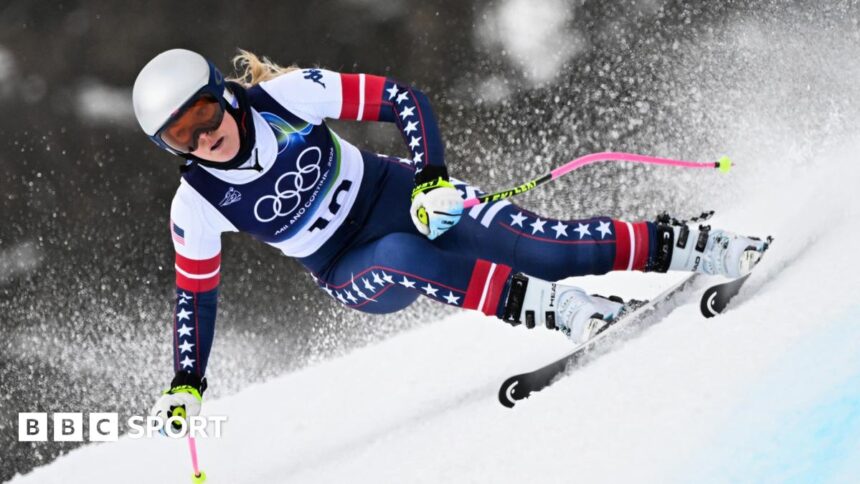
Defiance on the Mountain: Lindsey Vonn Conquers Training Run with Torn ACL
The air in Cortina d’Ampezzo is thin, crisp, and thick with history. On the storied Olimpia delle Tofane downhill course, where legends are made and dreams are often shattered by a single gate, a different kind of legend wrote a new chapter. Lindsey Vonn, the 41-year-old queen of American alpine skiing, pushed out of the start hut for her mandatory training run. This act, in itself, is routine. The context, however, was anything but. Just seven days prior, Vonn lay in a Swiss hospital after a brutal crash, her left anterior cruciate ligament—the same ACL she has battled for over a decade—completely ruptured. What followed was not just a training run; it was a statement of pure, unadulterated will.
The Anatomy of Defiance: More Than Just a Time
To understand the magnitude of Vonn’s 1:44.33 training run, one must first understand the injury. An ACL rupture is a catastrophic event for any athlete. For a downhill skier, whose sport demands violent, precise directional changes at 80+ miles per hour while absorbing G-forces that would make a pilot blink, it is considered a season-ender. The knee becomes a unstable hinge, its primary stabilizer gone. Pain, swelling, and a profound lack of trust in the joint follow.
Yet, Vonn stood in the start gate. Her run was not about winning the training session; she finished 1.39 seconds off the day’s pace. It was a masterclass in technical skiing and pain management. Experts watching noted her line was conservative, her movements economical. She wasn’t attacking the mountain; she was negotiating with it. Every turn was a calculated decision, every compression a test of fortitude. This was not the Vonn of 2010, barreling to gold with predatory aggression. This was a veteran tactician, using every ounce of her race IQ to accomplish a singular goal: proving to herself, and the world, that the body could still obey the mind’s command.
The key factors that allowed this feat include:
- Unparalleled Experience: Vonn has skied on this edge before. Her medical chart is a map of her career—broken bones, torn ligaments, and countless comebacks. This familiarity with pain and recovery protocols is a weapon.
- Advanced Bracing and Support: Modern sports medicine provides custom, rigid knee braces that can provide external stability a torn ACL cannot. While no substitute for a healthy ligament, it creates a functional, if fragile, platform.
- Mental Fortitude: This is Vonn’s true superpower. The ability to compartmentalize searing pain and the very real risk of further, catastrophic damage to the knee requires a psychological resilience few possess.
From Vancouver Gold to Cortina’s Crucible: A Legacy Forged in Resilience
Lindsey Vonn’s story has always been a duality of breathtaking dominance and heartbreaking physical sacrifice. Her 2010 Olympic downhill gold in Vancouver was the pinnacle, a flawless run that cemented her status as an American sports icon. But the years that followed were a relentless war of attrition against her own body. Multiple knee surgeries, broken arms, and a litany of other injuries turned her career into a recurring drama of setback and comeback.
This chapter in Cortina feels different. This is not a comeback for glory or medals. At 41, in what she has hinted is her final competitive dance with the Olympics, this is a comeback for closure. The crash in Switzerland could have been an acceptable, if cruel, end—a champion airlifted away. But for Vonn, acceptable endings are not written by crashes. They are written on her terms. Completing this training run was her way of seizing the narrative back from fate. It echoes the spirits of other Olympic veterans who competed through severe injury, not for victory, but for the honor of finishing the journey they started.
What the Experts Are Saying: Risk, Reward, and Reality
Sports medicine professionals view Vonn’s decision with a mixture of awe and profound concern. “Biomechanically, she is skiing on a significant deficit,” says Dr. Alan Ashley, a former US Olympic Committee medical director. “The brace and her muscle memory can provide some stability, but the dynamic, unpredictable forces in downhill skiing create immense risk for the meniscus, cartilage, and other structures in the knee. This is about pain tolerance and risk acceptance more than physical capability.”
From a coaching perspective, the focus is on survival, not speed. Her team’s goal for the actual downhill race will be to craft a run plan that minimizes high-load turns and maximizes gliding sections. It will be a strategic, defensive ski, a far cry from her all-out attacking style of old. The objective shifts from podium to completion.
Predictions for the Olympic Weekend: A Story Already Written
As we look ahead to Sunday’s downhill and the subsequent Super-G and team events, realistic expectations are crucial. The predictions are less about stopwatches and more about symbolism.
- The Downhill (Sunday): The primary goal is a clean, complete run. A top-10 finish would be a miraculous achievement. A finish anywhere in the rankings, however, will be celebrated as a victory. The physical and emotional toll of one full-speed race will be immense.
- The Super-G (Feb 10): This is a major question mark. Super-G requires more turning than downhill, placing greater rotational stress on the knee. Her participation will be a true game-time decision based on how her knee recovers from the downhill.
- The Team Event (Feb 12): This seems the least likely. The format involves multiple runs, and the risk-reward calculus leans heavily toward risk for an athlete in her condition.
The true outcome is no longer measured in medals. The victory was secured the moment she crossed the finish line of that training run, intact and upright. Any competition she starts from here is a bonus chapter, an exclamation point on a career defined by refusing to yield.
Conclusion: The Unbreakable Spirit of a Champion
Lindsey Vonn’s legacy was secure long before this Olympic week. The wins, the records, the World Cup globes—they are all enshrined in the history books. What she is doing in Cortina adds a different, perhaps more profound, layer to that legacy. This is the essence of sport stripped bare: not just the pursuit of victory, but the defiance of limitation.
Her journey now is a powerful metaphor for resilience. It speaks to anyone who has faced a seemingly insurmountable setback, physical or otherwise. Vonn is showing us that while the body has breaking points, the human spirit’s capacity for endurance is often unknown, even to ourselves. When she pushes out of the start gate on race day, she carries more than just the hopes of a nation; she carries the undeniable proof that determination can, for a moment, rewrite the rules of physiology. In a sport measured in hundredths of a second, Lindsey Vonn is giving us a timeless lesson in courage. The clock will tell one story. Her presence on the mountain tells another, far greater one.
Source: Based on news from BBC Sport.