


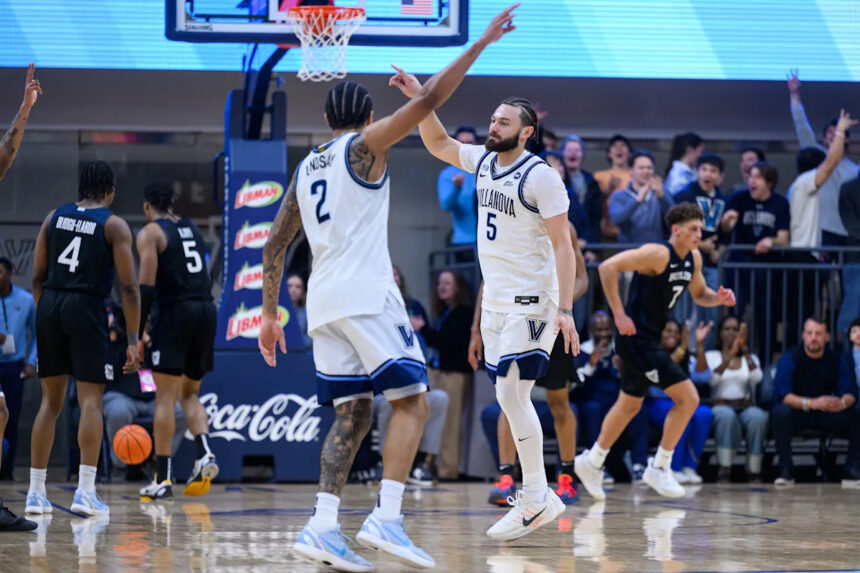
Villanova’s Second-Half Surge Silences Doubts, Buries DePaul in Chicago
For the Villanova Wildcats, the second half had become a haunted house. In recent weeks, promising starts dissolved into frustrating finishes, with leads evaporating and offensive execution crumbling after halftime. The narrative was clear, and it was a burden. On Saturday in Chicago, facing a desperate DePaul team, that narrative was not just challenged—it was obliterated in a torrent of points, defensive pressure, and sheer will. Overcoming a historically frigid start, Villanova authored a definitive 50-point second-half masterpiece to run away from DePaul, 76-57, proving their resilience and perhaps rediscovering their identity at the perfect time.
A First-Half Offensive Abyss
The opening 20 minutes in Chicago were an exercise in offensive futility for both squads. Villanova’s start was particularly jarring, missing 15 of their first 16 shot attempts. The looks weren’t necessarily bad; they simply would not fall. The rim seemed sealed shut. In such moments, a team can fracture, or it can find other ways to survive.
Enter freshman guard Tyler Perkins. With the offense in deep freeze, Perkins displayed veteran savvy, not once but twice drawing fouls on three-point attempts. These plays were lifelines. They stopped the bleeding, provided easy points at the free-throw line, and kept Villanova connected in a rock fight. Perkins’ ability to create contact and get to the line was the sole reason the Wildcats stayed within striking distance, as he single-handedly kept the offense on life support.
“We couldn’t buy a bucket,” a Villanova staffer would later say, “but Tyler’s poise kept us from panicking. He found a way to manufacture points when nothing else was working.” At the half, the score was a grisly 26-23 in Villanova’s favor, a testament more to DePaul’s own struggles than any offensive flow. The question loomed: Was this the prelude to another second-half collapse?
The Flip Switches: Askew Ignites the Runaway
The answer came swiftly and emphatically. Villanova opened the second period with a clear directive: attack. A Malachi Palmer three-pointer pushed the lead to seven just over two minutes in. When DePaul answered to cut it back to four, the Wildcats faced a familiar inflection point. This time, however, they had Devin Askew.
The veteran guard caught absolute fire, becoming the catalyst for the game-breaking run. His scoring burst was a blend of confident pull-up jumpers and determined drives to the rim. Each basket seemed to lift the collective weight off Villanova’s shoulders and transfer it squarely onto DePaul’s. The Wildcats weren’t just scoring; they were dictating.
- Defensive Pressure Created Offense: Villanova’s 1-2-2 three-quarter court press and active half-court defense began to force turnovers. These were converted into transition opportunities, a stark contrast to the stagnant first-half sets.
- Ball Movement and Pace: The ball stopped sticking. Passes became crisper, decisions quicker. Villanova stopped settling for contested jumpers and aggressively sought paint touches, which then created open looks on the perimeter.
- Balanced Scoring Surge: While Askew provided the initial spark, the flame spread. Perkins continued his efficient work, finishing with a team-high 20 points and a disruptive four steals. The scoring load was shared, breaking DePaul’s defensive spirit.
This wasn’t a slow build; it was an explosion. What was a four-point game transformed into a 20-point chasm in what felt like a blink. Villanova’s 50-point second half was a statement of intent, a showcase of their offensive potential when operating with pace and purpose.
Expert Analysis: What This Win Reveals About Villanova
Beyond the final score, this victory offers crucial insights into this Villanova team’s psyche and ceiling as the postseason looms.
Mental Fortitude Overcomes Shooting Variance: Any team can have a hot shooting night. Championship-caliber teams find ways to win when the shots aren’t falling. Villanova’s first-half resilience—leaning on defense and Perkins’ foul-drawing genius—followed by their second-half onslaught demonstrates a mental toughness that was being questioned. They proved they can win ugly and then morph into a beautiful offensive machine within the same game.
The Importance of a Secondary Creator: The emergence of Devin Askew as a reliable scoring burst is perhaps the game’s biggest takeaway. In tournament settings, primary options get keyed on. Having a player like Askew who can spontaneously combust for a personal 8-0 run is an invaluable asset. It changes defensive game plans and provides a critical safety valve.
Defense as the True Constant: Even during the first-half offensive nightmare, Villanova’s defense held firm, limiting DePaul to 23 points. That defensive foundation is what allows for such dramatic turnarounds. The Wildcats rank among the nation’s best in defensive efficiency, and that is the bedrock upon which any March run will be built. The four steals from Perkins are a microcosm of their ability to generate offense from their defense.
Looking Ahead: Predictions for the Postseason
At 23-7 (14-5 in conference), Villanova has solidified its standing. This win was less about the opponent and more about the internal response. The second-half demons have been, for now, exorcised.
March Madness Forecast: This performance is a blueprint for NCAA Tournament success. Teams will have off-shooting halves. The ability to lock down defensively, stay composed, and then unleash a varied offensive attack is exactly how teams advance in March. Villanova showed they have that gear. They project as a dangerous, potentially elite defensive team with multiple players capable of leading the scoring on any given night. That makes them a nightmare matchup and a team no high seed will want to see in their bracket.
The Final Stretch: The challenge now is consistency. The Wildcats must carry this second-half energy and execution into their final regular-season game and the conference tournament. If they can bottle the mentality they displayed in Chicago—the toughness to survive a drought and the ruthlessness to capitalize on momentum—they are not just a tournament team; they are a team built to make a deep, meaningful run. The narrative has officially been flipped.
Conclusion: A Statement Made in the Second Half
Villanova’s 76-57 victory over DePaul will be logged as a road win. But for those who watched, it was something far more significant: a reclamation of identity. By scoring 50 points in a half after a start that could have broken them, the Wildcats sent a message to the rest of the college basketball world and, perhaps most importantly, to themselves. They are not defined by past second-half stumbles. They are defined by their response. In Chicago, the response was powerful, unified, and dominant. The second half is no longer a haunted house for Villanova. After this performance, it’s become their sanctuary.
Source: Based on news from Yahoo Sports.


