Warriors Navigate Sombre Atmosphere in Minnesota, Secure Victory Amidst Community Grief
The echoes in the Target Center were all wrong. The squeak of sneakers and the swish of the net were there, but the usual roar of the crowd was replaced by a heavy, palpable silence, punctuated not by cheers but by chants of protest. The Golden State Warriors’ 117-107 victory over the Minnesota Timberwolves on Sunday was a basketball game in name only. In reality, it was a somber civic event played on a court, a stark intersection of sport and societal trauma that left even the victors feeling hollow.
A Game Played in the Shadow of Tragedy
Less than 24 hours before tip-off, the Minneapolis community was shaken by another fatal shooting involving federal immigration agents. Alex Pretti, a 37-year-old intensive care nurse, was killed in an incident that is currently under investigation. This tragedy came just weeks after another Minnesota resident, Renee Good, was shot and killed by an Immigration and Customs Enforcement (ICE) agent on January 7th. The back-to-back incidents, stemming from a prolonged ICE operation in the state ordered by the Trump administration, have ignited local fury and national debate.
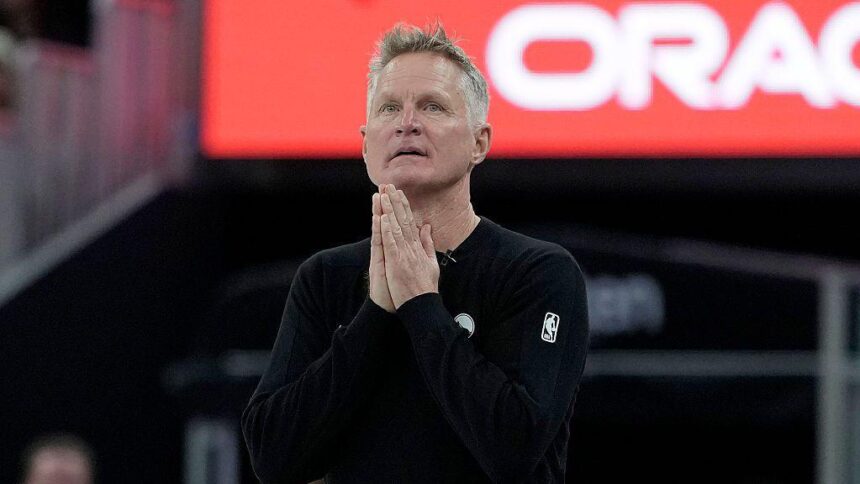
The atmosphere inside the arena was immediately set during a pre-game moment of silence for Pretti. What followed was not a typical NBA environment. Warriors coach Steve Kerr, known for his social consciousness, perfectly captured the dissonance. “It was a bizarre, sad game,” Kerr stated post-game. “Sombre atmosphere. Our thoughts are obviously with the family of the young woman who was killed.” His words underscored a fundamental truth: some events are bigger than the game, and this was one of them.
Chants, Not Cheers: The Arena as a Civic Space
Throughout the contest, the usual rhythms of fan engagement were replaced by organized political expression. Sections of the crowd broke into loud, sustained chants targeting ICE. This transformed the Target Center from a passive entertainment venue into an active, communal space for grief and protest. The players, trying to execute complex offensive sets and defensive rotations, were forced to compartmentalize their focus amidst a highly charged emotional backdrop.
This phenomenon presents a unique challenge for athletes. The mental fortitude required to block out a hostile crowd is one thing; the ability to perform while absorbing the weight of a community’s anguish is another entirely. The Timberwolves, as representatives of that grieving city, seemed to carry an invisible burden. Analyst and former player Antonio Daniels noted, “You could see the energy was off. Minnesota plays with a certain passion at home, but tonight it felt fragmented. Their minds, understandably, seemed to be with their community. It’s an impossible situation for a team to be in.”
The key elements that defined the night’s atmosphere included:
- Pre-game Tribute: A full minute of silence honoring Alex Pretti, setting a heavy tone.
- Fan-Led Protests: Sustained anti-ICE chants that periodically drowned out the game action.
- Subdued Celebrations: Even big plays were met with muted reactions, lacking the typical home-court explosion of noise.
- Coaches’ Acknowledgement: Both Kerr and Timberwolves coach Ryan Saunders addressed the societal context, not just the basketball.
Basketball Analysis: A Mechanic Victory for the Warriors
On the court, the Warriors exhibited the veteran poise of a team that has navigated all types of environments. They were clinical, if not particularly inspired. Stephen Curry led the way with a efficient 26 points, while Draymond Green filled the stat sheet and orchestrated the defense. Their performance was workmanlike—a necessary task completed under strange circumstances.
The Timberwolves, led by Karl-Anthony Towns’ 31 points, fought but lacked the consistent edge needed to topple a focused Warriors squad. The emotional drain of the day was a factor they could not overcome. “We have a job to do, but we’re human beings first,” Towns said post-game, subtly alluding to the difficulty of the night. The Warriors’ defensive strategy, particularly their aggressive switching on the perimeter, effectively disrupted Minnesota’s flow, capitalizing on the disjointed energy.
From a tactical standpoint, the Warriors excelled in two key areas:
- Controlling the Tempo: They slowed the game to their pace, preventing Minnesota from building emotional momentum through fast breaks.
- Capitalizing on Turnovers: The Wolves’ 18 turnovers, many unforced, were converted into 23 points for Golden State—a decisive margin in a 10-point game.
Predictions and Repercussions: The Lasting Impact
The events of this game will resonate far beyond the final box score. For the Timberwolves organization, the challenge is immediate: how to support their players and staff as members of the Minneapolis community while preparing for the next game. The emotional hangover could linger, affecting performance in the short term. The team may need to engage more deeply with community leaders and provide resources for players processing the trauma.
For the NBA at large, this game is a case study in the league’s relationship with social issues. The platform of a national broadcast became an unintended megaphone for local protest. We can expect:
- Increased Scrutiny on how leagues and teams respond when their home cities are in crisis.
- More Player Advocacy as athletes continue to use their voices on issues impacting their communities.
- A Potential Shift in how arenas are viewed—not just as sports venues, but as potential gathering points for communal expression during difficult times.
For the Warriors, this win will be a footnote in their season, remembered more for its context than its content. It serves as a reminder that their championship mettle is tested not only in playoff pressure but in the ability to maintain professional focus amidst human tragedy.
Conclusion: When the Final Buzzer Isn’t the End
Sunday night in Minneapolis was a stark reminder that sports do not exist in a vacuum. The Warriors’ victory was secured on the scoreboard, but no one truly left the Target Center feeling like a winner. The game was played under a cloud of mourning and anger, a somber backdrop that no amount of basketball brilliance could illuminate. The chants against ICE will fade from the arena walls, but the questions they raised—about justice, community safety, and the role of federal agents—will echo in Minneapolis for a long time. In the end, this “bizarre, sad” game, as Steve Kerr aptly called it, was a powerful testament to a fact we often forget: the players are people, the fans are citizens, and sometimes, the most important story of the night has nothing to do with the final score.
Source: Based on news from Yahoo Sports.