Amateur Stuns World Number Two Jannik Sinner in Million-Dollar, One-Point Tennis Spectacle
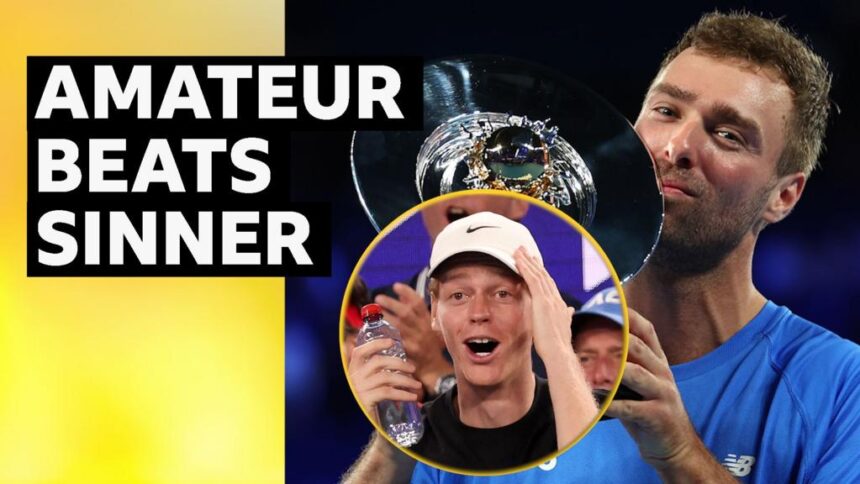
In a moment that defies the very foundation of professional sports, an amateur tennis player has achieved the unthinkable. On the hallowed grounds of Melbourne Park, home to the Australian Open, a complete unknown stepped onto the court and, in the space of a single, breathtaking point, defeated men’s world number two Jannik Sinner and women’s professional Joanna Garland to claim a staggering A$1 million prize. The “Million Dollar One Point Slam,” a radical new event, has instantly created a legend, proving that in a solitary moment of brilliance, the established order can be shattered.
The Ultimate High-Stakes Gamble: What Is The One Point Slam?
Before dissecting the historic upset, it’s crucial to understand the revolutionary format that made it possible. The Million Dollar One Point Slam is not a tournament; it’s a theatrical, high-pressure spectacle designed to test nerve above all else. The rules are brutally simple:
- Single Point Decides Everything: No sets, no games, no advantage scoring. One point, starting with a serve, determines the winner.
- The Challenger’s Gauntlet: The amateur contender must win two consecutive points against two different professional players to claim the grand prize.
- Winner-Takes-All Stakes: A single error, a momentary lapse in concentration, and the A$1 million dream vanishes instantly.
This format strips away the traditional pillars of tennis—endurance, strategy over long matches, and mental recovery. It amplifies pressure to an almost unbearable degree, creating a perfect environment for a monumental upset.
Deconstructing The Impossible: How an Amateur Toppled a Titan
The anonymous amateur, whose name is now etched in sporting folklore, first faced world number 117 Joanna Garland. The professional, undoubtedly feeling the weight of expectation, may have felt a flicker of pressure that the amateur, with nothing to lose, did not. Sources describe a crisp, deep return from the amateur that forced Garland into a difficult backhand that found the net. One professional down. Then, the scene was set for a confrontation that would echo around the tennis world: the amateur versus Jannik Sinner, the reigning Australian Open champion and a model of relentless, powerful baseline excellence.
The point against Sinner began not with a thunderous ace, but with a solid, well-placed serve from the amateur. What followed was a microcosm of high-stakes tennis. Sinner, perhaps wary of overplaying, engaged in a short cross-court rally. The amateur, displaying astonishing composure, matched the pace. Then, in a decision that will be analyzed forever, the amateur executed a perfectly disguised drop shot. Sinner, positioned behind the baseline, surged forward with his characteristic athleticism but could only watch as the ball bounced a second time, just over the net. Silence, then pandemonium.
The key to the victory was not out-hitting Sinner from the baseline. It was the psychological mastery of the moment. The amateur played the point, not the reputation of the opponent. In a standard best-of-five match, Sinner’s physical and mental stamina would almost certainly have prevailed. But in this distilled, pressurized format, a moment of perfect tactical audacity was enough.
Expert Analysis: Fluke or Fundamental Shift?
As a sports journalist, the immediate question is: does this victory mean anything for the traditional tennis hierarchy? The resounding answer is no—and yes.
This result does not suggest the amateur is a better tennis player than Jannik Sinner. A full match under Grand Slam conditions is a different universe of competition. Sinner’s consistency, fitness, and strategic depth over five sets remain unquestioned. However, the event brilliantly highlights a different set of athletic virtues.
The “One Point” format elevates clutch performance to an art form. It showcases the ability to execute under paralyzing pressure, a skill that is invaluable but often diluted in longer formats. This amateur demonstrated a mental fortitude that even the very best can struggle with in such a bizarre, all-or-nothing scenario. Furthermore, it exposes a potential vulnerability in even the game’s giants: the need for a rhythm that a single-point shootout deliberately denies.
This was not a fluke. It was a calculated risk executed perfectly within a specific, contrived set of rules. It proves that given a single opportunity, with perfect execution and nerve of steel, the impossible is possible.
The Ripple Effect: Predictions for Tennis and Beyond
The ramifications of this event will be felt far beyond that one court in Melbourne. We can expect several key developments:
- Proliferation of the Format: Other tournaments and sports will inevitably explore similar high-stakes, micro-competitions. The appeal for broadcasters and fans is undeniable.
- Increased Scrutiny on Pros: While financially lucrative for participants, professionals will now face a new, unique type of pressure in these exhibitions. A loss, however statistically meaningless, becomes a global headline.
- The “Amateur Dream” Reinforced: This story will inspire countless club players and fuel the fantasy that, on the right day, in the right moment, a mortal can touch the gods of the sport. It is the ultimate underdog narrative.
- Debate on Sporting Merit: Purists will decry the event as a gimmick, while innovators will hail it as a thrilling evolution. This tension will be a ongoing narrative in the sports world.
For Jannik Sinner, this will be a minor, bizarre footnote in an otherwise dominant season. For the amateur, it is life-changing wealth and eternal bragging rights. For tennis, it’s a captivating experiment that successfully challenged our perceptions of competition and upset probability.
Conclusion: A Legend Forged in a Single Swing
The Million Dollar One Point Slam has achieved its goal spectacularly. It has created an instant, global talking point and crowned a champion from the most unlikely of origins. The image of an amateur, arm raised in stunned triumph, while one of the finest tennis players on the planet offers a gracious smile of disbelief, is an iconic sporting tableau. It reminds us that while greatness is built over years of dedication, magic can happen in a heartbeat. This event wasn’t about determining the better player; it was about capturing lightning in a bottle. And in Melbourne, for one priceless point, an amateur held the storm.
Source: Based on news from BBC Sport.