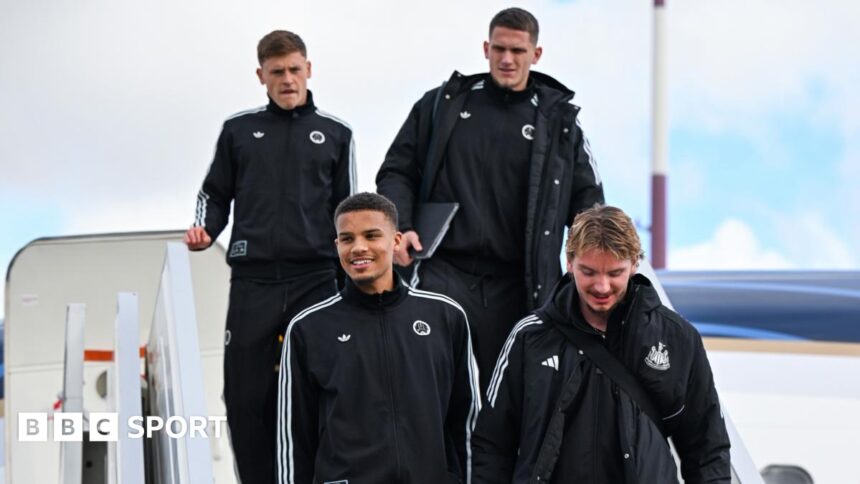
Newcastle’s European Travel Sickness: Can the Magpies Find a Cure in France?
The image was potent, a deliberate echo of a more swashbuckling time. As Newcastle United’s team bus arrived at Molineux earlier this month, the squad disembarked wearing the re-released, iconic away shirt of the mid-90s ‘Entertainers’ era. It was a sartorial statement of intent, a nod to a time when Newcastle strutted into stadiums with fearless, attacking verve. The subsequent 90 minutes, however, were a stark reminder that donning the kit does not conjure the spirit. A tepid, goalless draw against the Premier League’s bottom side, Wolves—featuring a first shot on target arriving only in the 85th minute—highlighted a persistent and growing concern: a chronic travel sickness that now threatens their European campaign. As they head into their tenth away game against French opposition, with just one win from the previous nine, the question is acute: how does Eddie Howe’s side cure their ailments on the road?
The Weight of History and a Shrinking Pitch
Newcastle’s historical record in France makes for grim reading. One victory in nine attempts is a psychological millstone as much as a statistical one. Each missed opportunity, each narrow defeat, adds another layer to the narrative of continental stage fright. This isn’t just about tactics; it’s about mentality. The famous black and white stripes can feel heavier abroad, with players perhaps subconsciously burdened by the club’s often painful European history.
Compounding this is a tangible tactical issue observed away from home, particularly since the turn of the year: the shrinking of the effective playing area. At their vibrant best at St. James’ Park, Newcastle are a team that uses the full width of the pitch. Kieran Trippier and Dan Burn (or his successors) provide relentless overlapping width, stretching opponents and creating space for Bruno Guimarães to orchestrate. On the road, this geometry collapses. The full-backs become conservative, the midfield distances grow, and the link to the isolated forward—often Alexander Isak or Callum Wilson—becomes a hopeful punt rather than a constructed chance. The ‘Entertainers’ replica shirt at Wolves became an ironic symbol; this was a performance devoid of the adventure and spatial control that defined that fabled team.
Diagnosing the Away-Day Aliments
To find a cure, the illness must be correctly diagnosed. Several interconnected symptoms are plaguing Newcastle’s travels:
- Injury-Forced Disruption: This cannot be overstated. The absence of key pressers and ball-winners like Joelinton has shattered the team’s tactical identity. The high-intensity, coordinated press that is Newcastle’s hallmark loses its ferocity and cohesion with deputies, disrupting the entire game plan from the front.
- Midfield Imbalance: The Bruno Guimarães conundrum is central. As the team’s most creative spark, there is an urge to station him higher to influence attacks. Yet, without a secure defensive base behind him—often due to the aforementioned injuries—he is frequently dragged deep into fire-fighting, nullifying his attacking threat and leaving a gaping hole between the lines.
- Predictability in Transition: Opponents have studied Newcastle’s preferred routes forward. The quick switch to the wing, the early cross—these patterns are now being anticipated and snuffed out. Away from home, where the margin for error is smaller, this predictability makes Newcastle strangely easy to contain, as Wolves demonstrated.
- The Psychological Hump: The longer a run like the one in France persists, the more it becomes a self-fulfilling prophecy. Early setbacks can lead to nervousness, which erodes technical execution, leading to more mistakes. Breaking this cycle requires a blend of tactical clarity and raw mental resilience.
Prescribing a Cure: Pragmatism Over Panache
Eddie Howe is not a manager who will willingly park the bus. His philosophy is rooted in proactive control. However, curing the travel sickness may require a short-term dose of strategic pragmatism. The solution lies not in abandoning their principles, but in a more calculated, perhaps even conservative, application of them.
First, solidity must be the foundation. This might mean starting with a more dedicated defensive midfielder to shield the back four, explicitly freeing Bruno Guimarães to operate in a defined advanced zone. It could mean accepting slightly less full-back adventure in the initial phases, ensuring the team is not exposed to the counter-attack that has repeatedly hurt them. The first goal in an away European tie is priceless; conceding it, as they have done too often, is a recipe for disaster.
Second, they must embrace the role of the underdog counter-attacker. With the pace of Anthony Gordon, Miguel Almirón, and Isak, Newcastle possess the weaponry to be devastating on the break. Setting up with a more compact mid-block, inviting a French side onto them, and then exploding with the rapid transitions they used so effectively last season could be the perfect antidote to their current stagnant away attacks. It’s a different kind of entertainment, but an effective one.
Finally, leadership on the pitch is paramount. In tense away environments, players like Trippier, Fabian Schär, and Dan Burn must be vocal organizers, constantly reinforcing shape and concentration. They must be the ones to steady the ship after a poor pass or a contentious decision, ensuring one mistake does not spiral into a collective collapse.
The Verdict: A Test of Character and Coaching
The trip to France is more than a football match; it is a direct test of Newcastle United’s maturation as a European entity. The players have openly stated, “We don’t want to be that team”—the one that falters when the lights shine brightest away from home. Now, they must prove it.
Victory will not require them to play like the 1995-96 Entertainers. In fact, trying to do so would likely be their undoing. It will require a performance of intelligence, discipline, and ruthless efficiency. It will require sacrificing some aesthetic ideals for the gritty substance of a positive result. Eddie Howe’s tactical flexibility and his ability to instill a resilient mindset will be under the microscope as much as his players’ technical execution.
Overcoming this historical French hex would do more than secure vital European points; it would sever a psychological chain. It would prove that this team can learn, adapt, and succeed in the crucible of a hostile continental arena. The stylish shirts were a nod to the past, but the performance must be a blueprint for the future. The cure for Newcastle’s travel sickness lies not in nostalgia, but in a hardened, modern pragmatism. The journey to find it starts now.
Source: Based on news from BBC Sport.