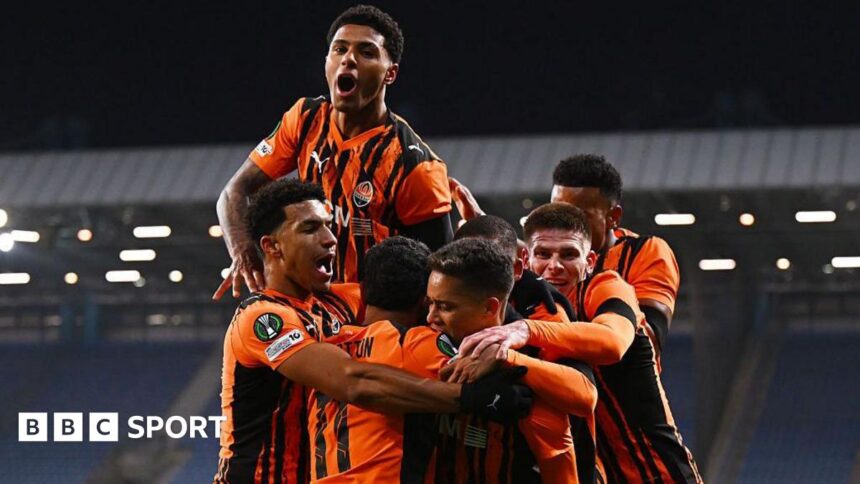
‘We Lost Our Home, Not Our Identity’ – Shakhtar Donetsk Eye European Glory
In the world of elite football, fixture congestion is usually a complaint about a busy Christmas schedule or a long flight to a Champions League group stage match. For Shakhtar Donetsk, however, the upcoming week is a logistical nightmare that would break most squads. They will travel by bus for 18 hours, cross a war-torn border twice, and play a pivotal Ukrainian Premier League title decider in between two legs of a UEFA Conference League semi-final. This is not a tale of hardship; it is a testament to an unbreakable identity.
As they prepare to face Crystal Palace in the first leg in Krakow, Poland, on Thursday, the Miners are not just playing for a place in the final. They are playing to prove that a club without a home can still have a soul. The message from the dressing room is clear: “We lost our home, not our identity.” Let’s dive into the extraordinary story of a club that has turned displacement into a driving force for European glory.
The Unseen Battle: Life as a Nomadic Giant
It is easy to forget that Shakhtar Donetsk have not played a competitive home match in their beloved Donbass Arena since May 2014. That stadium, a jewel of Ukrainian football, sits empty and silent in a city that has been under Russian-backed separatist control for a decade. Since then, the club has been on a permanent road trip, playing in Lviv, Kharkiv, and finally, settling in Kyiv. But the war that escalated in February 2022 changed everything again.
Now, the club operates on a split schedule. Their administrative base is in Kyiv, but their European “home” matches are played in the Polish city of Krakow. This week, that dislocation reaches its peak. After facing Crystal Palace on Thursday, the squad will not fly home. They cannot. Ukrainian airspace remains closed due to the ongoing war with Russia. Instead, they will board a bus for a grueling 18-hour journey back to Kyiv to face Dynamo Kyiv on Sunday in a match that could decide the Ukrainian Premier League title.
Let’s break down the sheer absurdity of their schedule:
- Thursday: UEFA Conference League semi-final first leg vs. Crystal Palace (Krakow, Poland).
- Friday: 18-hour bus journey from Krakow to Kyiv.
- Sunday: Ukrainian Premier League clash vs. Dynamo Kyiv (Kyiv, Ukraine).
- Monday: Reverse the 18-hour bus journey back to Poland.
- Tuesday: Fly from Poland to London.
- Thursday: UEFA Conference League semi-final second leg vs. Crystal Palace (London, UK).
“Most players in Europe complain about a two-hour flight delay,” said a source close to the Shakhtar camp. “Our players are planning how to sleep on a bus for a full day while keeping their legs fresh for a title decider.” This is the reality of being a top-tier Ukrainian club in 2024.
Identity Over Infrastructure: The Shakhtar DNA
Many clubs would have crumbled. The financial drain of relocation, the loss of home advantage, the constant threat of air raid sirens—these are not factors in a normal football season. Yet Shakhtar Donetsk are top of the Ukrainian Premier League and are 180 minutes away from a European final. How?
The answer lies in a philosophy that has been carefully cultivated by the club’s hierarchy, most notably by CEO Serhiy Palkin and the late president Rinat Akhmetov. They have built a club culture that is portable. The famous Shakhtar academy, which has produced stars like Fernandinho, Willian, and Fred, continues to operate, albeit in safer regions. The scouting network, renowned for finding Brazilian talent and integrating them with Ukrainian grit, remains intact.
The current squad is a perfect microcosm of this identity. It features Ukrainian internationals like Mykola Matviyenko and Taras Stepanenko, who have played through the war, alongside Brazilian stars like Kevin Kelsy and Marlon Gomes, who have chosen to stay and fight for the badge. This mix of foreign flair and local resilience is the Shakhtar DNA. They do not have a home stadium, but they have a home culture.
“When you lose your stadium, you realize the club is not the bricks. It’s the people, the shirt, the style of play,” one analyst noted. “Shakhtar still play that aggressive, high-pressing, technical football. They haven’t changed their identity to suit their circumstances. That is remarkable.”
Expert Analysis: Can They Beat Crystal Palace?
On paper, Crystal Palace are the favorites. The Premier League side boasts the pace of Michael Olise and Eberechi Eze, and the tactical nous of manager Oliver Glasner. They have the advantage of a settled schedule, domestic flights, and a full week to prepare for each leg.
But football is not played on paper. It is played in the mind. And Shakhtar’s mind is forged in fire.
Let’s look at the tactical battle:
- Shakhtar’s Weapon: Transition speed. Against a Palace side that likes to press, Shakhtar’s Brazilian attackers can exploit the space behind the full-backs. Look for Danylo Sikan to make runs in behind the Palace center-backs.
- Palace’s Weapon: Set pieces and individual brilliance. Shakhtar’s defense, while organized, can be vulnerable to the physicality of Jean-Philippe Mateta. Palace will target corners and free-kicks.
- The X-Factor: Fatigue. By the second leg in London, Shakhtar will have traveled over 3,000 kilometers by bus and played a high-intensity title match. Their legs could be heavy in the final 20 minutes. Palace must exploit that.
My Prediction: I see this being a tight, cagey affair in Krakow. Shakhtar will be buoyed by the emotional support of the Ukrainian diaspora in Poland. I predict a 1-1 draw in the first leg. The second leg in London will be a different story. If Shakhtar are still in the tie after 70 minutes, their mental strength could carry them through. However, I believe Crystal Palace’s depth and rest advantage will see them edge a 2-1 victory on aggregate. But do not be surprised if Shakhtar pull off the upset. This club thrives on adversity.
The Bigger Picture: More Than a Game
It is impossible to separate Shakhtar Donetsk’s European run from the context of the war in Ukraine. Every time the team takes the pitch, they carry the weight of a nation. Their journey is a metaphor for Ukrainian resilience. While missiles fall on energy infrastructure and cities are shelled, Shakhtar provide a distraction, a moment of pride, a symbol that Ukraine is still fighting, still competing, still alive.
The club has used its platform to raise funds for humanitarian aid. The players have visited hospitals, donated to the armed forces, and refused to leave the country en masse. This is not just a football club; it is a cultural and patriotic institution.
“We lost our home, not our identity,” is not just a slogan. It is a lived experience. The players know that their families, friends, and fans are living through a horror that most of Europe has forgotten. When they step onto the pitch in Krakow and London, they are not just playing for a trophy. They are playing to show that Ukraine’s spirit cannot be broken.
Strong Conclusion: The Final Stand of the Nomads
As the bus rolls through the night from Krakow to Kyiv, the Shakhtar players will likely be thinking about two things: the Dynamo Kyiv match and the second leg against Palace. They will be exhausted, sore, and mentally drained. But they will also be united. They are a band of brothers, a team without a home, but with an unshakeable sense of purpose.
Whether they lift the UEFA Conference League trophy in Athens or not, Shakhtar Donetsk have already won. They have shown the world that a club is not defined by its stadium, its budget, or its league. It is defined by its heart. And this team has a heart the size of the Donbas.
So, watch them this week. Watch the 18-hour bus rides, the emotional title deciders, and the European semi-finals. Watch a club that lost everything except the one thing that matters most: its identity. That is the story of Shakhtar Donetsk, and it is one of the most compelling narratives in modern football history.
The prediction? A narrow defeat in the semi-final, but a victory for the human spirit. And next season, they will be back, still homeless, still fighting, still Shakhtar.
Source: Based on news from BBC Sport.