Were Newcastle Robbed? The ‘Stonewall’ Penalty Debate That Has St. James’ Park Fuming
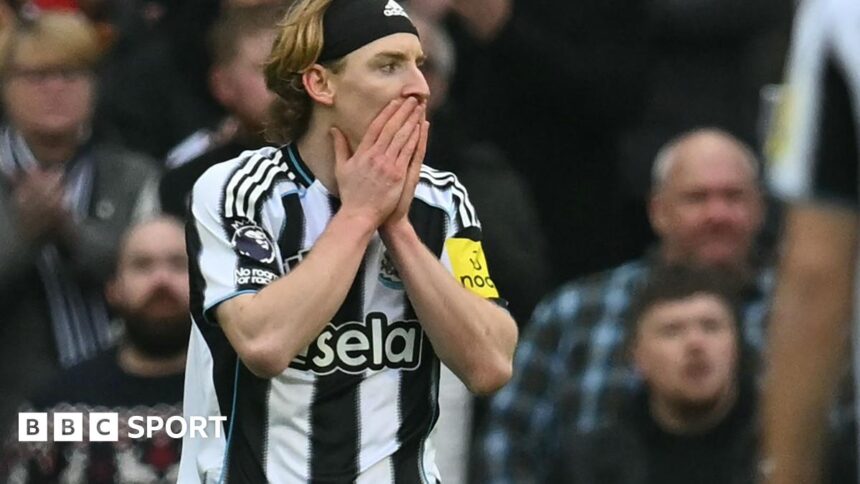
The final whistle at St. James’ Park was not met with applause for a hard-fought point, but with a crescendo of furious boos. Newcastle United, having surrendered a commanding 2-0 lead to draw 2-2 with Chelsea, felt a profound sense of injustice. The flashpoint? A 53rd-minute collision in the Chelsea box that has ignited a fiery debate about consistency, interpretation, and the very definition of a “stonewall” penalty in the modern Premier League.
Newcastle manager Eddie Howe did not mince his words post-match, branding the incident a “stonewall penalty.” His counterpart, Mauricio Pochettino, predictably saw it differently. With the game poised at 2-1 to the Magpies, the decision—or non-decision—felt monumental. We delve into the incident, the laws of the game, and the ramifications of a pivotal VAR call that left a city feeling aggrieved.
The Incident: Chalobah, Gordon, and a Moment of Mayhem
To understand the fury, we must reconstruct the moment. In the 53rd minute, a long ball was played towards the Chelsea penalty area. Newcastle’s livewire winger, Anthony Gordon, sensing an opportunity, darted across the front of Chelsea defender Trevoh Chalobah. What happened next is the crux of the controversy.
Chalobah, tracking the ball’s trajectory, made significant bodily contact with Gordon. He extended his left arm and made a clear barging motion into Gordon’s back and side, sending the Newcastle man tumbling to the turf. The immediate reaction from the Gallowgate End was a roar for a penalty. On-field referee John Brooks waved play on. The VAR, Jarred Gillett, initiated a review.
After a period of examination, the stadium awaited the verdict. To Newcastle’s disbelief, the original decision stood. No penalty. The Premier League’s official Match Centre later clarified the reasoning on social media, stating the contact was deemed “side-to-side in a shielding action” with the ball “within playing distance.” This explanation, rather than calming tensions, has become the focal point of the debate.
Expert Analysis: Shielding or Shoving? Dissecting the Law
According to the IFAB Laws of the Game, a direct free kick (and thus a penalty) is awarded if a player commits an offence deemed as careless, reckless, or using excessive force. This includes charges, jumps, kicks, or strikes. The critical interpretation here lies in the concept of a “fair charge.”
The law states: “A fair charge is shoulder to shoulder, when the ball is within playing distance, and the players have at least one foot on the ground and are not using their arms or elbows.” Let’s break down the Chalobah-Gordon incident against this criteria:
- Shoulder to Shoulder? This is the most contentious point. Replays show Chalobah’s contact begins more on Gordon’s back and side, not directly shoulder-to-shoulder. The “side-to-side” description from officials is being challenged by those who see a clear push in the back.
- Ball Within Playing Distance? This box is likely ticked. The ball was in the air and close by, justifying Chalobah’s attempt to position himself.
- Use of Arms? This is the smoking gun for Newcastle. Chalobah’s left arm is clearly extended and makes forceful contact, which many argue transforms a potential shield into an illegal push.
The core argument for a penalty is that the use of the arm and the angle of contact negate any claim of a fair, shoulder-to-shoulder challenge. It was a physical barge. The argument against, upheld by VAR, is that it was a physical but permissible battle for space between two players both entitled to contest the ball.
This incident highlights the Premier League’s apparent tolerance for a higher threshold of physical contact compared to European competitions. What might be a clear foul in the Champions League is often waved away as a “robust duel” domestically. This inconsistency is a primary source of fan and managerial frustration.
The VAR Conundrum: Clear, Obvious, or Subjective?
The role of VAR was pivotal, and its application here raises familiar questions. The protocol states VAR should only intervene for a “clear and obvious error” or a “serious missed incident.” By opting not to overturn Brooks’ on-field decision, the VAR room determined it was not a clear error.
This is the grey area that consumes football. The incident was undeniably “clear and obvious” to Eddie Howe, his players, and 52,000 Geordies. Yet, in the VAR hub at Stockley Park, it was judged a subjective call where the referee’s original decision held merit. This is not a case of offside or ball-out-of-play; it’s a judgment on force and intent. The “high bar” for VAR intervention in subjective decisions often leads to this no-man’s-land where one side feels vindicated by technology and the other feels betrayed by it.
The subsequent public explanation was an attempt at transparency, but it also acts as a lightning rod. By specifying “shielding action,” the PGMOL has drawn a line in the sand. They have set a precedent that such contact, with the ball in play, is acceptable. Teams will note this for future matches, but it does little to soothe Newcastle’s present anger, especially in a season where marginal decisions have significant consequences in a fiercely competitive league.
Ramifications and Predictions: A Lingering Shadow
The immediate fallout is two points dropped for Newcastle in their pursuit of European football. The psychological blow of losing a lead, compounded by a perceived injustice, could be significant. For Chelsea, it’s a valuable point rescued, perhaps aided by a generous non-call.
Looking ahead, this incident will be cited in every similar penalty appeal for weeks to come. The key predictions and ramifications are:
- Managerial Pressure on Officials: Eddie Howe’s vocal stance will be echoed by other managers when similar incidents go against their teams. The PGMOL’s interpretation is now under the microscope.
- Precedent for Defenders: Centre-backs will feel empowered to use similar physicality in shielding situations, knowing VAR is unlikely to penalize it unless the arm use is even more egregious.
- Fan Distrust Grows: Each controversial non-intervention deepens the rift between match-going fans and the remote VAR process. The boos at full-time were as much for the system as for the result.
- Season-Defining Moment? If Newcastle miss out on a European place by a point or two, this moment at St. James’ Park will be remembered as the one that got away.
Verdict: A Stonewall Case of Subjectivity
So, does Eddie Howe have a point? In the eyes of the law, and by the narrow margins by which VAR operates, the officials followed their protocol. It was deemed a subjective call, not a clear error. However, in the visceral, uncompromising world of football where points are precious, Newcastle have every right to feel aggrieved.
The term “stonewall” implies an indisputable, unambiguous foul. This incident, by sparking such debate, proves it was anything but. It was a classic 50/50 challenge seen through the prism of bias. Was it a foul? Many neutrals would say yes. Was it a “clear and obvious” error not to give it? That, in the VAR’s solitary judgment, was a no.
The real tragedy is that another thrilling Premier League match is now defined by controversy rather than the football itself. Chelsea showed resilience to fight back, Newcastle showed fragility in surrendering their lead. Yet, the narrative is dominated by a single decision that, true to the modern game, we are still arguing about days later. The only “stonewall” conclusion is that the debate over consistency in officiating is one penalty decision that will never be saved.
Source: Based on news from BBC Sport.