Trump’s Foreign Policy and the 2026 World Cup: A Global Sporting Storm
The beautiful game has long navigated the turbulent waters of global politics, but as the United States prepares to co-host the monumental 2026 FIFA World Cup, a new and potent storm is brewing. The intersection of President Donald Trump’s “America First” foreign policy and the world’s most-watched sporting event is creating unprecedented dilemmas for sports federations, nations, and fans alike. From the seizure of foreign leaders to stark warnings against sovereign states, the administration’s actions are casting a long shadow over the upcoming tournament. This raises a critical question: can the global celebration of football remain insulated from the hard realities of geopolitics, or is the 2026 World Cup destined to become the most politically charged in history?
The Diplomatic Pitch: From Peace Prize to Political Pressure
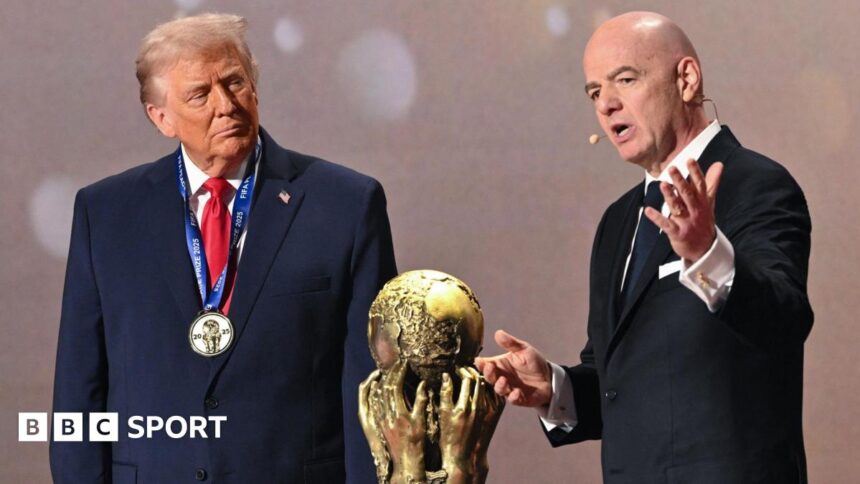
The relationship between the Trump administration and FIFA is a study in stark contrasts. In a move that raised eyebrows globally, FIFA President Gianni Infantino presented President Trump with the inaugural FIFA Peace Prize in December 2019, citing his role in brokering diplomatic agreements in the Middle East. This moment of détente, however, stands in sharp relief against a backdrop of escalating international tensions driven by Washington.
The catalyst for the current firestorm was the US-led raid in Caracas that captured Venezuelan leader Nicolás Maduro. This direct intervention, described by critics as a violation of international law, triggered an immediate response from a cross-party group of British MPs. They drafted a forceful letter to FIFA, urging the governing body to consider expelling the United States from the World Cup until it demonstrates “clear compliance with international law and respect for the sovereignty of other nations.” While a symbolic gesture, the letter formally placed the issue on the agenda of international sports governance.
Beyond Venezuela, analysts point to repeated veiled and overt threats issued by the administration toward nations like Iran, China, and even longstanding allies. This creates a fraught environment for a tournament built on the principle of peaceful international competition. “FIFA’s statutes explicitly promote neutrality and non-discrimination,” notes Dr. Anya Bergman, a professor of sports geopolitics. “When the host nation’s foreign policy is perceived as actively confrontational toward several member associations, it places FIFA in an impossible position. The Peace Prize now looks less like an endorsement and more like a fragile shield.”
Unprecedented Scenarios: Could a World Cup Host Face Sanctions?
The MPs’ call for expulsion, while extreme, opens a Pandora’s box of hypotheticals previously unthinkable in modern sports. The fundamental tension lies in FIFA’s own rules and the practical realities of hosting.
- Legal and Logistical Impossibility? Removing the primary host nation from a tournament it is physically staging is a logistical nightmare. With 60 of the 80 matches scheduled for the US, the event would collapse.
- The Precedent of Apartheid South Africa: The last major sports expulsion was South Africa during apartheid. The comparison is potent but politically explosive, and no current FIFA member state is likely to muster the votes for such a move against a superpower.
- Quiet Diplomacy vs. Public Stands: More plausible than expulsion is behind-the-scenes pressure. FIFA could, in theory, leverage its relationship to privately counsel for de-escalation, using the World Cup as a bargaining chip for softer rhetoric.
- The Athlete and Fan Dilemma: Could individual nations or athletes boycott? This is a more likely outcome, particularly from countries directly in the crosshairs of US policy. The spectacle of geopolitical feuds playing out on the pitch and in the stands becomes a real risk.
“The threat isn’t that FIFA will kick out the US,” explains veteran sports journalist Carlos Mendez. “The threat is that the tournament becomes a fragmented, politicized spectacle. The magic of the World Cup is its unifying narrative. Trump’s foreign policy actively works against that narrative, championing unilateralism over multilateralism.”
The Infantino-Trump Nexus: Realpolitik in the Boardroom
To understand FIFA’s likely path, one must analyze the strategic interests of its president, Gianni Infantino. His award to Trump was not merely ceremonial; it was a calculated move in the high-stakes game of international sports politics.
Infantino’s primary objectives are the commercial success of the 2026 tournament and the expansion of his own power base. The US market is crucial for broadcast and sponsorship revenue. Directly confronting the US administration jeopardizes that. Furthermore, Infantino has championed the 48-team World Cup format; a smooth 2026 event is his legacy project. Alienating the host nation is not an option.
This creates a dynamic of strategic acquiescence. FIFA will likely seek to compartmentalize: fiercely protecting the commercial and operational aspects of the World Cup while issuing generic, anodyne statements about “peace and unity” when political conflicts arise. The organization will become a master of avoidance, hoping the football itself can drown out the diplomatic noise. However, this passive stance is itself a political choice—one that critics will label as complicity.
Predictions for 2026: A Tournament Under the Microscope
Given these complex forces, several predictions for the 2026 World Cup emerge clearly.
First, expect symbolic protests to overshadow the football at moments. Whether from eliminated nations’ press conferences, gestures on the field, or fan displays, political statements will be frequent and amplified by global media.
Second, security will be unprecedented and tense. The US will deploy massive resources to protect athletes and fans, but the atmosphere may feel more like a fortified summit than a festival of football. High-profile matches involving nations like Iran could become security flashpoints.
Third, the “soft power” benefit for the US will be diluted. Traditionally, hosting a World Cup is a nation’s chance to showcase its culture and openness. The prevailing narrative in 2026 may instead focus on division, policy, and protest, undermining the very soft power gains the event is meant to generate.
Finally, the tournament will set a critical precedent. It will test whether global sports mega-events can survive in an era of rising nationalism and transactional diplomacy. The outcome will inform decisions for hosts of the 2030 World Cup and beyond.
Conclusion: The Final Whistle on Political Neutrality?
The 2026 FIFA World Cup is on a collision course with reality. Donald Trump’s foreign policy, characterized by unilateral actions and confrontational rhetoric, has shattered any illusion that the event can exist in a political vacuum. The call for the US’s expulsion, however implausible, is a symptom of a deeper malaise: the world of sport can no longer pretend it is separate from the world of statecraft.
FIFA, under Gianni Infantino, has chosen a path of engagement and appeasement with the Trump administration, betting that commerce and spectacle can override geopolitics. This is a high-risk strategy. The beautiful game thrives on passion, and the passions of 2026 may not be confined to last-minute goals and underdog stories. They may also be the passions of nations feeling the pressure of American power.
In the end, the 2026 World Cup may not be remembered for a stunning victory or a star player’s emergence. It may be remembered as the tournament where global politics took center stage, and the world’s game found it impossible to look away. The final whistle on sport’s political neutrality may be blown not by a referee, but by a president.
Source: Based on news from BBC Sport.