Tom Izzo’s Blunt Assessment: Michigan State’s Defensive Woes and a “Desperate” UCLA End Big Ten Tourney Run
The echoes of the final buzzer at the United Center had barely faded before Tom Izzo delivered his verdict. In a rare and candid post-game dissection, the Michigan State legend didn’t mince words, point fingers at officiating, or hide behind tournament fatigue. He looked squarely into the cameras and laid the failure at the feet of his own program. Following a stunning 88-84 loss to UCLA in the Big Ten Tournament quarterfinals—a game where the Spartans’ defense was shredded—Izzo’s message was one of stark accountability and a warning siren for a team with looming NCAA Tournament aspirations.
A Frank Admission: “They Kicked Us”
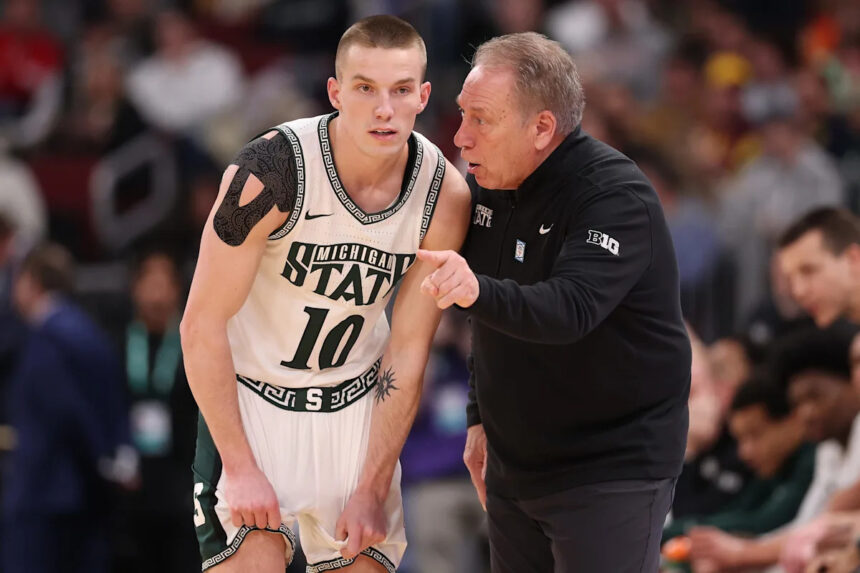
Tom Izzo’s post-game press conferences are often a blend of fiery passion and calculated coach-speak. On Friday night in Chicago, however, he was unflinchingly direct. “Really disappointed. UCLA played harder, better, tougher. Usually my team answers that. They definitely kicked us, they deserved to win that,” Izzo stated, setting a tone of unvarnished honesty. This wasn’t a loss chalked up to a lucky bounce or a superstar performance; it was a systemic failure in the areas Izzo holds most sacred: toughness and effort.
He specifically praised UCLA coach Mick Cronin, noting the Bruins’ late-season surge. “I love what Mick has done, what he did after our game. They won five out of six and changed,” Izzo said, acknowledging the strategic adjustments that left his team scrambling. Most telling was his analysis of his squad’s mentality: “We just weren’t with it tonight. It’s nothing to do with looking by someone. They (UCLA) played desperate tonight.” In Izzo’s lexicon, being out-desired is the ultimate sin, and his admission that the Spartans were on the wrong side of that equation is a significant red flag.
Breaking Down the Defensive Collapse
The box score tells a brutal story. Allowing 88 points to a UCLA team not known for offensive fireworks is an anomaly for an Izzo-coached team. The Bruins shot a scorching 53.7% from the field and, more damningly, exploited the Spartan defense with ease in the paint and from beyond the arc. This wasn’t just a poor shooting night for MSU—though Izzo lamented the “number of shots we missed at the rim” and “wide open threes”—it was a complete defensive breakdown.
- Ball Screen Vulnerability: UCLA repeatedly put MSU’s big men in high ball-screen actions, creating mismatches and driving lanes that collapsed the Spartan defense.
- Lack of Perimeter Pressure: The Bruins’ guards operated with comfort, initiating offense without consistent ball pressure, allowing them to pick apart sets.
- Transition Defense Lapses: Several key UCLA runs were fueled by easy baskets in semi-transition, where MSU’s communication and hustle were visibly absent.
Izzo’s comment about the comeback being “too little, too late” underscores the core issue: the defensive intensity and focus required to win in March were missing for the majority of the game. A late surge masked the preceding 35 minutes of uncharacteristically soft play.
Outcoached and Out-Toughened: The Cronin Factor
Izzo’s praise for Mick Cronin was more than collegial respect; it was an acknowledgment of being tactically beaten. Cronin, whose team was firmly on the NCAA bubble, engineered a game plan that perfectly attacked Michigan State’s weaknesses. UCLA played with a palpable, season-saving desperation that MSU could not—or did not—match.
Cronin’s decision to attack the paint relentlessly, coupled with well-timed three-pointers from players like David Singleton (who went 5-for-7 from deep), exposed a Spartan defense that was a step slow in rotations and weak on close-outs. While Izzo tried various lineups and defensive adjustments, the Spartans never found a consistent answer. In the high-stakes chess match of tournament play, UCLA’s desperation met a prepared game plan, and Michigan State had no counterpunch until their fate was largely sealed.
The Path Forward: Correcting Course for the Big Dance
For a team that entered the season with Final Four expectations, this loss serves as a jarring wake-up call. The NCAA Selection Committee will now scrutinize a resume with several Quad 1 wins but also puzzling inconsistencies. More importantly, Izzo must solve the defensive identity crisis in a matter of days. The issues against UCLA were not new; they were a magnification of flaws seen in other losses this season.
The upcoming NCAA Tournament practice week will be among the most critical of Izzo’s recent tenure. Expect a return to foundational principles:
- Defensive Drills Revisited: Intense, physical practices focused on ball-screen defense, rotation communication, and one-on-one containment.
- Mental Recalibration: Izzo must reignite the “desperate” mindset he saw in UCLA. The Spartans must play with the urgency of a team with everything to prove, not one burdened by expectation.
- Lineup Evaluation: The rotation may see tightening. Players who consistently execute defensively will earn minutes, regardless of offensive pedigree.
Final Verdict: A Defining Moment for the Spartans’ Season
Tom Izzo’s raw, unfiltered critique after the UCLA loss was a mirror held up to his team. It revealed a squad that strayed from its defining principles at the worst possible time. While the defeat ends their Big Ten title hopes prematurely, it provides a invaluable, if painful, lesson before the stakes become absolute.
History shows that an Izzo team, once humbled, is a dangerous entity in the NCAA Tournament. The 2023 Spartans now stand at a crossroads. They can treat the UCLA game as a final warning and channel the resulting frustration into a focused, ferocious defensive effort, making a deep March run that redefines their season. Or, they can allow the defensive lapses and lack of toughness to persist, resulting in a short and disappointing tournament stay.
Based on Izzo’s track record and the starkness of his message, bet on a response. The Spartans’ national championship hopes may have dimmed in Chicago, but their head coach just received the clearest possible blueprint of what must be fixed. The question is no longer about talent or potential; it’s about toughness and response. The answer will define their March.
Source: Based on news from Yahoo Sports.