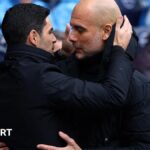
Winless in Six: The Champions League Reality Check for England’s Elite
The aura was palpable. For years, the narrative of Premier League financial dominance spilling onto European pitches felt less like hype and more like an inevitability. Heading into this week’s UEFA Champions League last-16 first legs, English clubs stood tall, buoyed by recent finals pedigree and squad investments that dwarfed most rivals. Yet, after a chastening six games across three nights, the scoreboard tells a starkly different story: Played 6, Won 0, Drawn 2, Lost 4. From Manchester to North London, a collective stutter has replaced the swagger. This isn’t a mere blip; it’s a systemic reality check. So, what went wrong for the Premier League’s standard-bearers on the grandest stage?
The Tactical Straightjacket: Predictability Meets European Pragmatism
European knockout football is a different beast. The Premier League’s breakneck pace and transitional chaos are often replaced by a chess match of disciplined structure and lethal counter-punches. This season, several English sides walked into a tactical ambush.
Manchester City, the reigning champions, faced a Copenhagen side that executed a perfect containment plan. While City dominated possession, they lacked their usual surgical edge in the final third, their patterns becoming predictable against a deep, organized block. The 1-1 draw, salvaged by Kevin De Bruyne but marred by a missed penalty, highlighted a recurring theme: when Plan A is slightly off, European opponents are experts at exploiting frustration.
More damning was the fate of Arsenal at Porto. Mikel Arteta’s young guns, so fluent domestically, were nullified by Sérgio Conceição’s veteran savvy. Porto ceded possession, choked the central channels, and struck with a moment of pure, unscripted genius in the 94th minute. Arsenal’s inability to create clear chances or control the game’s emotional tempo was a brutal lesson in Champions League knockout maturity.
The problems were even more acute for the clubs who suffered defeats. Manchester United and Newcastle, in particular, were exposed by superior tactical setups that targeted their specific, well-documented weaknesses.
Individual Errors and the Weight of the Occasion
While tactics provide the framework, games at this level are won and lost in moments of individual execution—or catastrophic failure. For English clubs this week, the error column was damning.
- Manchester United’s chaotic display in Copenhagen earlier in the group stage was a precursor, but their loss to Bayern Munich was defined by a critical Andre Onana mistake for the opening goal, setting a tone of vulnerability.
- Newcastle’s heartbreaking loss to Borussia Dortmund at St. James’ Park was a masterclass in inefficient finishing, squandering a slew of chances before being sucker-punched by a single, clinical German counter-attack.
- Even the usually unflappable Manchester City saw a rare Bernardo Silva penalty saved, a moment that could have transformed their tie.
These are not just bad luck; they are symptoms of pressure. The Champions League knockout stage amplifies every mistake. For players new to this stage or teams lacking deep runs in their recent DNA, that pressure can manifest as rushed finishes, poor decision-making, or defensive lapses. The continental veterans they face, from Bayern to Porto, are conditioned to pounce without a second invitation.
The Physical and Psychological Toll of the Premier League Grind
This factor cannot be overstated. The unrelenting intensity of the Premier League, with its unique winter schedule and competitive depth, leaves its top clubs physically and mentally drained when navigating the business end of European competition.
While other leagues may offer mid-season breaks or less competitive fixtures for their elite sides to rotate, English clubs are battling in what is often described as a “survival-of-the-fittest” domestic race. By February, the cumulative effect is real. Look at the injury lists: key players missing for Newcastle and Manchester United, others playing through knocks at City and Arsenal. The squad depth, while vast, is stretched to its limits.
Psychologically, the demand to be at peak intensity every three days is unsustainable. The Premier League grind can lead to a subtle drop in sharpness, a millisecond slower in reaction, or a fraction less intensity in pressing—the exact margins that define Champions League ties. Their European opponents, often fresher and with more focused preparation, are primed to exploit this.
Second-Leg Prognosis: Can Any English Side Turn the Tide?
The mountain to climb varies in steepness, but all four English clubs are now underdogs to progress. Here is the forecast for the return legs:
Manchester City remain the best-placed. A 1-1 away draw, with an away goal, is a solid foundation. At the Etihad, their power should tell. Prediction: Progress comfortably.
Arsenal face a tricky but winnable task at the Emirates against Porto. The lesson of the first leg must be learned: they need to be more inventive and patient. The home crowd will demand a storm, but control will be key. Prediction: A narrow, tense progression.
For Manchester United and Newcastle, the outlook is bleak. United must go to Bayern Munich and win, a stadium where the German giants are historically formidable. Newcastle’s task away to a savvy Dortmund side, needing to score at least twice while remaining solid, seems a bridge too far for their injury-ravaged squad. Prediction: Both English clubs are eliminated.
Conclusion: A Necessary Humility and a Path Forward
The collective winless streak is a jarring statistic, but it serves as a vital corrective. The idea of Premier League supremacy was becoming a lazy assumption. This week proved that European football remains a distinct challenge, one that rewards tactical nuance, psychological resilience, and cold-blooded efficiency as much as financial might and domestic fervor.
For the Premier League’s elite, the path forward is clear. Success requires not just assembling expensive squads, but mastering the specific, patient, and often brutal format of knockout European football. It demands squad management that accounts for the domestic grind, tactical flexibility beyond high-pressing orthodoxy, and the cultivation of a mentality that thrives, not just survives, under the unique glare of the Champions League knockout lights.
This week wasn’t the end of English influence in Europe. But it was a powerful reminder that in the Champions League, pedigree, money, and domestic form are merely the entry fee. The real currency is perfection on the night. And for six games in a row, England’s best found it alarmingly out of reach.
Source: Based on news from Sky Sports.
Image: CC licensed via dag.wikipedia.org