


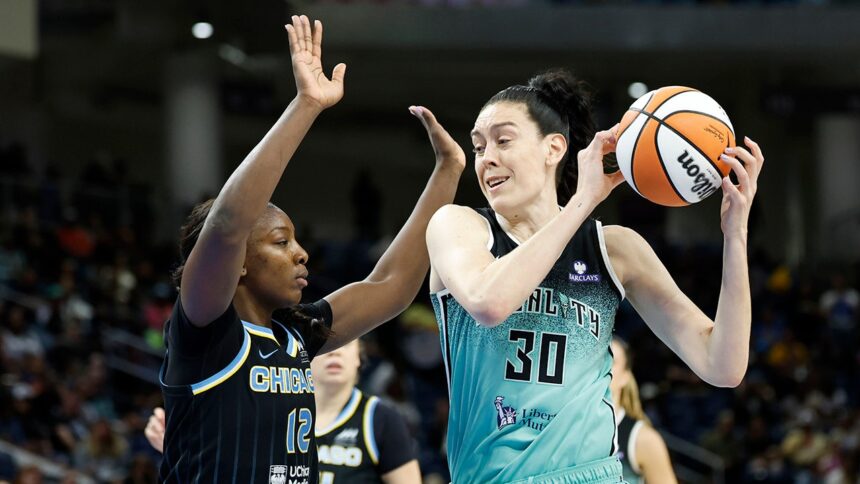
WNBA Star Breanna Stewart’s “Abolish ICE” Protest Ignites Debate on Athlete Activism and Border Policy
The intersection of sports, politics, and social justice flared into public view once again this weekend, as WNBA superstar Breanna Stewart made a bold political statement on the court. Before her game with the Mist in the Unrivaled basketball league, Stewart held aloft a sign bearing the slogan “Abolish ICE,” directly referencing U.S. Immigration and Customs Enforcement. This act of protest, captured in photos that quickly circulated online, was a direct response to the ongoing unrest in Minneapolis following a deadly Border Patrol-involved shooting. The moment has reignited a fierce national conversation about the role of athlete activism, the policies of federal immigration enforcement, and the growing trend of sports figures leveraging their platforms for political causes.
A Courtroom Gesture Amidst National Unrest
Stewart’s protest did not occur in a vacuum. The backdrop is a tense and tragic situation in Minnesota, where community protests have erupted after a man was killed in an incident involving U.S. Border Patrol agents. The details of the shooting are under investigation, but the event has tapped into deep-seated frustrations regarding immigration enforcement and policing. On political talk shows like ‘The Sunday Briefing,’ figures such as former sportscaster and Minnesota Senate candidate Michele Tafoya have framed the unrest as a symptom of broader national disorder, often criticizing the “defund the police” movement. Stewart’s sign, held silently but powerfully on the hardwood, served as a counter-narrative—a high-profile athlete aligning herself with a progressive movement that views ICE as a symbol of systemic oppression and family separation.
This is not Stewart’s first foray into activism. A former WNBA MVP and multi-time champion, she has been a vocal advocate for pay equity, LGBTQ+ rights, and social justice. The WNBA itself has a storied history of player-led activism, dating back to its founding and prominently displayed in 2020 when players dedicated their season to social justice and wore Breonna Taylor’s name on their jerseys. Stewart’s latest action continues this tradition but sharpens its focus to a specific, and highly polarizing, federal agency.
Expert Analysis: The “Abolish ICE” Movement and Its Critics
The call to “abolish ICE” entered the mainstream political lexicon around 2018, championed by progressive Democrats and activists who argue the agency, created in 2003 under the Department of Homeland Security, is fundamentally cruel and inhumane. Proponents argue its enforcement tactics lead to widespread fear in immigrant communities, the separation of families, and violations of due process. They advocate for a complete restructuring of the U.S. immigration system, moving away from what they see as a punitive, deportation-focused model.
Critics, however, see the slogan as dangerously simplistic. They argue that ICE plays a critical role in national security, combating human trafficking, drug smuggling, and enforcing the nation’s immigration laws as passed by Congress. Political figures like Michele Tafoya represent this viewpoint, often framing calls to abolish or defund enforcement agencies as a threat to public safety and the rule of law. The debate leaves little middle ground, making Stewart’s endorsement a lightning rod for both praise and condemnation.
Sports sociologist Dr. Alicia Johnson weighs in: “What Stewart did is a textbook example of athlete activism in the digital age. It was a visual, easily shareable moment that attached a globally recognizable face to a complex political issue. She didn’t give a speech; the sign was the speech. This forces her fans, and her detractors, to confront the issue of ICE directly. The backlash is inevitable, but so is the amplification of the message. She’s using her platform capital, knowing a segment will disagree, but betting that the conversation itself has value.”
The Political and Professional Reckoning for Modern Athletes
Stewart’s protest raises immediate questions about the potential consequences, both for her and for the Unrivaled league. In an era where brands and leagues are often cautious about alienating parts of their audience, such a direct political act carries risk.
- League and Sponsor Reaction: Will Unrivaled, a new league co-founded by Stewart herself and other stars, issue a statement? Will corporate sponsors distance themselves or align with her stance? The WNBA’s support for player activism may set a precedent, but Unrivaled operates in a different, nascent landscape.
- Fan Base Polarization: Stewart’s action will undoubtedly energize her progressive fan base but may alienate more conservative sports fans who believe politics should stay out of sports. The economic impact of this is often debated but rarely clear-cut.
- Political Weaponization: As seen with Michele Tafoya’s commentary, figures on the right will likely use Stewart’s protest as a cultural touchstone in political campaigns, framing it as an example of elite athlete progressivism out of touch with mainstream American values.
However, the modern athlete, particularly in the WNBA, has increasingly calculated these risks and found them worth taking. The league’s demographic and its players’ collective ethos have created a space where social advocacy is often expected, not just tolerated.
Predictions: The New Normal of Integrated Activism
Looking ahead, Stewart’s “Abolish ICE” sign is not an anomaly but a signpost for the future of sports.
First, we can expect athlete protests to become more targeted and policy-specific. Moving beyond broad statements against racism, athletes are now naming agencies, legislation, and specific judicial cases. This requires a more informed public and invites more complex debate.
Second, the backlash will become more organized. Political operatives and media figures will quickly integrate these moments into broader cultural narratives, as seen with the immediate linkage to the Minneapolis unrest and political commentary. Athletes must be prepared for their actions to become fodder in larger political wars.
Finally, the very business of sports will continue to adapt. Leagues will grapple with how to market teams whose stars are active political agents. Some brands will see opportunity in alignment; others will seek neutrality. The model of the apolitical sports hero, if it ever truly existed, is effectively obsolete.
Conclusion: More Than a Game
Breanna Stewart’s simple act of holding a sign has once again proven that the basketball court is more than a venue for athletic competition; it is a modern public square. In the charged atmosphere following tragedy in Minneapolis, her “Abolish ICE” protest connects the dots between community grief and federal policy, between personal platform and political power. Whether one agrees with her message or not, its potency is undeniable. It has sparked dialogue, drawn lines, and demonstrated that today’s athletes are unwilling to be confined to their sport. As the 2026 Unrivaled season continues and the political season heats up, the reverberations from this moment will be felt far beyond the confines of the Sephora Arena in Medley, Florida. The game continues, but the conversation it now carries is about the very soul of the nation’s policies and the right of its citizens—athletes included—to demand change.
Source: Based on news from Fox Sports.


