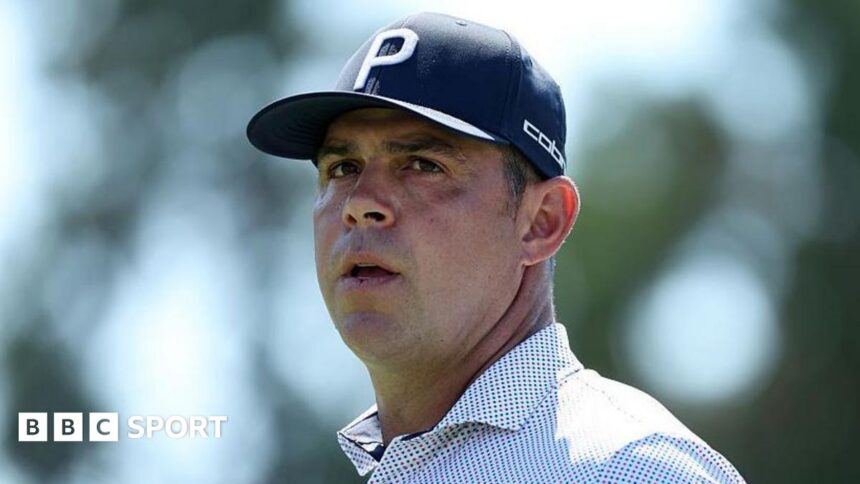
Gary Woodland’s Brave New Chapter: From US Open Glory to PTSD Advocacy
The walk from the 18th green at Pebble Beach is etched in golfing lore. In 2019, Gary Woodland made that walk a champion, his powerful swing and steady nerve securing the U.S. Open trophy, the pinnacle of a lifetime of athletic pursuit. Today, Woodland is navigating a different, far more personal walk—one from the shadows of silent struggle into the light of vulnerable truth. The 2025 PGA Tour Courage Award recipient is no longer hiding, declaring he “can’t waste energy any more” concealing his battle with post-traumatic stress disorder (PTSD), a diagnosis that followed a life-altering brain surgery. This is not just a sports comeback story; it’s a profound narrative about mental health, resilience, and the redefinition of strength in professional athletics.
The Diagnosis Behind the Comeback
Gary Woodland’s return to the PGA Tour in early 2024 was hailed as a medical miracle. In September 2023, he underwent surgery to remove a lesion from his brain, a procedure that came with no guarantees about his future in the game. The physical recovery was daunting, but the world saw a triumphant narrative: the champion golfer, beating the odds, back on the fairways. What remained invisible was the psychological toll.
As Woodland recently revealed to the Golf Channel, approximately a year ago, he was diagnosed with post-traumatic stress disorder. This revelation reframes his entire comeback. The brain surgery was not just a physical hurdle to clear; it was a traumatic event that left deep psychological scars. For an athlete whose profession demands razor-sharp focus, unwavering confidence, and complete control over one’s body, the aftermath of a brain operation is a uniquely terrifying experience. The fear of the unknown, the confrontation with mortality, and the intense stress of returning to world-class competition created a perfect storm for PTSD.
“I can’t waste energy any more hiding this,” Woodland stated, a simple sentence that carries the weight of a profound personal shift. For months, he likely expended immense mental effort masking symptoms—perhaps anxiety, hypervigilance, intrusive thoughts, or emotional numbness—to conform to the often-unspoken stoicism expected in professional sports. That energy is now being redirected toward healing and honesty.
Breaking the Stoic Silence in Professional Golf
Woodland’s disclosure is a seismic moment in a sport historically steeped in a culture of quiet fortitude. Golf is a game of invisible battles—the six inches between the ears—but rarely have those battles been framed in the clinical context of mental health disorders. By attaching the name PTSD to his experience, Woodland moves the conversation beyond general “mental toughness” into a specific, and highly relatable, medical reality.
His journey mirrors a growing, but still nascent, trend in men’s professional sports. Athletes are increasingly becoming advocates, using their platforms to normalize these struggles:
- Vulnerability as Strength: Woodland’s PGA Tour Courage Award signifies a crucial evolution. Courage is no longer defined solely by playing through physical pain, but by the bravery to publicly address psychological pain.
- The Support System: Woodland highlighted his “blessing” of support on Tour. This points to a potentially changing environment within the PGA Tour ecosystem, where players, caddies, and staff may be fostering a more empathetic network.
- Redefining the Comeback: The narrative expands. Success is no longer just measured by cuts made or world ranking points earned. For Woodland, a successful comeback now intrinsically includes managing his mental health openly and effectively.
This act of transparency does more than just help Woodland; it sends a lifeline to countless fans and amateur athletes who see their own struggles reflected in a champion’s eyes. It demystifies PTSD, showing it can affect anyone, even those who appear physically invincible.
Expert Analysis: The Intersection of Trauma and High Performance
From a sports psychology perspective, Woodland’s case is a critical study in trauma and performance. Dr. Anya Petrova, a leading sports psychologist, explains: “An athlete’s identity is often wholly tied to their physical capability and control. A brain tumor diagnosis and surgery directly attacks that core identity. The resulting PTSD isn’t just about fear of the event itself, but a fundamental disruption of the mind-body connection essential for elite performance.”
Woodland’s decision to stop hiding is, in fact, a high-performance strategy. The cognitive energy required to suppress emotions and mask symptoms is enormous. By freeing up that energy, he may unlock a more sustainable and present competitive mindset. His statement is less an admission of weakness and more a strategic reallocation of mental resources. The focus can shift from “acting normal” to actually engaging in the moment on the golf course, a state all great players seek.
Furthermore, his openness creates a feedback loop that aids recovery. Social support is a known protective factor against PTSD’s worst effects. By inviting support, he strengthens his own resilience, turning a potential source of shame into a pillar of his recovery and career longevity.
Predictions: Impact on Woodland’s Game and Golf’s Future
What does this mean for Gary Woodland, the competitor? Predicting performance in golf is always a gamble, but this new chapter offers intriguing possibilities.
- Liberated Performance: The weight of a secret is heavy. Without it, we may see a freer, more instinctive Woodland. His powerful game, when unencumbered, is capable of winning on any stage.
- New Perspective: Near-death experiences and profound health challenges often reorder an athlete’s priorities. While the desire to win remains, the paralyzing fear of failure may diminish. This can lead to a more aggressive, joyful, and process-oriented approach to the game.
- Advocacy Role: Expect Woodland to naturally assume a leadership role on mental health within the Tour. His voice, backed by his major championship pedigree and tangible medical ordeal, carries unique authority. He could champion better mental health resources for players, caddies, and staff.
For the sport, Woodland’s courage sets a new precedent. It paves the way for younger players to seek help without stigma. It encourages fans to view athletes as whole human beings. The 2019 U.S. Open champion is now championing a cause far bigger than a trophy. His legacy will inevitably be split between that glorious Sunday at Pebble Beach and his courageous decision to speak out in 2025.
Conclusion: A Champion Redefines Victory
Gary Woodland’s journey from the summit of Pebble Beach to the operating table, and now to the forefront of mental health advocacy, is a masterclass in evolving strength. His PGA Tour Courage Award is impeccably named. The courage to face a brain tumor is one thing; the courage to then face the invisible wounds it left behind is another. By stating he “can’t waste energy any more” on hiding, he has reclaimed his narrative and his power.
His story transcends leaderboards and swing mechanics. It is a powerful reminder that trauma does not discriminate, and that seeking help is a sign of profound strength, not weakness. The fairways and greens of the PGA Tour are now a stage for a more important message: that true resilience is found not in silence, but in the willingness to be seen, struggles and all. Gary Woodland, US Open winner, is now winning a different, more impactful game—and in doing so, he is helping to heal not just his own mind, but the culture of the sport he loves.
Source: Based on news from BBC Sport.