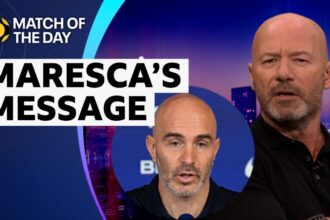
Maresca’s Chelsea Conundrum: A Cryptic ‘Worst 48 Hours’ Mars Crucial Everton Win
On paper, it was a perfect Stamford Bridge afternoon. A 2-0 victory over Everton, a clean sheet, a return to the Premier League’s top four, and goals from the talismanic Cole Palmer and the marauding Malo Gusto. Yet, the post-match narrative was hijacked not by the three points, but by a cloud of cryptic discontent from the manager’s office. Enzo Maresca, the Italian tactician who joined Chelsea from Leicester City last July, delivered a stunning verdict, labeling the build-up to the match as “the worst 48 hours” since his arrival at the club. This revelation, dropped casually amidst questions about Gusto’s assist, has sent shockwaves through SW6, exposing a potential rift behind the scenes that a routine win could not mask.
- The Cryptic Bombshell: Unpacking Maresca’s Post-Match Revelation
- Contextualizing the Crisis: A Season of Unrelenting Pressure
- Expert Analysis: What Could Have Triggered Maresca’s Frustration?
- Predictions and Ramifications: Where Does Chelsea Go From Here?
- Conclusion: A Victory Overshadowed by a Loud Silence
The Cryptic Bombshell: Unpacking Maresca’s Post-Match Revelation
The moment was a masterclass in dramatic tension. Having just secured a vital result to steady the ship after a four-match winless run, Maresca was in a position to preach resilience and progress. Instead, he chose a path of intriguing opacity. When asked about Malo Gusto’s excellent performance, he replied: “I am very pleased for Malo because the last 48 hours for him, for me, for the club, for everyone, was the worst 48 hours since I arrived here. So I am very pleased for him.”
The statement was deliberate and loaded. By refusing to elaborate, Maresca accomplished several things at once:
- Publicized Internal Turmoil: He confirmed a period of significant strife within Cobham, shifting focus from on-pitch success to off-pitch drama.
- Asserted Control: The comment served as a public airing of grievance, a tool often used by managers to pressure the board or playing squad.
- Created a Unified Front: By including “for the club, for everyone,” he framed the issue as a collective crisis, potentially rallying his players against an external or internal pressure point.
This calculated ambiguity leaves a vacuum filled only by speculation. Was it a reaction to the damaging Champions League defeat at Atalanta? A furious row over transfer strategy with the sporting directors? Or a dressing room revolt against his demanding tactical philosophy? The mystery is the message.
Contextualizing the Crisis: A Season of Unrelenting Pressure
To understand the weight of Maresca’s words, one must consider the relentless pressure cooker he stepped into. His appointment last summer was part of a bold, long-term project by Chelsea’s ownership, favoring a possession-dominant, system-based coach over a proven trophy-winner. The project demands patience, but the environment at Chelsea rarely provides it.
The “worst 48 hours” did not occur in a vacuum. They were the boiling point after a sequence of escalating pressures:
- The Atalanta Aftermath: A 3-0 loss in Italy was not just a defeat; it was a tactical dismantling that extended a worrying winless streak and raised serious questions about the team’s mentality and structure in big games.
- Top-Four Scrutiny: The Premier League race is ferocious. Dropping points against Everton would have been catastrophic, amplifying the criticism from the European setback.
- The Chelsea “Noise”: The club is a perpetual media cyclone. Every setback is magnified, every rumor given credence. Maresca, a relatively private coach, is learning that managing this external chaos is as crucial as managing the team.
The victory over Everton, therefore, was a pressure-release valve. But Maresca’s comments suggest the underlying pressure within the building had reached a peak that even three points couldn’t instantly alleviate.
Expert Analysis: What Could Have Triggered Maresca’s Frustration?
As a seasoned observer of the managerial chessboard, Maresca’s move is a high-stakes gambit. While the exact catalyst remains unknown, several plausible scenarios align with the behavior of a modern elite coach.
Scenario 1: A Clash with the Hierarchy. Chelsea’s transfer model is data-driven and committee-led. The 48 hours before a game often involve finalizing January plans or post-season strategy. A major disagreement with the ownership or sporting directors over a key target, a contract renewal, or even the long-term vision could have sparked a severe confrontation. Maresca may be signaling that off-pitch instability is hindering on-pitch progress.
Scenario 2: A Dressing Room Flashpoint. Following a humbling loss, squad morale is fragile. A key player or group of players challenging his methods, team selection, or training intensity would represent an existential threat to his authority. His public statement could then be a warning shot to the squad: the project is non-negotiable.
Scenario 3: The Weight of Expectation. It’s possible the “worst 48 hours” were an internal, personal crisis of confidence or a moment of overwhelming frustration with the sheer scale of the rebuild. By externalizing it, he shares the burden and makes it a club issue, not a personal failing.
His decision to praise Gusto specifically is telling. It isolates the positive performance as a beacon of professionalism amidst the turmoil, potentially highlighting others who did not match that standard in the lead-up to the game.
Predictions and Ramifications: Where Does Chelsea Go From Here?
Maresca has deliberately thrown a stone into the pond. The ripples will define Chelsea’s immediate future.
Short-Term (Next 5-10 Games): This can go one of two ways. The comment could galvanize the squad, creating an “us against the world” mentality that fuels a consistent run. Alternatively, if the issue is with players, it could fracture the dressing room further. The response in the next Champions League leg and against top-half Premier League foes will be revealing. Watch for player body language in interviews and on the pitch for clues.
Long-Term (End of Season & Beyond): This incident is a stark test of the ownership’s commitment to their “project.” If they back Maresca unequivocally, it strengthens his hand immensely. If they perceive him as a destabilizing force, the seeds of doubt are sown. His cryptic outburst will be remembered as either a masterstroke of internal politics or the first crack in a doomed tenure.
The key will be results. If Chelsea cement a top-four finish and make a deep Champions League run, the “worst 48 hours” will be a forgotten blip. If form dips, it will be cited as the moment the project began to unravel.
Conclusion: A Victory Overshadowed by a Loud Silence
Chelsea’s 2-0 win over Everton was a fixture that solved one problem and unveiled another, perhaps more profound one. Enzo Maresca, the architect of a crucial victory, chose to highlight not the triumph, but the turmoil. His description of the preceding days as the worst since his arrival is a piercing soundbite that echoes around Stamford Bridge louder than any goal celebration.
In the high-stakes theatre of modern football, where managers are part-tactician, part-politician, and part-psychologist, Maresca’s move was deliberate. It was a cry for help, a power play, or a rallying cry—perhaps all three. The only certainty is that beneath the surface of a return to the top four, significant tensions are simmering at Chelsea. How the club—from owners to players—responds to their manager’s very public frustration will determine whether this season is remembered for its promising progress or for the 48 hours of crisis that a win could not hide. The project’s truest test has now begun, and it’s happening off the pitch.
Source: Based on news from BBC Sport.