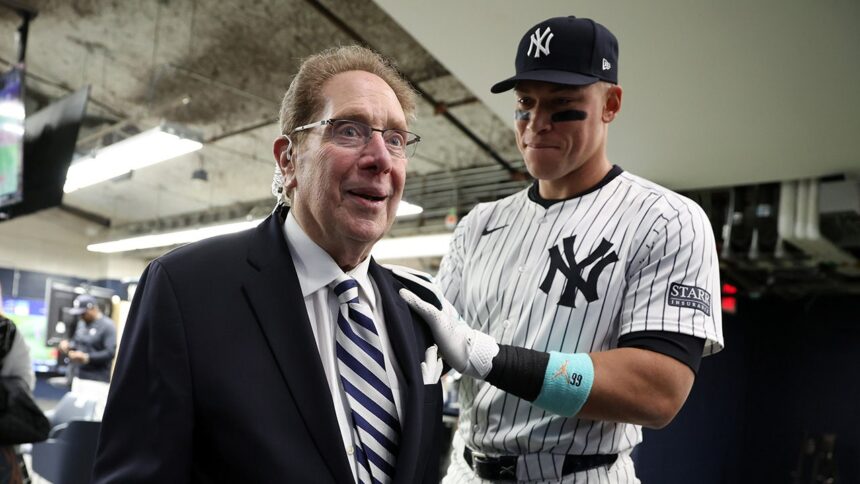
Yankees Radio Icon John Sterling Dead at 87: The Voice That Defined an Era Falls Silent
The unmistakable, booming voice that painted a million Yankee home runs and turned routine fly balls into dramatic theater has fallen silent forever. John Sterling, the legendary New York Yankees radio broadcaster, has died at the age of 87. WFAN Sports Radio in New York confirmed the devastating news on Monday, leaving a gaping hole in the fabric of baseball and New York sports culture.
“We are devastated to hear about the passing of John Sterling, a WFAN and Yankees radio icon whose voice was synonymous with an entire generation of Yankee fandom,” the radio station wrote on social media. For those who grew up listening to him, Sterling wasn’t just a broadcaster; he was the soundtrack of summer, the companion on long drives, and the narrator of the Yankees’ dynastic run. This isn’t just the loss of a voice—it’s the end of an era.
The Man Behind the Microphone: More Than Just “It Is High, It Is Far, It Is…Gone”
John Sterling’s career spanned over five decades, but his legacy is permanently etched into the Bronx Bombers history. He called the play-by-play for 5,420 consecutive regular-season games, a streak of unparalleled dedication. His style was polarizing—some loved the theatricality, others found it grating—but no one could deny his impact. Sterling didn’t just call games; he created moments.
His signature home run call, “It is high, it is far, it is… gone!” became a cultural touchstone. But he didn’t stop there. Sterling famously crafted unique, personalized calls for every player who went deep. From “Bern, baby, Bern!” for Bernie Williams to “A-bomb from A-Rod!” for Alex Rodriguez, and “The Judge is now in session!” for Aaron Judge, his catchphrases were a masterclass in branding and fan engagement. He understood that radio is a visual medium for the blind, and he filled the airwaves with color, emotion, and personality.
His partnership with color commentator Suzyn Waldman was legendary—a dynamic, often chaotic, but deeply authentic broadcast duo. They bickered, they laughed, and they cried together, most famously after the Yankees’ emotional return to the playoffs in 2017 following the death of former pitcher Hideki Irabu. Sterling’s voice cracked with genuine emotion, reminding everyone that beneath the bombast was a man who truly loved the game.
Expert Analysis: What Sterling Meant to the Yankees’ Brand and Baseball Culture
As a sports journalist who has covered the Yankees for years, I can tell you that John Sterling was a brand ambassador unlike any other. In an era of sterile, corporate broadcasts, Sterling was gloriously unapologetic. He was a homer. He celebrated Yankee victories with unchecked glee and lamented losses with theatrical despair. That authenticity resonated with a fanbase that expects nothing less than championship-level intensity.
Here’s the reality: Radio broadcasters are the unsung architects of a team’s mythology. Television shows you the play; radio makes you feel it. Sterling’s voice was a psychological anchor for Yankees fans. When you heard that opening theme music and his iconic “Hello, everybody, and welcome to Yankee baseball,” you knew summer had officially arrived. He didn’t just describe the action; he elevated it. A routine pop-up became a “caught on the warning track!” with an urgency that made you lean forward. A walk-off home run became a symphony of ecstatic repetition: “The Yankees win! Theeeee Yankees win!”
His impact on the SEO landscape of sports media is also undeniable. For decades, fans searched for “John Sterling home run call,” “John Sterling catchphrases,” and “Yankees radio broadcast.” His death will trigger a massive wave of digital nostalgia. Expect a flood of tribute articles, podcast episodes, and social media clips. The Fox News Flash top sports headlines were already buzzing with the news, and the broadcast world is now in a state of collective reflection. Sterling wasn’t just a voice; he was a content engine.
Predictions: The Future of Yankees Radio in a Post-Sterling World
Let’s be brutally honest: The Yankees broadcast booth will never be the same. Replacing John Sterling is impossible. You don’t replace a legend; you usher in a new era. However, the transition will be seismic. Here are my predictions for what comes next:
- The “Homer” Style Will Fade: Younger broadcasters are trained to be more neutral and analytical. The next voice of the Yankees will likely be more reserved, focusing on advanced metrics and game strategy rather than theatrical catchphrases. This is a loss for the romanticists.
- Suzyn Waldman’s Role Will Expand: Waldman, Sterling’s longtime partner, is a treasure in her own right. Expect her to become the emotional center of the booth, perhaps transitioning to a more prominent play-by-play role or mentoring a new co-host. Her chemistry with Sterling was irreplaceable, but her knowledge is invaluable.
- A “Sterling Era” Retrospective Boom: Over the next few weeks, expect a deluge of “best of” compilations. The Yankees organization will likely create a permanent tribute at Yankee Stadium, perhaps a plaque in the broadcast booth or a statue of a microphone. The team knows that Sterling was part of the stadium’s soul.
- Fan Division Will Intensify: Younger fans who grew up with modern, data-driven broadcasts may welcome a change. But the core, older fanbase—the ones who listened on transistor radios in the 80s and 90s—will feel a profound sense of loss. The debate over who should succeed him will be fierce.
One thing is certain: The next broadcaster will have impossibly large shoes to fill. They won’t just be calling baseball games; they will be inheriting a throne built on five decades of iconic, unforgettable noise.
Strong Conclusion: The Echo of a Legend
As we process this loss, it’s important to remember that John Sterling did not just broadcast baseball games. He broadcast emotion. He gave us permission to celebrate wildly, to groan in agony, and to believe that every game—even a meaningless Tuesday night contest in July—mattered. In a world that often demands neutrality and detachment, Sterling was a glorious, full-throated partisan.
His final call, whenever it came, was likely just another game to him—another chance to serve the fans. But for us, the silence in the booth is deafening. The voice that announced Derek Jeter’s 3,000th hit, the voice that cried “The Yankees win!” during the 1996, 1998, 1999, 2000, and 2009 World Series runs, is now a memory. But what a memory it is.
So, the next time you hear a crack of the bat on a summer afternoon, take a moment to listen. You might just hear an echo. An echo of a man who, from a tiny booth high above the field, made millions of us feel like we were right there in the stands. John Sterling is gone, but his voice—high, far, and forever—will never leave us. Rest in peace, legend. You were the soundtrack of our lives.
FILE – In this Sept. 25, 2009, file photo, New York Yankees broadcaster John Sterling sits in the booth before the Yankees’ baseball game against the Boston Red Sox at Yankee Stadium in New York. (AP Photo/Bill Kostroun, File)
Source: Based on news from Fox Sports.