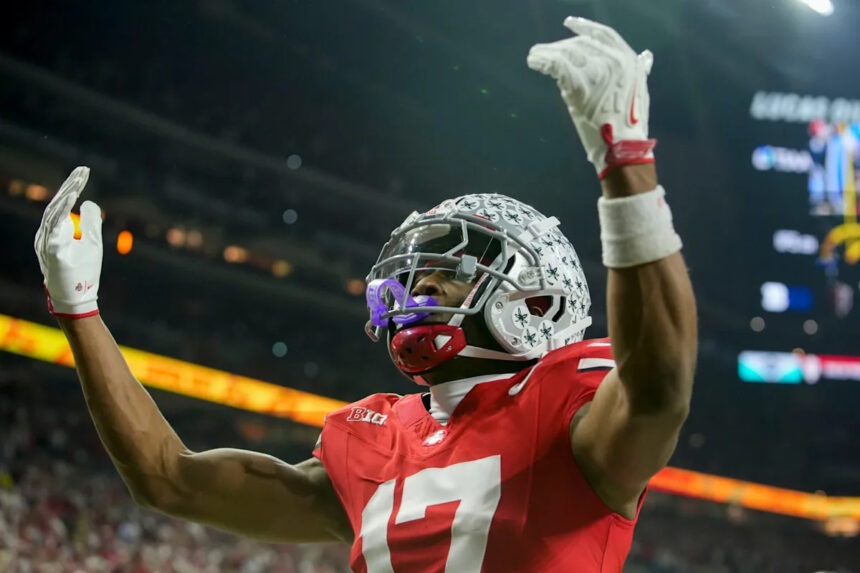
2026 NFL Draft: Could the Jets Shock the League and Take Ohio State’s Carnell Tate at No. 2?
The New York Jets hold the keys to the 2026 NFL Draft’s first night. With the No. 2 overall pick, a selection born from years of struggle and a desire to finally build a perennial contender, the entire league is watching to see which direction General Manager Joe Douglas will steer the franchise. While conventional wisdom screams for a defensive cornerstone or a trade-down scenario, a fascinating and explosive possibility is gaining steam: Ohio State wide receiver Carnell Tate.
In a draft cycle where only Indiana quarterback Fernando Mendoza is considered a true lock for the top spot, the Jets’ board is remarkably fluid. This openness has allowed for outside-the-box speculation, and according to one of the most respected voices in the scouting community, that speculation includes a blue-chip pass-catcher at the very top of the draft. NFL Network’s Daniel Jeremiah, connecting the dots of team need, prospect talent, and draft philosophy, has thrown a potential blockbuster into the mix. “I think he’s in play at two,” Jeremiah stated, sending shockwaves through the draft analyst community and igniting debate among the Gang Green faithful.
The Unconventional Path: Why a WR at No. 2 Isn’t as Crazy as It Sounds
For a franchise picking this high, the expectation is often to select a quarterback, a franchise left tackle, or a game-wrecking defensive end. The Jets, however, exist in a unique timeline. Having invested heavily in their quarterback of the future in the 2024 draft and fortified their offensive line in subsequent seasons, the glaring need for a true, alpha WR1 has come into sharp focus. The offense, while improved, lacks the dynamic, separation-heavy weapon that defines modern Super Bowl attacks.
Selecting a wide receiver this high is rare, but not unprecedented. The historical success of players like A.J. Green (4th), Calvin Johnson (2nd), and more recently Ja’Marr Chase (5th) proves that a transcendent talent at the position is worth a premium pick. The Jets’ calculus revolves around one central question: does Carnell Tate represent that caliber of generational receiving talent? His tape at Ohio State suggests the answer could be yes. In an offense loaded with future pros, Tate consistently separated with polished route-running, displayed elite body control, and showcased after-catch ability that turns short passes into long touchdowns. He is not just a receiver; he is an offensive weapon.
Scouting Carnell Tate: The Ohio State Product Primed for Stardom
Emerging from the “Wide Receiver U” pipeline, Carnell Tate has all the hallmarks of the next Buckeye superstar to dominate the NFL. Standing at an estimated 6’2″ and playing with a blend of smooth athleticism and sudden explosiveness, Tate’s game is built for immediate impact.
- Elite Route Running: Tate’s release package and understanding of leverage are advanced for his age. He creates separation at the line and at the top of his routes with subtle, efficient moves that leave defenders grasping at air.
- Contested Catch Mastery: While possessing the speed to stretch the field, Tate’s calling card may be his ability in traffic. His large catch radius, strong hands, and fearlessness over the middle allow his quarterback to throw with confidence in any situation.
- Yards-After-Catch Threat: This is where Tate transforms from receiver to playmaker. His vision in the open field, combined with a deceptively powerful stiff-arm and breakaway speed, makes every reception a potential highlight.
For the Jets, pairing a talent like Tate with their young quarterback would be a deliberate, aggressive move to create a high-octane offensive identity. It’s a statement that the organization is committed to building an attack that can go score-for-score with the AFC’s elite, rather than relying solely on a stout defense.
The Case Against: Weighing the Risks of a Premium Pick
Of course, the path of taking Tate at No. 2 is fraught with legitimate debate and risk. The primary argument against the selection is the immense value found at the wide receiver position later in the draft. History shows Pro Bowl receivers can be found in the late first and even second rounds. Using the No. 2 overall pick on the position, therefore, represents a significant opportunity cost.
Furthermore, the Jets also hold another first-round pick in 2026 (acquired via trade). Critics will argue the smarter play is to address the defensive front or secondary at No. 2—where premium positions like edge rusher and cornerback offer more traditional top-of-draft value—and target a receiver with their later selection. The draft board is also expected to be deep with top-tier defensive prospects at positions of need, including:
- Game-changing edge rushers who can transform a pass rush.
- Shutdown cornerbacks to match up in a division with elite quarterbacks.
- Versatile offensive tackles to provide long-term security on the QB’s blindside.
The allure of trading down to accumulate more capital while still landing an impact player will also be a powerful temptation for Joe Douglas. Passing on that flexibility for a single player, even one as talented as Tate, is a massive gamble.
Daniel Jeremiah’s Vision and the Jets’ Ultimate Decision
When Daniel Jeremiah floats a scenario, the NFL world listens. His connection to front offices and deep understanding of team-building philosophies give his projections weight. His suggestion that Tate is “in play” indicates this is not mere media speculation, but a scenario that has been discussed in league circles. Jeremiah is likely seeing the same things Jets scouts are: a perfect marriage of elite talent and a specific, glaring roster need.
The Jets’ decision will ultimately come down to their draft philosophy. Are they a “best player available” team, or a “draft for need” team at this pivotal moment? If their evaluation grades Tate as the clear second-best prospect in the entire class, surpassing all defensive players, then the pick becomes justifiable. It would signal a bold, offensive-minded vision for the future, one centered on empowering their young quarterback with a true No. 1 target for the next decade.
However, if their board shows a cluster of similarly-graded players between positions of greater premium value, the smart money may still be on a trade-down or a selection on the defensive side of the ball. The presence of their second first-round pick gives them the flexibility to be patient at receiver, but also the ammunition to be aggressive for the right guy.
Conclusion: A Franchise-Defining Crossroads
The 2026 NFL Draft presents the New York Jets with a franchise-defining choice. The No. 2 pick is a rare asset, a chance to alter the trajectory of the organization for years to come. While the safe, traditional picks lie on defense, the most transformative selection—the one that could ignite the offense and accelerate a championship timeline—might just wear an Ohio State jersey.
Carnell Tate represents the ultimate high-risk, high-reward proposition. Daniel Jeremiah has illuminated the path. Now, the Jets must decide if they have the conviction to walk it. Whether they select the dynamic receiver, fortify their defense, or engineer a strategic trade, the decision at No. 2 will reveal the true blueprint for the Jets’ future. One thing is certain: all options, including a seismic wide receiver selection at the very top of the draft, are firmly on the table.
Source: Based on news from Yahoo Sports.