2026 NFL Draft Scouting Report: Is Georgia State’s Ted Hurst a Hidden Gem or a Fool’s Gold?
The annual pilgrimage for NFL scouts is not confined to the hallowed grounds of Tuscaloosa or Columbus. The true art of evaluation often lies in the shadows, at the smaller programs where diamonds in the rough await discovery. As the 2026 NFL Draft cycle begins to crystallize, one such name generating buzz in war rooms is Georgia State wide receiver Ted Hurst. A prolific stat-sheet stuffer with a compelling underdog story, Hurst appears to be the classic late-round flier. But a deeper dive into the tape reveals a contentious debate: is Ted Hurst a small-school darling poised to outperform his draft slot, or is he a classic case of production masking fatal flaws?
The Ted Hurst Origin Story: From Zero-Star to Sun Belt Star
The narrative surrounding Ted Hurst is undeniably compelling. A zero-star recruit out of Savannah’s Sol C. Johnson High School, Hurst’s path bypassed the Power Five entirely. His initial destination was Division II Valdosta State, a program known for its offensive firepower. There, Hurst didn’t just compete; he dominated, posting massive numbers that forced the FBS level to take notice. His ticket to the Sun Belt Conference and Georgia State was earned, not given.
At Georgia State, the production never wavered. In his standout 2025 campaign, Hurst solidified his draft profile with a First Team All-Sun Belt season, hauling in 71 receptions for 1,004 yards and six touchdowns. The raw numbers paint the picture of a reliable, high-volume target. His frame—listed at 6’4″ and approximately 215 pounds—fits the modern NFL prototype for an “X” receiver who can win on the perimeter and in the red zone. On paper, Ted Hurst checks every box for a Day 3 steal. The game tape, however, tells a more complicated and less flattering story.
Scouting the Strengths: The Allure of the Profile
To understand why Hurst is on the draft radar, you must first acknowledge what he does well. His strengths are not subtle, and they are exactly the traits that get scouts to hit “play” on his film in the first place.
- Vertical Threat Ability: For a player of his size, Hurst possesses deceptively good long speed. He is not a burner who will run by elite NFL corners, but he has enough juice to stretch the field and command respect from safeties. This is his most translatable NFL skill.
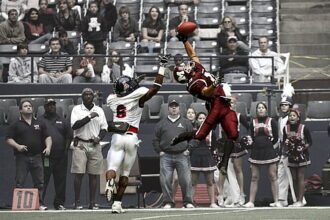
- Ball Tracking Downfield: When the ball is in the air on vertical routes, Hurst shines. He demonstrates good awareness and body control to locate the deep ball over his shoulder, a skill that cannot be taught.
- Physical Frame: The 6’4″ build is his calling card. In a league that covets size and catch radius, Hurst offers a massive target, particularly appealing in contested-catch situations and red-zone packages.
These attributes form the foundation of the “pro-Hurst” argument. They are tangible, measurable, and projectable to the next level. The problem is that the rest of his game lacks the polish and consistency required to make those strengths matter.
The Alarming Deficiencies: Why the Tape Raises Red Flags
This is where the scouting report turns sour. Beyond the enticing frame and the gaudy college statistics lies a player with fundamental flaws that are severe enough to question his NFL viability. The critique is not about a lack of elite athleticism; it’s about a lack of core competency at the position.
Catastrophic Hands and Contested-Catch Failures: The most damning indictment of Hurst’s game is his inconsistent, often unreliable hands. For a player built to be a “50/50 ball” winner, his failure rate in contested situations is staggering. He allows the ball into his frame too often, suffers from focus drops on routine passes, and loses physical battles at the catch point despite his size. This is not a minor flaw; it is a potential deal-breaker.
Sloppy, Unrefined Route Running: Hurst’s route tree at Georgia State was simplified, relying heavily on verticals, crossers, and quick screens. When asked to run detailed routes, his poor footwork and rounded breaks are exposed. He lacks the suddenness to create separation against tight man coverage and does not sell his routes with savvy or precision. NFL defensive backs will feast on this lack of nuance.
Non-Existent Blocking Effort: In today’s NFL, wide receivers must be willing and able blockers in the run game. Hurst’s effort and technique in this area are abysmal. He often appears disinterested, lunges without leverage, and is easily discarded by defensive backs. This limits his scheme versatility and will frustrate offensive coordinators.
NFL Projection and Draft Verdict
So, where does this leave Ted Hurst in the 2026 NFL Draft landscape? The disconnect between his college production and his technical flaws creates a wide range of potential outcomes.
The Optimist’s View: A team falls in love with the frame and vertical speed, using a late sixth or seventh-round pick as a developmental project. They believe NFL coaching can fix his hands and route-running, hoping to unlock a red-zone specialist.
The Realist’s View: This is the more likely scenario. Hurst’s glaring weaknesses on tape will cause him to slide out of the draft entirely. He becomes a priority undrafted free agent (UDFA), invited to a camp based on his measurable traits and college production. His battle will be against other UDFAs and late-round picks for a spot on the practice squad.
The Final Verdict: Based on a holistic evaluation, the hype surrounding Ted Hurst as a potential mid-round target is misguided. The deficiencies in his game—specifically the drop issues and unrefined routes—are foundational and historically difficult to correct at the professional level. While the underdog story is captivating and his deep-speed is intriguing, he lacks the well-rounded skill set or a single, dominant “above-the-line” trait to warrant significant draft capital.
Conclusion: A Cautionary Tale for Draft Enthusiasts
Ted Hurst embodies the eternal draft dilemma: production versus traits, potential versus polish. His journey from zero-star recruit to Sun Belt standout is a testament to his work ethic and determination. However, the NFL is a merciless evaluator of talent, where every weakness is exploited. For every small-school success story, there are dozens of high-producers whose games don’t translate.
Investing a third-day pick in Hurst is a significant risk with a low probability of a tangible return. The team that signs him as an undrafted free agent is making the appropriate value play—no cost, minimal risk, with the hope that a competitive environment sparks improvement. For fans and analysts dreaming of Ted Hurst as the next great draft steal, temper your expectations. The tape suggests he is more likely a training camp body than a future impact player, a classic case where the juice, indeed, may not be worth the squeeze.
Source: Based on news from Yahoo Sports.