Anthony Joshua Doubles Down: The Heavyweight Champion’s “Kill” Comments Ignite Fury and Fuel Safety Debate Ahead of Jake Paul Fight
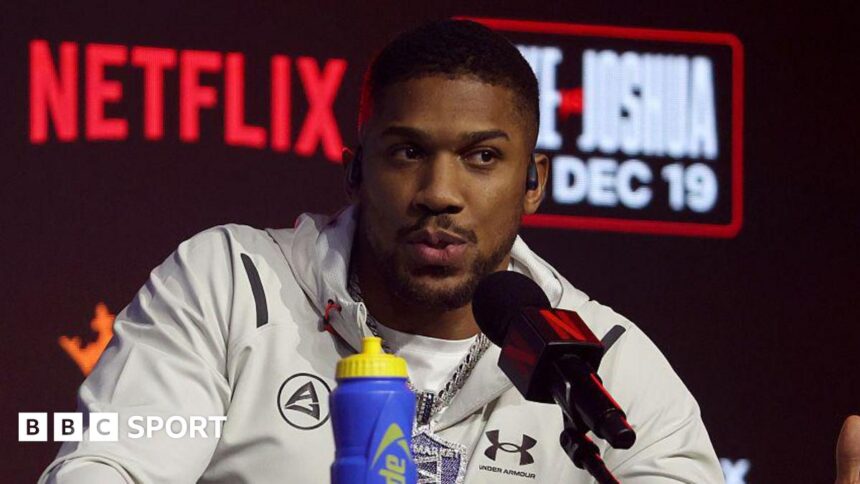
The world of crossover boxing is no stranger to bombastic trash talk, but a chilling line in the sand was drawn this week in Miami. As the spectacle of Anthony Joshua versus Jake Paul reached its final, fevered pitch, the two-time heavyweight champion of the world delivered a statement that transcended typical fight-week hype and plunged the event into a serious, and deeply uncomfortable, debate. When asked if he would hold back against the YouTuber-turned-boxer, Joshua’s response was stark and visceral: “if I can kill you, I’ll kill.” A day later, confronted on the remark, he doubled down. This singular moment has reframed Saturday’s fight, shifting the narrative from mere sporting curiosity to a conversation about morality, responsibility, and the very real dangers inherent in a colossal mismatch.
Beyond Hype: The Anatomy of a Controversial Comment
In the theater of combat sports, violent metaphor is standard currency. Fighters routinely speak of “war,” “destruction,” and “taking souls.” However, Anthony Joshua’s choice of language landed with a uniquely disturbing thud. The context is critical. This is not a heated rivalry between seasoned equals; it is a confrontation between one of the most decorated heavyweight champions of his generation and a social media star whose boxing resume, while improving, is built on facing aged MMA fighters and fellow influencers. The size difference is staggering—Joshua is a sculpted 6’6″ former Olympic gold medalist, while Paul is a natural cruiserweight. The power discrepancy is not just notable; it is potentially lethal.
Joshua’s subsequent justification at Wednesday’s news conference did little to quell the storm. He framed his words as a reflection of the “kill or be killed” mentality required at the elite level, a mindset he believes Paul has not yet earned the right to understand. “This is a serious sport,” Joshua implied, suggesting his language was a sober acknowledgment of reality, not a promotional stunt. Yet, this explanation rings hollow to many critics. It exposes a fundamental tension at the heart of crossover boxing: the attempt to market a novelty act with the gravitas and deadly seriousness of a world title fight. The comment, and its defense, forced the uncomfortable truth to the surface: safety concerns are not just a subplot; they are the main event.
The Fury of Criticism: Class, Safety, and the Soul of Boxing
The backlash was swift and came from the highest echelons of the sport. Most notably, lineal heavyweight champion Tyson Fury branded Joshua a “classless loser” for the remarks. Fury’s critique carries weight, not just as a rival, but as a figure who has mastered the art of provocative promotion without, his supporters would argue, crossing into genuinely distasteful territory. Fury’s comment taps into a long-standing narrative about Joshua’s perceived authenticity, but it also underscores a broader ethical line.
Beyond the Fury feud, the criticism stems from three core issues:
- The Responsibility of the A-Side: As the established, vastly superior professional, Joshua carries an immense duty of care. His words are seen by some as an abdication of that role, unnecessarily amplifying fear and darkening the event’s atmosphere.
- Normalizing Extreme Violence: Critics argue that such language, in a mismatch context, trivializes the very real tragedies boxing has seen. It commodifies the sport’s darkest potential for clicks and headlines.
- The Integrity of the Sport: Purists see the comment as another symptom of crossover boxing’s corrosive effect, where the lines between sport, entertainment, and reckless endangerment are dangerously blurred.
Jake Paul, for his part, has predictably used the remarks as fuel, portraying himself as the disrespected underdog and leveraging the controversy for engagement. But the bravado cannot mask the underlying dynamic: a novice is stepping into the ring with a man whose primary function for over a decade has been to concuss other elite, physically comparable athletes.
Expert Analysis: What the “Kill” Mentality Reveals About Joshua’s Mindset
To dismiss Joshua’s comments as mere pre-fight theater is to miss their deeper significance. They offer a rare, unfiltered window into the psyche of a champion at a crossroads. After his back-to-back losses to Oleksandr Usyk, the polished, media-friendly “AJ” persona has been gradually stripped away, revealing a more hardened, desperate competitor. The “kill” rhetoric is less about Jake Paul and more about Anthony Joshua’s own reconstruction.
Sporting psychologists might interpret this as a form of intense self-programming. By vocalizing the most extreme version of the combat mindset, Joshua is perhaps trying to eradicate any lingering hint of complacency. He is reminding himself, and the world, that despite the circus surrounding this fight, his fists carry apocalyptic power. He is reasserting his identity as a finisher, a seeker of knockouts, which was a hallmark of his early career. In this light, the comments are a stark message to the entire heavyweight division: the old, violent Joshua is back, and no opponent—be it a YouTuber or a world champion—will be afforded an ounce of mercy.
However, this psychological gambit comes at a severe reputational cost. It has allowed critics to paint him as unhinged and has overshadowed the technical aspects of what should be a straightforward fight for him. The narrative is no longer about his footwork or jab; it’s about his intent.
Prediction & Conclusion: The Inevitable Outcome and Its Lasting Shadow
The actual in-ring prediction is the simplest part of this saga. Anthony Joshua will win, and he will win decisively. The significant disadvantage Jake Paul faces is insurmountable. The only real questions are how long Paul’s courage and chin can hold up, and in what manner Joshua chooses to end it. Will he look for a swift, clinical stoppage to prove a point, or will he administer a prolonged, punishing lesson? His recent comments suggest the latter.
When the final bell rings on Saturday, the result will be forgotten quickly. The spectacle, however, and the preceding week’s controversy, will linger. Anthony Joshua’s decision to double down on his “kill” comments has achieved something remarkable: it has made a Jake Paul fight feel *too real*. It has pierced the veneer of entertainment and forced a confrontation with the sport’s inherent brutality. Whether this was a calculated act of intimidation, a genuine expression of mindset, or a grave error in judgment, it has cast a long shadow.
Ultimately, this episode serves as a grim reminder. In boxing, the hyperbolic talk of violence is always just a few steps away from the actual thing. When a man of Anthony Joshua’s capability explicitly frames his objective in mortal terms, the world has a responsibility to listen, to critique, and to remember that some lines, even in the hurt business, are not meant to be crossed. The fight may be a mismatch, but the conversation it has sparked about power, language, and consequence is perfectly balanced.
Source: Based on news from BBC Sport.