Trump Claims Credit as IOC Announces Sweeping Policy to Restrict Women’s Sports to Biological Females
In a move that has ignited a fierce global debate, the International Olympic Committee has unveiled a landmark policy shift, mandating that only biological females may compete in women’s sports categories, with genetic testing to be employed as a key enforcement mechanism. The announcement, which comes amid years of escalating controversy over transgender athlete participation, was immediately seized upon by former President Donald Trump, who claimed sole credit for the international body’s decision, pointing to his own executive order from the previous year. As activists on one side celebrate what they call a necessary protection for fairness, the decision sets the stage for a complex and contentious new era in elite athletics.
- The Announcement and the Immediate Political Reaction
- Expert Analysis: Unpacking the IOC’s Shift and the Science of Enforcement
- A Political Football: The 2024 Election and the Culture War Arena
- Predictions and Ramifications for the Future of Global Sport
- Conclusion: A Defining Moment with No Easy Finish Line
The Announcement and the Immediate Political Reaction
The policy change emerged into public view during the USOPC Media Summit, where CEO Sarah Hirshland and Chief Medical Officer Dr. Jonathan Finnoff faced pointed questions regarding the integrity of women’s sports. While details of the full IOC framework are still being analyzed, the core mandate is clear: the women’s category will be reserved for athletes whose biological sex assigned at birth is female. The IOC’s reported turn to genetic testing, a method with a controversial history in sports, signals a stringent approach to verification.
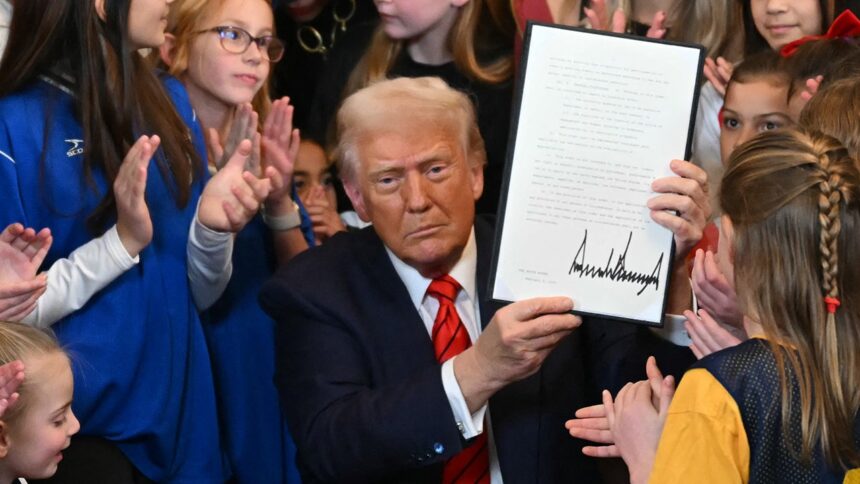
Within hours, former President Donald Trump posted a triumphant message on his Truth Social platform. “Congratulations to the International Olympic Committee on their decision to ban Men from Women’s Sports. This is only happening because of my powerful Executive Order, standing up for Women and Girls!” he wrote. This assertion was swiftly echoed by his campaign. White House Press Secretary Karoline Leavitt stated, “You cannot change your sex. President Trump’s Executive Order protecting women’s sports made this happen!” This direct line of credit from the Trump campaign to the IOC’s decision frames the issue not just as a sports governance matter, but as a potent political victory.
The referenced executive order, titled “Keeping Men Out of Women’s Sports,” was signed by Trump during his presidency and faced immediate legal challenges. Its core premise was to tie federal education funding to policies requiring athletic participation to be based on biological sex.
Expert Analysis: Unpacking the IOC’s Shift and the Science of Enforcement
Sports policy analysts were caught somewhat off-guard by the scope of the IOC’s new stance. “This represents a dramatic reversal from the IOC’s previous framework, which emphasized inclusion and allowed individual sports federations significant leeway,” notes Dr. Alicia Morrow, a sports sociologist. “The shift to a uniform, biology-based standard with genetic testing is a direct response to immense political and public pressure, primarily from certain member nations and advocacy groups.”
The enforcement mechanism raises significant scientific and ethical questions. Genetic testing, often looking for the presence of a Y chromosome, is an imperfect tool. Conditions like Androgen Insensitivity Syndrome (AIS) mean some athletes are biologically male (XY) but are insensitive to testosterone and develop typically female anatomy. Historically, such athletes have faced humiliating disqualifications.
- Historical Precedent: Genetic sex testing was abandoned by the IOC in the late 1990s due to its invasiveness and scientific complexity.
- Enforcement Challenges: Implementing consistent, fair, and respectful testing across 200+ National Olympic Committees will be a logistical and diplomatic minefield.
- Legal Battles: The policy is certain to face immediate legal challenges under national and international human rights laws.
“The IOC is attempting to draw a bright line in an area where biology often presents a spectrum,” says Dr. Finnoff’s counterpart at a major research university, speaking on background. “While the intent to create a protected category is clear, the tools they are proposing are blunt and come with a troubled past.”
A Political Football: The 2024 Election and the Culture War Arena
The timing and nature of this announcement cannot be separated from the current U.S. political landscape. Women’s sports has become a central flashpoint in the nation’s culture wars, and the Trump campaign’s rapid claim of ownership over the IOC’s decision underscores its strategic importance. For Trump’s base and many independent voters, this issue resonates as a clear-cut matter of fairness and traditional values.
“This is a textbook example of policy laundering,” argues political strategist Ben Carter, who works with progressive advocacy groups. “A domestic political priority, via claimed influence, becomes an international standard, which can then be pointed to as validation. It energizes a key constituency and creates a ‘winner’ narrative around a deeply polarizing topic.” The Biden administration, which has advocated for more inclusive policies, is now forced into a defensive posture on an issue that polls show generates complex and often conflicted public opinion.
The debate transcends talking points. Proponents of the ban argue it is the only way to preserve the integrity of female competition, citing advantages in bone density, muscle mass, and lung capacity. Opponents decry it as discriminatory and harmful, arguing it excludes a vulnerable population from public life and ignores modern understandings of gender identity.
Predictions and Ramifications for the Future of Global Sport
The ripple effects of this decision will be felt far beyond the Olympic stage. Several major predictions can be made:
- Fragmentation in Sports Governance: Some international federations (like World Athletics) may align with the IOC, while others (like FIFA or World Aquatics) could chart their own, potentially conflicting, courses, creating a patchwork of regulations.
- Increased Scrutiny of Female Athletes: All elite female athletes, not just transgender athletes, may face heightened and invasive scrutiny regarding their biology, potentially reviving the traumatic “gender verification” practices of last century.
- State-Level Legislation Acceleration: In the U.S., the IOC’s move will likely bolster efforts in conservative-led states to pass similar bans at the K-12 and collegiate levels, citing the Olympic standard as justification.
- Boycott Threats and Diplomatic Strain: Nations with more progressive policies on transgender rights may protest the new rules, leading to potential boycotts or the formation of alternative, inclusive competitions.
The 2024 Paris Olympics may arrive too soon for full implementation, but the 2028 Los Angeles Games are likely to be the first major test of this policy on the world’s biggest athletic stage, ensuring the controversy will remain at a boiling point for years to come.
Conclusion: A Defining Moment with No Easy Finish Line
The International Olympic Committee’s decision to restrict women’s sports to biological females, enforced by genetic testing, marks a defining and divisive moment in sports history. It is a decisive turn away from a trajectory of inclusion and toward a model of biological determinism. While former President Trump and his supporters have framed it as a vindication of his policies and a straightforward victory for fairness, the reality is far more convoluted.
The path forward is fraught with ethical dilemmas, scientific disputes, and profound human costs. The policy attempts to solve one contentious problem but risks creating others: the potential for discrimination, the revival of archaic testing, and the alienation of athletes who do not fit a binary biological mold. As the world’s athletes prepare for competition, they do so under a new shadow—one cast by the intersecting spotlights of politics, science, and a fundamental debate about identity and fairness. The finish line for this race is not in sight, and the journey there promises to be one of the most challenging in the history of sport.
Source: Based on news from Fox Sports.