The Inevitable Countdown: Inside Manchester City’s Search for a Post-Pep Future
The architect of Manchester City’s golden era has, for the first time, publicly drawn a blueprint for his own succession. Pep Guardiola, the visionary who transformed the club into a relentless trophy-winning machine, has shifted the narrative from an unthinkable departure to a necessary conversation. His recent admission that the club “must be prepared” for life after him is not a casual remark; it is a seismic directive that has set in motion one of the most consequential searches in modern football.
A Proactive Directive: Guardiola’s Pragmatic Vision
In a football world often defined by reactive chaos, Guardiola’s call for preparedness is a masterclass in forward-thinking governance. Despite signing a contract extension just months ago that ties him to the Etihad until the summer of 2027, the 54-year-old is acutely aware of his own expiry date at the club. “Sooner or later, 75 or 76, I will quit from Manchester City,” he quipped, before adding with characteristic focus, “but I have 18 months, I am so delighted.” This juxtaposition—joking about a distant retirement while acknowledging the finite nature of his current deal—underscores a profound reality: for City, the future is now.
Guardiola’s tenure has been built on control, precision, and leaving nothing to chance. It is fitting, then, that he insists the same principles apply to his succession. This is not a manager angling for an exit, but a leader embedded in the club’s long-term health. By initiating this dialogue, he aims to ensure the transition, whenever it comes, is seamless rather than seismic, protecting the sporting and structural empire he helped build.
The Speculation Engine: Candidates and Contenders
Following Guardiola’s comments, it is understood that the City football hierarchy, led by Director of Football Txiki Begiristain, has begun the delicate process of identifying potential successors. The ideal candidate must be more than a tactician; they must be a cultural custodian, capable of stewarding a complex, data-driven operation while maintaining the insatiable hunger that defines the current era.
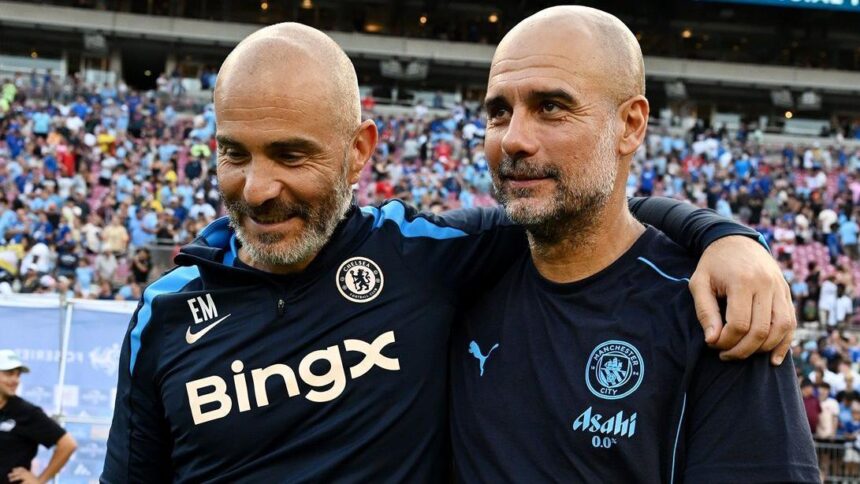
The rumor mill, predictably, is in overdrive. Names like Xabi Alonso, whose transformative work at Bayer Leverkusen embodies a modern, possession-based philosophy, are frequently mentioned. Mikel Arteta, Guardiola’s former assistant and Arsenal architect, possesses an intimate understanding of the “City way,” though prising him from a rival project would be fraught with difficulty. Then there is the intriguing case of Enzo Maresca, another former Guardiola lieutenant, who led Leicester City to promotion playing a distinct Pep-style system. However, Maresca himself has poured cold water on the links, calling reports “100% speculation,” highlighting the sensitive and premature nature of the discussion.
Key attributes City will likely prioritize include:
- Philosophical Alignment: A commitment to proactive, controlling football.
- Developmental Acumen: The ability to improve players within a structured system.
- Tactical Flexibility: Guardiola’s greatest legacy may be his constant evolution; his successor cannot be a dogmatic imitation.
- Personality & Pressure: The mental fortitude to handle the immense weight of expectation and scrutiny.
The Unprecedented Challenge: Succeeding the Unsucceedable?
Whoever takes the reins will face a challenge unlike any other in football management. The task is not rebuilding or restoring glory; it is sustaining near-perfection. Guardiola will depart having potentially set a bar of six Premier League titles in seven seasons, a historic treble, and a complete redefinition of English football excellence. The shadow he casts will be long and inescapable.
The new manager will inherit a squad of immense quality but also one at a crossroads. Key pillars like Kevin De Bruyne and Kyle Walker will be deeper into their thirties, while the next generation—Phil Foden, Erling Haaland, Jérémy Doku—will need to be guided into their prime. The successor must be both a continuation and an innovator, respecting the past while having the courage to impose their own ideas. The graveyard of football is littered with managers who failed following an iconic predecessor. Manchester City’s entire project is designed to avoid that fate through structural continuity, making the sporting director and CEO roles as crucial as the manager’s.
Predictions: A Phased Transition or a Clean Break?
Analyzing Guardiola’s history and City’s operational model allows for informed predictions about how this saga will unfold.
First, the timeline: While 2027 is the contractual endpoint, few would be shocked if Guardiola departed sooner, should he feel he has achieved all he can. The 2025-26 season feels like a potential natural conclusion, offering a clean decade at the club.
Second, the candidate pool: Expect City to look for a manager already proven at a high level, but not necessarily at a direct rival. The Alonso profile is compelling: a elite football intellect, achieving success with a clear philosophy, without the baggage of a prior Premier League rivalry. An internal appointment, such as promoting a figure like current assistant Juanma Lillo, seems less likely given the club’s global ambitions.
Third, the process: This will be clandestine and respectful. City’s leadership operates with discretion. Public campaigns or leaks will be minimized until a decision is imminent. Guardiola will be consulted, but the final call will rest with Begiristain and Chairman Khaldoon Al Mubarak, ensuring the decision serves the club’s next decade, not just the previous one.
Conclusion: The Beginning of the End of an Era
Pep Guardiola’s call for Manchester City to prepare for his successor is the first, quiet toll of the bell for his own historic tenure. It marks the moment the club officially transitions from savoring a golden present to meticulously planning a future designed to defy the typical cycles of football dominance. The search is not an admission of weakness but a declaration of strength and permanence. It signals that the “City project” was always meant to be bigger than one man, even if that man is the most transformative coach of his generation.
The coming months will be filled with whispered names and informed speculation, but the real work will happen in the silence of the boardroom. The ultimate testament to Guardiola’s legacy will not be the trophies in the cabinet, but the strength and stability of the club he leaves behind. By forcing the conversation today, he has given Manchester City the most precious commodity in planning for the unthinkable: time. And in the high-stakes game of football succession, time is the one advantage even money cannot buy.
Source: Based on news from Yahoo Sports.