Ole Miss Steamrolls Tulane in Playoff Debut, Proving Resilience After Kiffin’s Exit
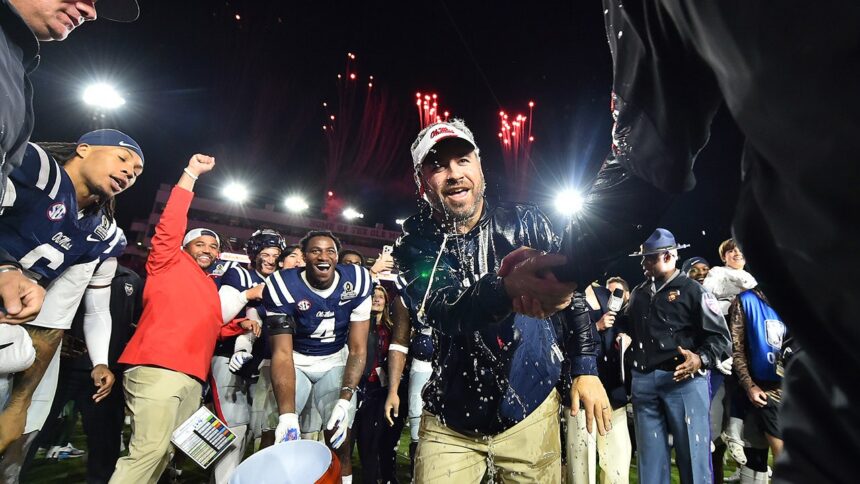
In a season defined by seismic shifts and relentless debate, the Ole Miss Rebels delivered a statement that echoed far beyond the final score in New Orleans. Just weeks after the shocking and controversial departure of head coach Lane Kiffin, the Rebels, under interim leadership, not only showed up for their historic first College Football Playoff appearance—they dominated. With a commanding 41-10 victory over the 11th-seeded Tulane Green Wave, Ole Miss silenced doubters and ignited a fresh firestorm of conversation about the selection committee’s choices, a sentiment famously amplified by Heisman winner Robert Griffin III’s blunt critique that the committee “got it wrong this year.”
A Rebel Statement Amidst the Chaos
The narrative entering Saturday’s matchup was inescapable. Could a team, so recently stripped of its charismatic and strategic leader, possibly maintain its focus and firepower on the sport’s biggest stage? The answer was a resounding and immediate yes. From the opening kickoff, Ole Miss played with a palpable, unified intensity that suggested a group motivated to define its own legacy, rather than be defined by an abrupt coaching change.
The Rebels’ defense set a ferocious tone, stifling Tulane’s potent offense and creating short fields. The offense, though facing a momentary scare, operated with ruthless efficiency. This was not a team in disarray; it was a squad playing with a chip on its shoulder, seemingly channeling the external noise into on-field production. The victory served as a powerful testament to the culture and player leadership within the program, proving that the foundation was stronger than any single departure.
Chambliss’ Scare and Resilient Return Steals the Show
The game’s most pivotal moment came not from a touchdown but from an injury evaluation. Star quarterback Trinidad Chambliss, the dynamic engine of the Ole Miss attack, went down late in the second quarter and was sidelined for the final series of the half after receiving treatment on the field. The collective breath of the Rebel nation was held as he was evaluated for a concussion.
In a turn of events that swung the game’s momentum decisively, Chambliss was cleared to return. He jogged back onto the field for Ole Miss’ first possession of the third quarter and promptly erased any remaining doubt. Displaying remarkable poise and resilience, Chambliss picked apart the Tulane defense, finishing the day with a passing touchdown and adding two critical rushing scores. His performance was a masterclass in toughness and a key reason the comfortable lead turned into a rout.
- Key Moment: Concussion evaluation just before halftime.
- Critical Outcome: Cleared to play, reentered for first third-quarter drive.
- Impact: Accounted for three second-half touchdowns, sealing the victory.
RGIII and the Lingering Playoff Committee Controversy
While Ole Miss celebrated on the field, the context of their victory fueled a pre-existing controversy. The inclusion of a team like Ole Miss—a powerhouse program with a recent coaching change—over other contenders was a hot-button issue. ESPN analyst and former Heisman Trophy winner Robert Griffin III became the voice for a widespread sentiment, stating unequivocally that the College Football Playoff selection committee “got it wrong this year.”
Griffin’s argument likely centered on the perceived inconsistency of the committee’s criteria, weighing conference championships, strength of schedule, and “eye test” in a way that many found contradictory. Ole Miss’s dominant performance, ironically, both validated their spot for some (“See, they belong!”) and intensified the criticism for others (“Imagine if a more ‘deserving’ team had that spot?”). This debate is the unavoidable subtext of the Rebels’ entire playoff run, adding an extra layer of intrigue to every game they play.
Expert Analysis: What This Win Reveals About Ole Miss
The true takeaway from the Tulane blowout is not simply that Ole Miss is talented—that was never in question. The revelation is about their mental fortitude. In the high-stakes, pressure-cooker environment of the playoff, with a coaching transition hanging over them, the Rebels displayed exceptional maturity and focus.
The offensive game plan, likely installed by remaining staffers, was expertly executed. The defense played with an edge. This suggests a program built on solid systems, not just one man’s genius. The players, from veterans to leaders like Chambliss, took ownership. They played for each other, and that bond proved stronger than the surrounding turbulence. This intangible quality makes them a far more dangerous and unpredictable opponent moving forward than anyone might have assumed a month ago.
Predictions: How Far Can This Rebel Team Go?
Ole Miss has now transformed from a question mark into a legitimate threat. Their performance answered the biggest immediate question about their stability. Now, the query becomes about their ceiling.
- Immediate Future: Their next opponent will be a top-tier national seed. The Rebels have proven they won’t be intimidated by circumstance, but they will face a massive talent gap.
- Key to Advancement: Continued health of Trinidad Chambliss is paramount. The defense must replicate its disruptive performance against a more sophisticated offense.
- The X-Factor: The “us against the world” mentality. If Ole Miss can continue to harness the energy from being doubted post-Kiffin and criticized as a playoff selection, they possess the emotional fuel to compete with anyone for four quarters.
While a national title remains a steep climb, Ole Miss has already won something crucial: respect. They are no longer a sidebar story about a coaching carousel. They are a tough, unified football team that has earned its place in the bracket and has the talent to shock the college football world one more time.
Conclusion: More Than Just a Football Game
The final score at Yulman Stadium, Ole Miss 41, Tulane 10, tells only part of the story. This was a game about resilience in the face of upheaval, about players rising when narratives suggested they might fall. Ole Miss didn’t just beat Tulane; they challenged the assumption that a program needs perfect continuity to compete for a championship.
They also poured gasoline on the raging fire that is the College Football Playoff selection debate, giving Robert Griffin III’s criticism a compelling new data point. As the Rebels advance, they carry with them this dual identity: the resilient underdog and the controversial invitee. One thing is certain after their emphatic debut: they have ensured that their journey, however long it lasts, will be one of the most compelling stories of this playoff era.
Source: Based on news from Fox Sports.