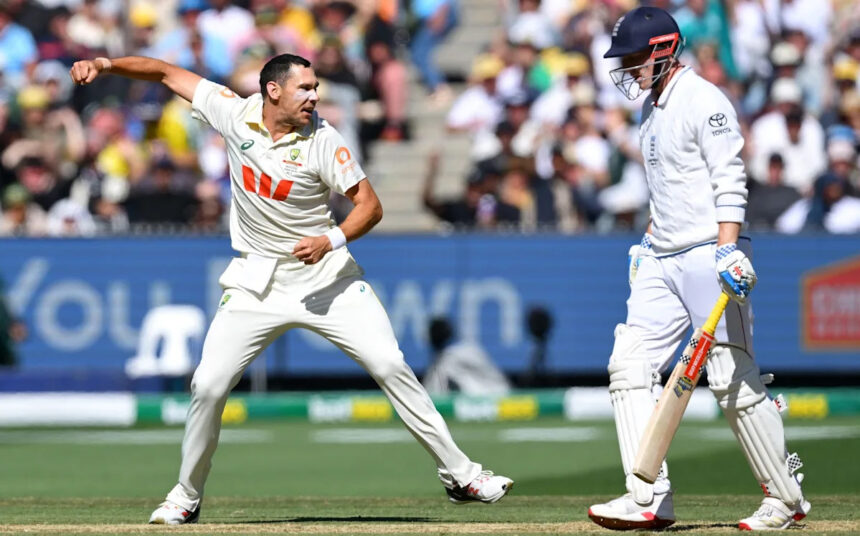
England in Tatters as Melbourne Mayhem Sees 20 Wickets Fall in a Day
The hallowed turf of the Melbourne Cricket Ground, a stage for legendary batting feats, was transformed into a bowlers’ paradise of pure, unadulterated chaos on Boxing Day. In a breathtaking and brutal display of seam bowling supremacy, a staggering 20 wickets tumbled on the opening day of the third Ashes Test, leaving England’s campaign in ruins and a record crowd of 94,199 spectators oscillating between shock and delight. When a pitch draws criticism from a seasoned fast bowler for being too helpful, you know you have witnessed something extraordinary.
A Pitch of Peril and a Batting Circus
The narrative was set from the first over. Under leaden Melbourne skies, the ball seamed, swung, and spat off a surface with a pronounced green tinge. This was not a subtle test of batting patience; it was an outright examination of survival. Techniques were brutally exposed, and for some, the pressure proved too much. As former England paceman Stuart Broad noted on Australian radio, with palpable envy in his voice, “Test-match bowlers do not need this amount of movement to be threatening.” His comment, laced with the regret of a man holding a microphone and not a Kookaburra, underscored the day’s imbalance.
Broad, a veteran of the soporific 2017-18 Boxing Day Test where only 24 wickets fell in five days, understood the historic shift. This time, the MCG cathedral felt more like a circus tent, with batsmen as reluctant performers. There were moments where a batter might as well have ridden in on a unicycle:
- England’s top-order collapse was a masterclass in poor judgement, losing 4 for 7 at one stage.
- Australian openers, perhaps complacent, then fell in near-identical fashion, pushing hard at balls they could have left.
- Footwork was static, hands were hard, and minds appeared scrambled by the relentless movement.
It was a day where the bowlers’ margin for error was vast, and the batsmen’s was virtually non-existent.
Expert Analysis: Bowling Brilliance or Batting Ineptitude?
Dissecting such a collapse requires a balanced view. To attribute the carnage solely to the pitch would be a disservice to the skill on display. England’s James Anderson and Ollie Robinson were magnificent, exemplifying the art of seam bowling with metronomic control and subtle variations in length. Australia’s attack, led by the relentless Pat Cummins and the resurgent Scott Boland (who electrified his home crowd with 2 wickets in an over), was equally clinical.
However, the batting on both sides featured critical lapses. England, having won a crucial toss, will rue a catastrophic failure to post a commanding first-innings total. The dismissals revealed a team caught between aggression and preservation, executing neither. Joe Root’s loose drive and Ben Stokes’ uncharacteristic waft were symptoms of a side under immense scoreboard and series pressure.
Technique under the microscope was the real story. On a pitch offering lateral movement, the fundamental principles of playing late, with soft hands, and committing fully forward or back were abandoned. The modern batsman, bred on true surfaces and white-ball confidence, was laid bare by classic, unforgiving Test match conditions.
The Aftermath: What Now for England and the Ashes?
At stumps, England, bowled out for 185, had fought back valiantly to skittle Australia for 167, holding a fragile 18-run lead. But the psychological damage is immense. The Ashes urn is now all but mathematically secured by Australia, leading 2-0. For England, this day has shifted the focus from series redemption to salvaging pride.
The immediate predictions are fraught. The pitch, having baked under sun on day two, may slow and become slightly easier for batting. But the memory of that movement will haunt every batsman. England’s second innings will be the ultimate test of character. Can they:
- Overcome the mental scarring of the first innings?
- Build a lead substantial enough to pressure Australia on a wearing day four/five pitch?
- Find a method to combat the still-potent Australian attack?
For Australia, the task is simpler: exploit English fragility, chase whatever target is set, and seal the series in front of a home crowd. The momentum, despite the close scoreline, rests firmly with the hosts.
A Day That Will Live in Infamy
December 26, 2021, at the MCG will be etched into Ashes folklore not for a heroic century or a fiery spell, but for its sheer, unrelenting carnage. Twenty wickets in a day is a statistical anomaly that speaks to a perfect storm of conducive conditions, exceptional bowling, and fallible batting. While purists may debate the pitch’s merits, no one can deny the dramatic, nerve-shredding theatre it produced.
For England, reeling is an understatement. Their Boxing Day batting collapse has likely sealed their Ashes fate, exposing deep technical and temperamental flaws. For Australia, it was a day of forceful reaffirmation of their bowling dominance. As the dust settles on this chaotic day, one truth remains: Test cricket, in its most raw and unforgiving form, remains the ultimate challenge. On this day, it was a challenge that very few with a bat in hand could even begin to meet.
Source: Based on news from Yahoo Sports.