Geno Auriemma Apologizes: The Tension, The Apology, and What’s Next for Two Titans
The final seconds of a national semifinal are typically reserved for the victor’s celebration and the vanquished’s quiet exit. But in the waning moments of South Carolina’s commanding 62-48 victory over UConn in the women’s Final Four, a different, more personal drama unfolded on the sideline. It involved two of the sport’s most iconic figures—Geno Auriemma and Dawn Staley—in a tense, confusing exchange that momentarily overshadowed a brilliant basketball performance. Now, with Auriemma’s public apology, the incident opens a window into the immense pressure of the sport’s biggest stage and the complex relationships that define its elite tier.
A Heated Finale Overshadows a Masterclass
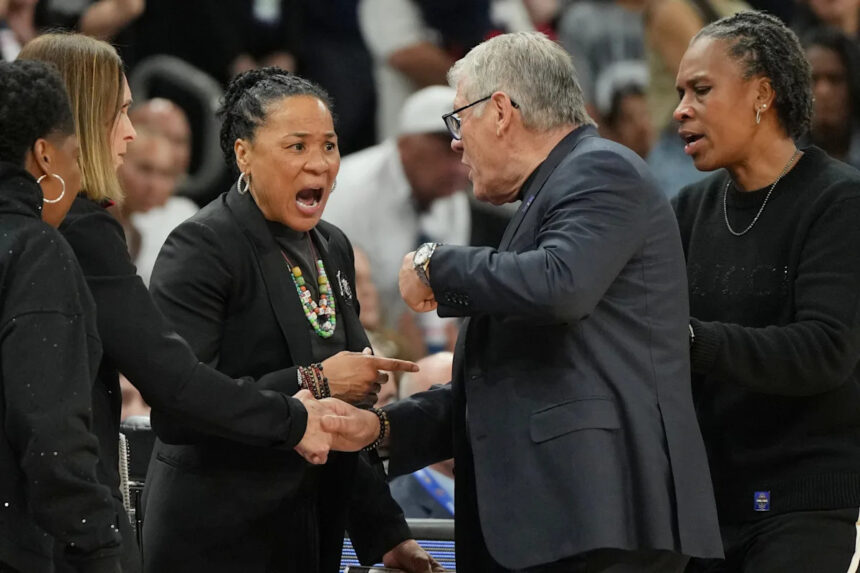
With the outcome no longer in doubt, cameras captured a visibly agitated Geno Auriemma approaching Dawn Staley near the South Carolina bench. Words were exchanged, tone was sharp, and assistants from both sides quickly moved in to create separation. The scene was jarring for its rarity; these are two Hall of Famers who have publicly expressed mutual respect for years. The tension didn’t subside at the buzzer. Auriemma, breaking from a lifetime of coaching protocol, walked directly to the locker room, bypassing the traditional postgame handshake line entirely.
The basketball story was clear: South Carolina’s defense was historically dominant, and UConn’s offensive struggles were profound. But the human story suddenly became about a breach of decorum between legends. In her postgame press conference, Staley expressed genuine bewilderment. “I have no idea,” she stated, emphasizing her integrity. She revealed the potential root: a pregame handshake she believed she had completed with Auriemma’s staff, but which Auriemma apparently felt was absent for him personally.
The Apology and the Unspoken Pressure Cooker
On Saturday, Geno Auriemma released a statement taking full responsibility. The apology was notable for its directness and lack of qualification. “There’s no excuse for how I handled the end of the game,” Auriemma said. “It’s unlike what I do and what our standard is here at Connecticut.” He specifically apologized to Staley’s staff and team, acknowledging that his actions risked detracting from South Carolina’s performance.
This incident, however brief, speaks volumes about the Final Four pressure cooker. Consider the context for Auriemma:
- Historic Offensive Failure: UConn’s 48 points were its lowest total in an NCAA Tournament game since 1992.
- Injury-Ravaged Season: The Huskies’ legendary season was marred by catastrophic injuries, adding a layer of “what could have been” frustration.
- The Staley Standard: Facing a rival program that has, in many ways, assumed the mantle of dominance UConn held for decades.
For a competitor of Auriemma’s caliber, the culmination of these factors in a season-ending loss can create a volatile emotional stew. The perceived slight of a missed handshake—a symbol of respect—may have been the spark that ignited that frustration. This is not to excuse the action, but to analyze the high-stakes environment that produced it.
Expert Analysis: Respect, Rivalry, and Legacy
The Auriemma-Staley relationship has long been characterized by public admiration and private competition. Staley has frequently credited Auriemma for his role with USA Basketball, helping her secure Olympic gold as a player and later supporting her ascent as a coach. Auriemma has consistently praised Staley’s program-building and cultural impact.
This incident introduces a new, albeit likely temporary, complexity. Sports psychologists often point to “competitive disinhibition” in moments of extreme stress, where ingrained protocols can momentarily lapse. Auriemma’s swift apology is a return to protocol, an attempt to re-establish the respectful framework their rivalry has been built upon.
The legacy of both coaches remains untarnished. Staley’s continues to ascend with a pursuit of a third national title. Auriemma’s 11 championships and foundational role in growing the game are immutable. This episode will be a footnote, but an instructive one. It highlights that even for the most decorated icons, the emotions of competition—especially in defeat—are profoundly human. The key differentiator for champions is how they handle those moments after the fact. Auriemma’s choice to apologize unequivocally aligns with the accountability he has demanded from his players for four decades.
What’s Next for the Rivalry and the Sport?
Looking ahead, the trajectory of this rivalry and the sport’s narrative is clear.
Short-Term Fallout: The apology will likely serve as the closing chapter on this incident. The women’s basketball community is tightly knit, and a public statement of this nature is typically accepted as a peace offering. Expect both coaches to downplay the event if asked in the future, pivoting focus back to their teams and the game itself.
Long-Term Implications: The core narrative remains South Carolina’s dynasty under Staley and UConn’s quest to rebuild and return to the summit. This incident may even add a subtle new layer of personal intrigue to their future matchups, which will remain the most anticipated non-conference games on the calendar. Fans and media will watch their interactions closely, though both are savvy enough to project unity and respect.
The Bigger Picture: Ironically, the very existence of this headline-grabbing moment is a testament to the growth of women’s sports. The coaches are stars, their emotions are dissected, and their interactions are deemed national news. This is the realm of major sports leagues, and women’s college basketball has firmly arrived there. The passion displayed, even if misplaced in this instance, underscores the massive stakes involved.
Conclusion: A Moment of Humanity in a Championship Chase
The Final Four stage is designed to crown champions, but it also reveals character. In South Carolina’s victory, we saw the character of a relentless, united team. In the aftermath, we saw the character of two coaching giants: one confused by a rival’s outburst, the other remorseful for letting emotion override professionalism.
Geno Auriemma’s apology was necessary and definitive. It ensures that the primary legacy of the night will be South Carolina’s defensive masterpiece, not a sideline confrontation. It also serves as a reminder that the pursuit of excellence at this level carries an immense emotional weight. The greatest competitors are not immune to its pressure. How they respond—with accountability and a refocus on the standards they embody—is what ultimately defines their legacy. This incident, now closed with an apology, will soon be filed not as a feud, but as a fleeting, human moment in the long, storied, and still-evolving rivalry between two pillars of the game.
Source: Based on news from Yahoo Sports.