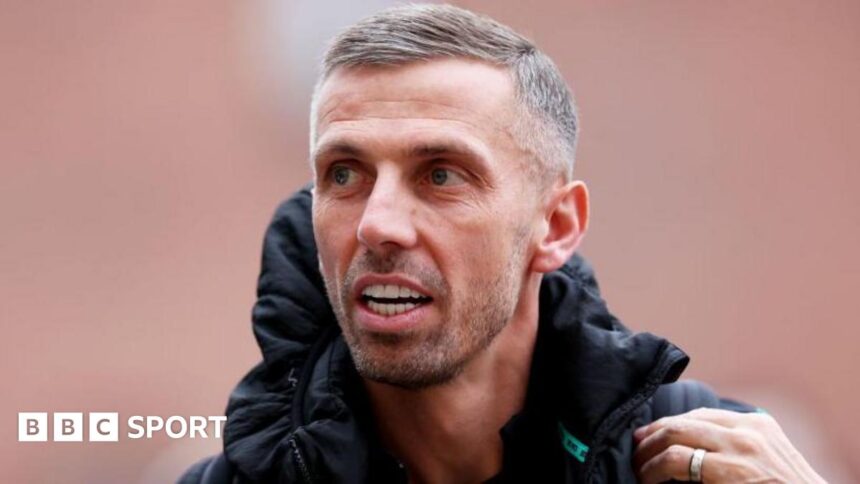
Gary O’Neil’s Continental Gamble: From Wolves Exit to Strasbourg’s Hot Seat
The managerial carousel spins with relentless, often ruthless, speed. One moment you’re out, the next you’re handed the keys to a new project in a foreign land. For Gary O’Neil, the whirlwind has taken him from the Midlands of England to the heart of Alsace, France. Just months after his departure from Wolverhampton Wanderers, the 42-year-old has been thrust into a fascinating and high-stakes challenge, appointed as the new manager of Racing Club de Strasbourg Alsace, succeeding Liam Rosenior who departed for Chelsea. This isn’t just another job; it’s a bold strategic move by the club’s owners and a critical career pivot for O’Neil himself.
A Swift Appointment in the Shadow of Chelsea
The chain reaction began at Stamford Bridge. With Chelsea moving for Liam Rosenior, a highly-rated young coach who had impressed with his progressive style at Strasbourg, a sudden vacancy opened at the Stade de la Meinau. Strasbourg’s leadership, under the ambitious BlueCo umbrella—the same multi-club ownership group that includes Chelsea—acted with decisive speed. They turned not to a continental European name, but to a proven Premier League operator in Gary O’Neil. His availability, following his sack by Wolves in December 2024, presented a unique opportunity. For O’Neil, the call represents a rapid and prestigious return to the dugout, affirming his reputation within the game despite his Molineux exit. “I am proud to join a club with a high-quality squad and clear, ambitious goals for the season,” O’Neil stated, acknowledging the immediate pressure to perform.
O’Neil’s Managerial DNA: Pragmatism Meets Opportunity
To understand what Strasbourg is getting, one must look at O’Neil’s brief but eventful managerial CV. His tenure at Bournemouth was a masterclass in exceeding expectations against the odds. Tasked with steering a seemingly doomed ship after Scott Parker’s departure, O’Neil organized the Cherries into a resilient, counter-attacking unit, securing their Premier League status against all predictions. His move to Wolves continued this theme of steadying a listing ship, though his tenure there ended more abruptly. His football has often been characterized by:
- Structural Discipline: Teams are hard to break down and well-drilled in defensive transitions.
- Pragmatic Game Management: A keen focus on set-pieces and exploiting specific opponent weaknesses.
- Strong Man-Management: Known for clear communication and getting buy-in from squads.
However, Strasbourg represents a different proposition. This is not purely a relegation firefight. The club, backed by significant investment, aims for European qualification. The question becomes: can O’Neil’s pragmatic core evolve into a more dominant, possession-based style that satisfies the Alsatian faithful? “My priority is to work hard with the team and give everything for the club’s success,” he said, hinting at the workmanlike approach that will form the foundation.
The Strasbourg Project: Ambition and Unique Pressure
O’Neil is walking into one of France’s most passionate and unique football environments. Strasbourg is a club with a deep, fervent identity, a fact the new manager quickly acknowledged: “Racing has a unique history, extraordinary passion, great resilience, and of course, loyal fans who want to see this team play attractive football and succeed.” The high-quality squad he inherits is a blend of experienced Ligue 1 campaigners and exciting young talent, many of whom have been developed through the club’s excellent academy or recruited with a clear development pathway in mind. The shadow of Rosenior’s attractive, front-foot football looms large. The fans have tasted a modern, proactive style, and will expect O’Neil to deliver results without completely abandoning those principles.
Furthermore, the multi-club model dynamics add an intriguing layer. As part of BlueCo, Strasbourg is both a sister club to Chelsea and a standalone project. The appointment of O’Neil, a coach with recent top-flight English experience, suggests a potential strategic alignment. He may be seen as an ideal conduit for integrating young talent from the wider network or preparing players for the Premier League’s intensity. His success or failure will be a major test case for this model’s managerial pathway.
Predictions and Pivotal Challenges Ahead
O’Neil’s first season in France will be judged on several key metrics. Can he quickly adapt to a new league, with different tactical nuances and a less physical, more technical style? Can he harness the squad’s attacking potential—featuring players like Emanuel Emegha and Dilane Bakwa—while instilling his trademark defensive solidity? The early signs will be crucial. His ability to connect with the fanbase, to show an understanding of the club’s culture, will be as important as his first few results.
We predict a season of transition, but not without promise. O’Neil is a quick learner and a shrewd tactician. Expect:
- A strong initial emphasis on defensive organization to build a platform.
- Potential for Strasbourg to become a set-piece powerhouse in Ligue 1.
- An evolving style, perhaps more pragmatic away from home and more expansive at the Meinau.
- Intense scrutiny on his ability to develop younger players within the squad.
The ceiling for this Strasbourg side is a Europa Conference League spot. The floor is a muddled, mid-table finish that disappoints an ambitious board. O’Neil’s task is to ensure the former is within reach as the season progresses.
Conclusion: A Defining Chapter for Coach and Club
Gary O’Neil’s move to Strasbourg is a compelling narrative of modern football. It’s a story of a coach seeking redemption and a new horizon, and a club leveraging a multi-club network to secure a manager they believe can translate Premier League grit into European progress. The clear, ambitious goals O’Neil referenced are no secret. This is not a retirement home or a safe haven; it’s a pressure cooker with the heat turned up by passionate fans and ambitious owners.
Success here would redefine O’Neil’s career, marking him as a versatile, culturally intelligent manager capable of thriving abroad. Failure could see him pigeonholed as a purely British firefighter. For Racing Club de Strasbourg, the gamble is on O’Neil’s adaptability and tactical flexibility. One thing is certain: the journey of this English manager in the heart of Europe will be one of the most closely watched stories of the coming Ligue 1 season. The whistle is about to blow on a fascinating new chapter.
Source: Based on news from BBC Sport.