Martinelli’s Moment of Madness: An Apology, An Outcry, and Football’s Unwritten Rules Tested
The final whistle at the Emirates Stadium on Sunday signaled a pivotal 0-0 draw in the Premier League title race, but it was a moment of pure frustration in stoppage time that has dominated the discourse. In a flash, Arsenal’s vibrant winger Gabriel Martinelli transformed from potential match-winner to the villain of the piece, his desperate shove of an injured Conor Bradley sparking a firestorm of controversy that threatens to burn longer than the memory of the goalless stalemate.
The Incident: A Shove That Silenced the Emirates
Deep into added time, with the tension palpable, Liverpool’s young Northern Irish defender Conor Bradley embarked on a relentless chase for a loose ball. As he reached the touchline, his foot caught awkwardly in the turf. The result was immediate and distressing: Bradley crumpled to the ground, his hands instinctively clutching his right knee, his face contorted in pain. Play, however, raged on around him.
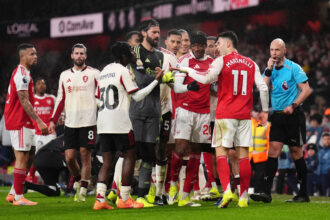
What happened next was a jarring breach of footballing etiquette. Arsenal’s Gabriel Martinelli, retrieving the ball that had gone out near the stricken defender, made a decision that would define the post-match narrative. He placed the ball beside Bradley, and in a move devoid of sportsmanship, placed both hands on the Liverpool man’s back and shoved him, attempting to roll the injured player off the pitch to allow a quick throw-in. The reaction was instantaneous. Liverpool players swarmed, led by the furious Ibrahima Konaté. Pundits in commentary boxes gasped. Social media ignited. In the eye of this storm, referee Anthony Taylor brandished only a yellow card—a decision that felt lenient to many and unjust to those in red.
The severity of Bradley’s injury quickly became apparent. After extensive on-pitch treatment, he was stretchered off, later seen leaving the stadium on crutches and wearing a knee brace—a sobering image that cast Martinelli’s impatience in an even harsher light.
The Fallout: Apology, Analysis, and Angry Reactions
Facing a tidal wave of criticism, Martinelli moved quickly to contain the damage. The Brazilian issued a public apology, stating he was “deeply sorry” for his actions and that his emotions got the better of him in the heat of the moment. While the apology is a necessary first step, it does little to quell the analytical and ethical debate now raging.
Expert analysis of the incident hinges on two key points: the rules of the game and the unwritten code within it.
- The Letter of the Law: Was it a red card? Many former referees and pundits argue yes. Martinelli’s actions could fall under “violent conduct”—the use of excessive force or brutality against an opponent. While not a traditional strike, the shove on an obviously injured player was deemed needless and aggressive. The yellow card has been widely criticized as a significant officiating error in a high-stakes match.
- The Spirit of the Game: Beyond the rulebook, this incident cuts to the core of football’s sportsmanship. The unwritten rule is clear: when a player is seriously injured, especially with a head or knee issue, you put the ball out. Martinelli’s attempt to physically remove the obstacle, rather than show concern, was a stark violation of this principle. It highlighted a win-at-all-costs mentality that many feel is eroding the game’s core values.
The reaction from the Liverpool camp has been one of muted fury. While publicly accepting the apology, the sight of a promising young teammate potentially sidelined due to an opponent’s unsporting act will linger. It adds a layer of needle to an already fierce rivalry.
Broader Implications: What Happens Next?
This incident is not an isolated one, but a symptom of a larger tension in modern elite football. The margins for error are minuscule, the pressure is immense, and gamesmanship often blurs the line with outright poor sportsmanship. So, what are the potential consequences and predictions moving forward?
For Martinelli and Arsenal: The immediate fallout is reputational. Martinelli, known for his infectious smile and thrilling play, now has this moment attached to his name. Mikel Arteta, a manager who passionately demands intensity, will likely address the lapse in judgment internally. The Football Association could review the incident for potential further punishment, though that is not guaranteed. More certain is that Martinelli will face a ferocious reception on his next visit to Anfield.
For Conor Bradley and Liverpool: The primary concern is the youngster’s health. An ankle ligament injury is suspected, which could see him miss a crucial period of the season. For Liverpool, it’s another defensive injury blow in a campaign already plagued by them, testing their squad depth as they fight on four fronts.
For the Premier League: This incident serves as a case study for referees. It will undoubtedly be part of future briefing sessions, clarifying that such actions against injured players must be met with the strongest sanctions. The hope is that it reinforces the priority of player safety over tactical expediency.
A Lesson in the Heat of Battle: The Final Whistle
The 0-0 draw may prove to be a critical point in the title race, but the legacy of this match will be the ugly stoppage-time scene. Gabriel Martinelli’s apology, while welcome, cannot erase the act. It was a moment where raw desire to win overrode basic humanity and the collective spirit that holds the sport together.
In the end, this incident is a stark reminder that football is more than points and trophies. It’s a cultural touchstone where actions are magnified and values are constantly negotiated. The push on Conor Bradley wasn’t just a foul; it was a failure of empathy in a pressure-cooker environment. The hope is that the widespread condemnation serves as a lesson—not just for Martinelli, but for every player who steps onto the pitch. The beautiful game loses its beauty when competition extinguishes compassion. As Bradley faces a spell on the sidelines, the true test for Martinelli will be whether his future conduct on the pitch reflects the remorse expressed in his words.
Source: Based on news from India Today Sport.
Image: CC licensed via commons.wikimedia.org