Keane’s Hair-Pull Ban Upheld: Everton Fume as FA Sends a Stern Message
The beautiful game is often a theater of passion, but sometimes that passion spills over into moments of pure, unscriptable folly. The fallout from Everton’s midweek 1-1 draw with Wolverhampton Wanderers has crystallized into a disciplinary storm, with the Football Association’s decision to uphold Michael Keane’s three-match ban for pulling an opponent’s hair becoming a flashpoint for debate. Everton’s public outrage—declaring themselves “surprised and disappointed”—clashes with the FA’s seemingly zero-tolerance stance, setting a fascinating precedent and leaving Sean Dyche’s squad significantly weakened at a critical juncture of the season.
The Incident: A Moment of Madness Meets VAR’s Cold Eye
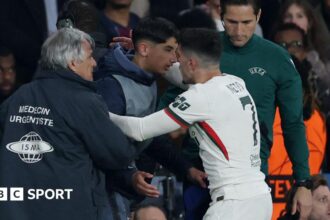
In the chaotic, closing stages of a tense Premier League encounter, with Everton clinging to a point, a seemingly innocuous tangle between Michael Keane and Wolves’ towering substitute, Tolu Arokodare, turned consequential. As players jostled following a set-piece, Keane’s hand was caught on camera gripping and pulling Arokodare’s hair. It was a brief, almost childish act of frustration, missed by the on-field officials but inevitably flagged by the ever-watchful Video Assistant Referee (VAR).
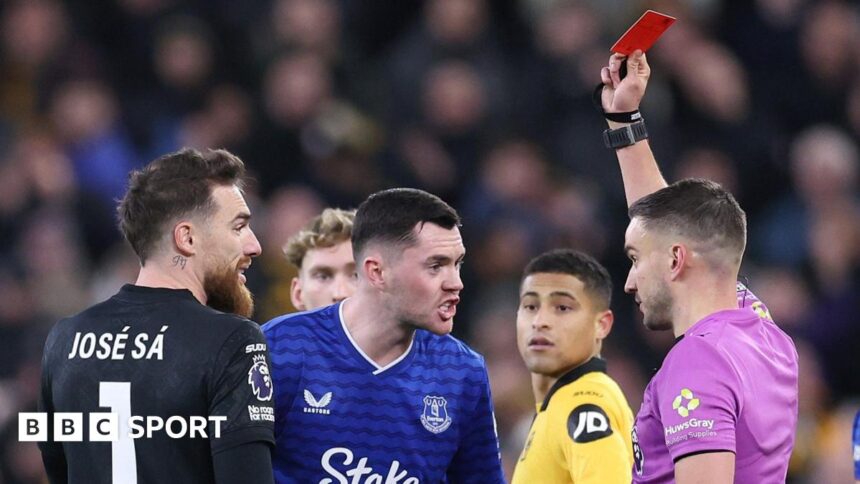
After reviewing the monitor, referee Anthony Taylor produced the red card. The decision was clear-cut under the letter of the law: violent conduct. Law 12 states that a player must be sent off for “striking or attempting to strike” or “violent conduct” against an opponent. The FA’s interpretation classifies a hair-pull not as a trivial scuffle, but as an act of aggression worthy of the game’s ultimate sanction. This incident, juxtaposed with Jack Grealish’s simultaneous sending-off for a second bookable offense, encapsulated a game spiraling out of control.
Everton’s Appeal: The Case for “Excessive” Punishment
Everton’s decision to appeal was a calculated risk, likely rooted in two core beliefs: the nature of the act and the severity of the suspension. The club’s statement was pointed, arguing the three-game ban was “clearly excessive.” Their perspective, shared by many pundits and fans, hinges on context and comparative justice.
- Lack of Force or Danger: The argument contends that a hair-pull, while unsporting, lacks the malicious force or potential for injury present in a stamp, elbow, or reckless tackle.
- Precedent and Proportion: Critics point to other red-card offenses that arguably carry more physical risk but yield the same mandatory three-match suspension, questioning if the punishment truly fits this specific crime.
- Game Impact vs. Ban Length: Missing three matches for an instant of petulance is seen by some as a draconian outcome that disproportionately hurts the team.
However, the FA’s Independent Regulatory Commission saw it differently. By rejecting the appeal, they reinforced a fundamental principle: the action itself, not its perceived force, defines violent conduct. It is a stance that prioritizes the eradication of all non-footballing aggression from the sport, a line in the sand against any action deemed outside the spirit of competition.
The Ripple Effect: Dyche’s Defensive Dilemma
The practical consequences for Everton are severe. Michael Keane, an experienced head in a squad that has relied on defensive solidity under Sean Dyche, will now be absent for a pivotal run of fixtures:
• FA Cup Fourth Round vs. Sunderland: A chance for a deep cup run and vital morale boost, now facing a defensive reshuffle.
• Premier League vs. Aston Villa & Leeds: Crucial league matches in what remains a tight battle for survival and positioning. The absence of a key centre-back disrupts defensive cohesion and limits Dyche’s options.
This suspension forces Dyche into a tactical recalibration. With James Tarkowski a certain starter, the manager must choose between the youthful Jarrad Branthwaite or the versatile Ben Godfrey to fill the void. It also depletes his bench options, making Everton more vulnerable to further defensive injuries or in-game setbacks. In a season where every point is precious, losing a senior player for three games over such an incident is a self-inflicted wound that the club will deeply rue.
Expert Analysis: A Precedent for Petulance?
From a broader disciplinary standpoint, the FA’s firm stance is significant. It sends an unambiguous message to every professional in English football: any act of physical aggression, regardless of how “soft” it may appear, is subject to the full force of the rules. In the age of VAR, where every angle is scrutinized, players can no longer plead that moments of madness will go unseen.
This incident draws inevitable comparisons to the most famous hair-pull in football history: the 2006 World Cup final, where Italy’s Marco Materazzi infamously provoked France’s Zinedine Zidane. The context was vastly different, but the principle remains. The game’s authorities are determined to remove such provocations and retaliations from the modern game. By upholding Keane’s ban, they are effectively codifying that pulling hair is not a minor act of gamesmanship, but a red-card offense, full stop.
The debate it sparks is healthy for the sport. Does this strict application make the game better and safer, or does it risk sanitizing the raw emotion that is also part of football’s allure? Where is the line between acceptable aggression and punishable violence? The Keane decision firmly plants that line at the roots of an opponent’s hair.
Conclusion: A Costly Tug and a Lasting Lesson
Michael Keane’s momentary lapse in judgment has evolved into a costly episode for Everton and a landmark case for Premier League discipline. While the club’s frustration is understandable from a competitive standpoint, the FA’s unwavering decision underscores a commitment to a broader, if debated, standard of conduct. This is no longer about the force of the pull, but the principle of the action.
For Keane and his peers, the lesson is stark: in today’s hyper-analyzed football, petulance carries a premium price. The three-game ban is a heavy personal and professional punishment, but its true weight may be in its symbolic value. The FA has pulled back hard on any notion that some forms of violent conduct are more acceptable than others. As Everton navigate a tricky fixture list without their defender, the rest of the league will be nervously checking not just their tackles, but their impulses, knowing that even a split-second tug can lead to a very long suspension.
Source: Based on news from BBC Sport.