5 Painful Takeaways from the Chargers’ Season-Ending Playoff Loss to Patriots
The Los Angeles Chargers’ 2024 season, a campaign defined by resilience in the face of a historic injury crisis, ended with a thud in Foxborough. A 16-3 AFC Wild Card loss to the New England Patriots wasn’t just a defeat; it was a grim, familiar autopsy of the franchise’s most persistent flaws. While the injury report—a novel in its own right—will be cited, Sunday’s elimination exposed deeper, systemic issues that a healthy roster alone may not cure. Here are the five defining takeaways from a loss that sends the Chargers into a pivotal offseason shrouded in difficult questions.
The Offensive System, Not Just Injuries, Reached a Breaking Point
Yes, the Chargers fielded a league-high 32 different offensive line combinations. Yes, stars like Rashawn Slater, Joe Alt, and rookie sensation Omarion Hampton were absent. But Sunday’s performance was a carbon copy of every Chargers loss this season, revealing a scheme that has been solved and exploited.
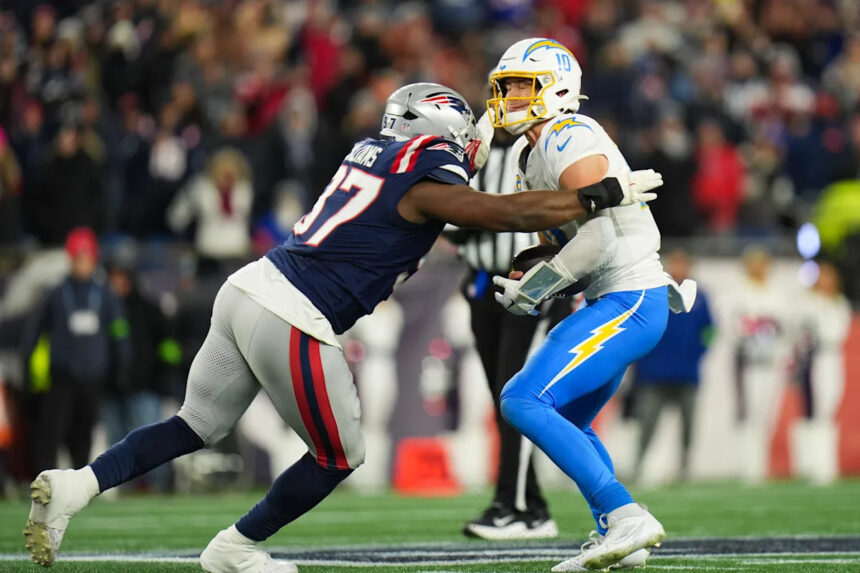
The run game was nonexistent, generating no push and forcing Justin Herbert into obvious passing situations. The offensive line, a patchwork unit by season’s end, was repeatedly embarrassed by basic defensive line stunts, leading to 11 hits and six sacks on Herbert. The passing concepts failed to create separation, rendering the field a congested mess. While offensive coordinator Greg Roman and line coach Mike Devlin may be retained due to the injury mitigation argument, this game was a glaring indictment. The system, designed to create physicality and explosive plays, produced neither when it mattered most. The Chargers must ask: are we building around Herbert, or asking him to survive within a limiting structure?
Justin Herbert’s Uncharacteristic Struggles Under the Brightest Lights
For all the valid criticism of the offensive infrastructure, Justin Herbert did not play his best game. In the critical opening drive of the second half, with the Chargers down just 6-3, Herbert’s mechanics and decision-making unraveled. He went 1-for-7, turning every dropback into a frantic scramble drill before ultimately losing a strip-sack fumble.
He looked uncharacteristically strained, choosing to challenge Patriots defenders head-on rather than evade. The final stat line—19-of-31 for 159 yards, no touchdowns, six sacks—will fuel a long offseason of external debate about his ability to elevate a wounded team in the playoffs. This performance was an outlier in an otherwise heroic season played with a broken hand, but in the win-or-go-home crucible, Herbert’s off-day proved catastrophic for a team with zero margin for error.
- Critical Sequence: 1-for-7 passing to start second half, including a drive-killing strip sack.
- Pocket Presence: Looked harried and opted for power over elusiveness against pressure.
- Big Picture Question: The game adds to a premature narrative Herbert must work to dismantle next season.
A Valiant Defensive Effort Wasted by Offensive Ineptitude
The Chargers’ defense, maligned at times this season, delivered a performance worthy of a playoff victory. They held a rookie quarterback in check, bent but didn’t break for three quarters, and gave the offense repeated opportunities to seize control.
Daiyan Henley’s interception in the third quarter, setting the offense up at the New England 10-yard line, was the gift of the day. The defense forced punts, held the Patriots to field goals, and gave the ball back to Herbert with the game firmly within reach. Yet, every time the door was opened, the offense slammed it shut. The failure to score a touchdown after Henley’s pick was a symbolic death knell. Henley himself was later outhustled for a potential game-changing fumble recovery. The defense did its job; its reward is an early vacation.
The Red Zone Failures Were a Season-Long Condemnation
If one statistic encapsulates the Chargers’ offensive woes, it is their red zone performance on Sunday. Two trips inside the New England 10-yard line resulted in a grand total of three points. This wasn’t bad luck; it was a failure of design, execution, and perhaps philosophy.
On fourth-and-goal from the 2, the play call and execution lacked conviction. Later, from the 3-yard line, they settled for a chip-shot field goal. In a defensive slugfest, red zone touchdowns are non-negotiable. The Chargers’ inability to convert premium field position into seven points is a direct reflection of an offense that lacks a reliable, physical identity in condensed areas. This flaw haunted them all season and became the primary reason their season ended in New England.
An Offseason of Consequential Crossroads Ahead
This loss does not exist in a vacuum. It forces the Chargers’ front office into a period of intense self-scrutiny. The easy path is to run it back, citing health and continuity. The harder, but perhaps necessary, path involves acknowledging that the current formula has a ceiling.
Key decisions loom: Is the Roman/Devlin partnership the right one to unlock the final tier of Herbert’s potential? How aggressively must they rebuild the offensive line’s depth to avoid total collapse? Does the skill position group around Herbert require another major investment? This game proved the Chargers are not a player or two away; they are a philosophical recalibration away from contending. The defense showed it can be playoff-ready. The offense, from scheme to execution, must now undergo a ruthless evaluation.
Conclusion: A Failure of Foundation, Not Just Fortune
The 2024 Los Angeles Chargers will be remembered as a team that battled admirably through a storm of injuries, only to see its core weaknesses fatally exposed in January. The loss to the Patriots was a tragedy in two acts: a defense providing a championship-level platform, and an offense utterly incapable of standing upon it. While the injured reserve list provides context, it cannot excuse the systemic failures in pass protection, route concepts, and red zone planning that have become this team’s trademark in big games.
Justin Herbert’s subpar performance adds a complicating, personal layer to the offseason narrative, but the burden of change does not rest on his shoulders alone. It rests on an organization that must decide if it is satisfied with resilience, or hungry enough to build an offense that doesn’t require its quarterback to be a superhero just to score a touchdown. The Chargers’ final game was a mirror, and the reflection was painfully clear.
Source: Based on news from Yahoo Sports.