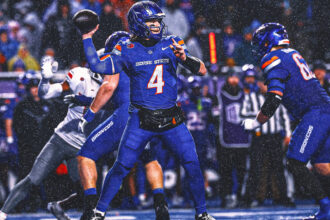
Is Matthew Stafford Ready for Chicago’s Gauntlet? A Chilling Statistical Preview
The NFL playoffs are a tournament of survival, but they are also a test of adaptation. For the Los Angeles Rams and their veteran quarterback Matthew Stafford, the road to the Super Bowl now runs through the frozen, unforgiving turf of Soldier Field. After the Chicago Bears authored a legendary comeback against the Green Bay Packers—a victory forged in swirling snow and bone-deep cold—the stage is set for a brutal NFC Divisional showdown. While Stafford’s arm talent and experience are unquestioned, a deep dive into the numbers reveals a daunting reality: the elements and the environment in Chicago could conspire to create significant problems for the Rams’ passing attack.
The Windy City’s Wintry Welcome: More Than Just a Cliché
To dismiss Chicago’s weather as mere playoff ambiance is to misunderstand its impact. The Bears’ victory over Green Bay was a masterclass in cold-weather football. Caleb Williams didn’t just make throws; he launched frozen ropes through falling snow, displaying an almost supernatural grip and arm strength that left analysts scrambling for comparisons. Pro Football Focus noted he packed an entire Patrick Mahomes playoff run into one game, a testament to his otherworldly performance in abysmal conditions.
This is the gauntlet Stafford must now run. Chicago playoff weather isn’t just cold; it’s a penetrating chill that affects everything. It stiffens joints, numbs fingers, and turns a pristine football into a slick, hard rock. For a quarterback like Stafford, who relies on precision timing and feathery touch on intermediate and deep routes, these conditions are a direct threat. The snow may hold off, but the January cold on the lakefront is a constant, and it historically favors the team built to withstand it.
Stafford’s Statistical Frost: A History in the Cold
Matthew Stafford is a future Hall of Famer with a cannon for an arm, but his career numbers in cold-weather games present a clear trend. While “cold” is often defined as below 40 degrees, the subset of games in truly frigid, playoff-like conditions tells a more specific story.
- Career Record in Games Below 35 Degrees: Stafford’s win-loss record in such games is notably below his overall career winning percentage, highlighting the systemic challenges cold weather presents to his style of offense.
- Dip in Efficiency Metrics: Across key metrics like completion percentage, yards per attempt, and passer rating, a noticeable decline is evident in cold weather. The margin for error shrinks, and the high-wire, back-shoulder throws that are staples of the Rams’ offense become far riskier.
- Turnover Concerns: The combination of a hard ball, reduced grip, and tighter coverage windows has historically led to a slight uptick in interception rates for Stafford in cold games. Against a Bears defense that feasts on takeaways and just rattled Jordan Love, this is a paramount concern.
This isn’t about toughness—Stafford has proven his mettle for years. This is about physics and consistency. The Bears’ defense, already playing at an elite level, receives an exponential boost from conditions that simplify their task: pin their ears back and disrupt the timing of a finesse-based passing attack.
The Bears’ Blueprint: Built for January in the Midwest
While the Rams navigated a warmer wild-card path, the Bears are a roster constructed with explicit purpose. Their dramatic win over Green Bay was no fluke; it was a validation of their identity. They are built to leverage the very conditions that may hinder Stafford.
Defensive Line Dominance: With a monstrous front that can generate pressure without excessive blitzing, the Bears can collapse the pocket and make Stafford uncomfortable, forcing him to move his feet in suboptimal footing. A pass rush is always potent, but it’s devastating against an offensive line trying to execute precise pass sets on frozen ground.
The Caleb Williams Factor: Williams’ performance last week wasn’t just impressive; it was informational. It showed the Bears’ coaching staff that their quarterback can make magic happen even when the playbook shrinks. This allows them to commit fully to a game plan centered on defense, field position, and the run game. They don’t need to force anything. They can wait for the conditions and their defense to force Stafford into a mistake.
Chicago’s offense, with a powerful running game and a quarterback who can create off-script, is inherently more adaptable to the cold. The Rams, with their reliance on Stafford’s arm and the exquisite route-running of Cooper Kupp and Puka Nacua, face a stiffer adaptation challenge.
Predictions: Can Stafford Defy the Numbers and the Elements?
This matchup will be a classic clash of style versus environment. The Rams’ offensive brilliance against the Bears’ defensive physicality and home-field elements. Here’s how it could unfold:
The Rams’ Path to Victory: It requires early success. If Stafford can engineer a couple of scoring drives in the first quarter, before the cold fully sets in and the Bears’ pass rush finds its rhythm, he can force Chicago to alter its plan. Quick, short passes, a heavy dose of the run game to maintain balance, and flawless protection are non-negotiable. Stafford must be willing to take the check-downs and live for another play, something his gunslinger mentality has sometimes resisted.
The Bears’ Path to Victory: This is the more likely scenario. Chicago will aim to make the game a grueling, low-possession slog. They will run the ball relentlessly with their stable of backs, use Williams’ legs strategically, and ask their defense to win the turnover battle. They will trust that as the game wears on and the temperature drops, their physicality and comfort in the cold will become an overwhelming advantage. A game in the teens or low-20s with wind is a decisive edge for the home team.
Key Matchup to Watch: The Rams’ offensive line vs. the Bears’ defensive front in the fourth quarter. If the game is close late, every block, every step, and every hand placement will be magnified by fatigue and the cold. That is where championships—and this game—will be decided.
Conclusion: A Test of Will as Much as Skill
The question isn’t whether Matthew Stafford can make great throws in Chicago. He can. The question is whether he can do it consistently for four quarters against a top-tier defense while battling a climate that actively works against his strengths. The numbers from his past suggest it will be an uphill battle.
The Chicago Bears, fresh off a historic, weather-defying win, are not just a team with momentum; they are a team perfectly engineered for this exact moment. They have the defense, the emerging superstar quarterback in Caleb Williams, and the elemental advantage. While Stafford’s pedigree and talent guarantee nothing will come easy, the chilling data and the visceral reality of Soldier Field in January point to a sobering conclusion for the Rams. In this frozen crucible, the Bears are built to survive and advance, potentially leaving a legendary quarterback out in the cold.
Source: Based on news from Yahoo Sports.