The Agony and the Ecstasy: George Kittle’s Candid Confession After Season-Ending Injury
The visceral roar of a playoff victory crowd had barely faded when the cold, quiet reality set in for George Kittle. In the crucible of the San Francisco 49ers’ hard-fought 23-19 win over the Philadelphia Eagles, a game defined by grit and championship aspiration, the All-Pro tight end suffered the ultimate personal defeat: a torn Achilles tendon. The following day, from the solitude of recovery, Kittle did not offer a polished, PR-sanitized statement. Instead, he delivered a raw, two-sentence elegy that resonated with every athlete and fan who understands the sport’s brutal duality: “Football sucks sometimes. But I love it.”
The Cost of Glory: A Victory Marred by Injury
The scene at Lincoln Financial Field was a classic NFL playoff battleground. The 49ers, locked in a tense defensive struggle, were leveraging every weapon to advance. George Kittle, the heart and soul of the team’s offensive identity, was in the thick of it. Then, in a non-contact moment that sends a chill through every sideline, he went down. The immediate diagnosis was ominous, and an MRI confirmed the worst: a complete Achilles tear, ending his season on the spot. The juxtaposition was cruel—teammates celebrated a berth in the NFC Championship while Kittle confronted a grueling 9-12 month rehabilitation process. This injury, occurring in the pursuit of the ultimate team goal, underscores the profound individual risk inherent in every snap of professional football.
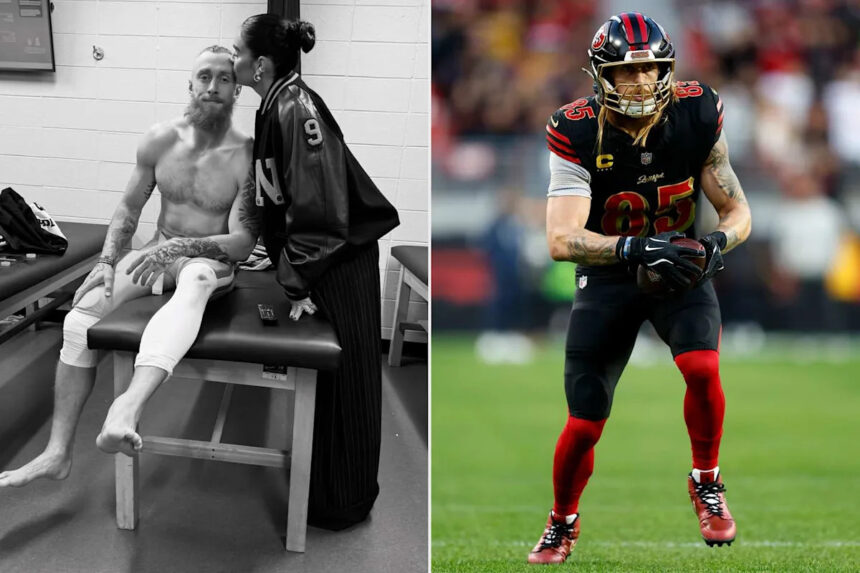
Kittle’s post, accompanied by images from Getty photographer Lachlan Cunningham capturing both his on-field intensity and the moment of injury, was a masterclass in emotional transparency. It refused to sugarcoat the devastation. “Football sucks sometimes” is an acknowledgment of the physical toll, the shattered dreams in an instant, and the lonely road ahead. It’s a sentiment rarely voiced so plainly by active stars, who often feel compelled to project unwavering toughness. Yet, it is an undeniable truth known in training rooms across the league.
Beyond the Bravado: The Unfiltered Reality of NFL Life
George Kittle has built a reputation as one of the NFL’s most charismatic and relentless players, a man who embodies the “bang-bang” mentality of the tight end position. His candid reflection post-injury, however, peeled back the layers of that persona to reveal the vulnerable competitor beneath. This is not a sign of weakness, but of profound clarity. Professional football is a high-reward, high-risk contract that players sign with their bodies. Kittle’s statement eloquently captures the central conflict of that existence.
- The Physical Toll: The Achilles tear is a notoriously difficult injury, affecting explosiveness and requiring immense mental fortitude to overcome.
- The Emotional Whiplash: Processing a season-ending injury within hours of a season-extending win creates a complex psychological burden.
- The Authentic Voice: In an era of carefully managed messaging, Kittle’s unfiltered honesty is a powerful connection point with fans.
- Love for the Game: The second clause, “But I love it,” is equally crucial, explaining why athletes willingly accept this risk.
This duality is the core of the sport’s allure and its tragedy. The very collisions, cuts, and explosive movements that make Kittle’s play so spectacular are what make his body susceptible to catastrophic injury. His acknowledgment doesn’t diminish his passion; it frames it. It is precisely because he loves the camaraderie, the competition, and the pursuit of a championship that the sudden loss of the ability to participate feels so profoundly unfair.
Impact and Analysis: What Kittle’s Absence Means for the 49ers
From a tactical standpoint, losing George Kittle is a monumental blow to the San Francisco 49ers’ Super Bowl aspirations. He is not merely a tight end; he is the emotional engine of the offense and a scheme-defining weapon. His ability to dominate as a blocker in the run game—a rarity for a player with his receiving stats—is the foundation of Kyle Shanahan’s outside zone scheme. As a receiver, he commands double teams, creates mismatches, and makes clutch, chain-moving catches in critical moments.
Offensive coordinator Chris Flood must now reconfigure an attack that has lost its most versatile piece. Backup tight ends will be asked to shoulder a composite of Kittle’s responsibilities, but no single player can replicate his unique skill set. This likely means a heavier reliance on wide receivers Deebo Samuel and Brandon Aiyuk in the intermediate passing game and an increased load for running back Christian McCaffrey. The 49ers’ offense remains potent, but it loses a dimension of unpredictability and sheer force that Kittle provides. His absence will be felt most acutely in the red zone and on third downs, where his rapport with quarterback Brock Purdy has been telepathic.
The Road Ahead: Rehabilitation and Return
The path forward for George Kittle is now defined by discipline and patience. Achilles tendon rehabilitation is a rigorous, linear process. The early stages focus on immobilization and healing, gradually progressing to weight-bearing exercises, strength training, and finally, sport-specific agility work. The modern NFL has seen successful returns from this injury, with players like future Hall-of-Famer Aaron Rodgers aiming to come back stronger. However, the timeline is measured in many months, not weeks.
Kittle’s mentality, however, may be his greatest asset. His renowned work ethic and positive, team-first attitude will be channeled into this new, solitary challenge. Predictions for his return will center on the start of the 2025 NFL season. The key will be not just restoring physical capability, but rebuilding the trust in his body to perform at the violent, elite level he demands of himself. If anyone can attack rehab with the same ferocity he attacks a seam route, it is George Kittle.
A Testament to the Game’s True Nature
George Kittle’s four-word philosophy—”Football sucks sometimes. But I love it”—is more than a personal lament; it is a universal truth for the NFL. It encapsulates the sacrifice, the pain, and the heartbreak that exist in direct proportion to the joy, the brotherhood, and the glory. His injury, suffered in the heat of playoff battle, is a stark reminder that the spectacle we consume is built on the fragile physicality of its participants.
As the 49ers press forward in their championship quest, they will do so with the spirit of their fallen teammate fueling them. And for Kittle, the long journey back begins. His candid admission does not signal an end, but a painful pause. It reaffirms that the love for the game, forged in the grind and the camaraderie, ultimately outweighs the moments when it sucks. His return, when it comes, will be a testament to that love, and a powerful chapter in the career of one of football’s most authentic stars. The game gives, and the game takes away. And true players, like Kittle, understand and accept that brutal, beautiful bargain.
Source: Based on news from Yahoo Sports.