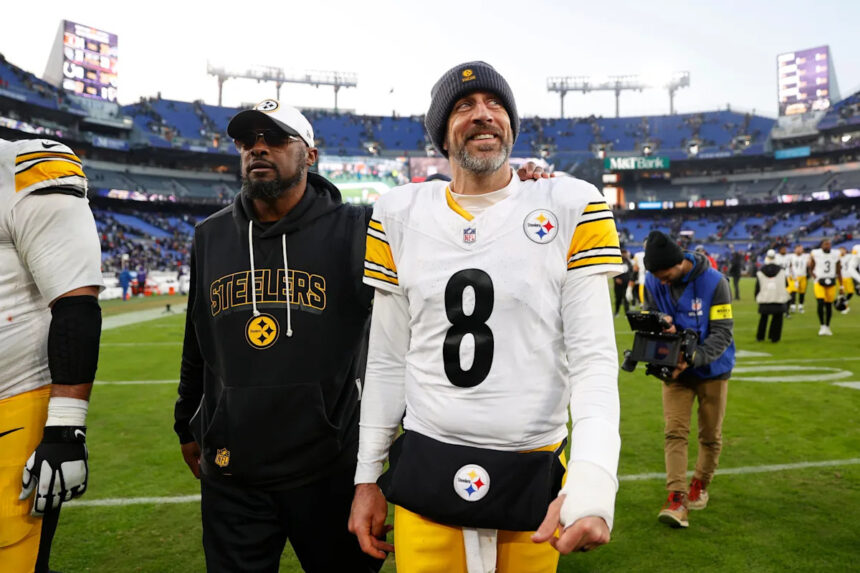
Mike Tomlin’s Stunning Exit: 4 Immediate Implications for the Pittsburgh Steelers
The bedrock of the Pittsburgh Steelers for nearly two decades has suddenly shifted. In a move that sent seismic waves across the NFL, Mike Tomlin has voluntarily stepped away as head coach, less than 24 hours after a crushing playoff defeat to the Houston Texans. This wasn’t just another coaching change; this was the end of an era defined by relentless competitiveness, a singular culture, and, in recent years, mounting postseason frustration. With Tomlin’s unparalleled stability now gone, the Steelers organization faces its most consequential and uncertain offseason in a generation. The path forward is uncharted. Here are the four most significant things the Mike Tomlin news could mean for the future of the Pittsburgh Steelers.
1. The End of an Era and the Dawn of a Complete Identity Overhaul
For 17 seasons, “The Standard is the Standard” was more than a motto in Pittsburgh; it was the organizational heartbeat, personified by Mike Tomlin. His departure signals more than just a new voice in the head coach’s office. It necessitates a complete re-examination of what the Steelers want to be in the modern NFL.
Tomlin’s tenure was a masterclass in managing personalities and maintaining floor, but the ceiling had undeniably lowered. The seven consecutive playoff losses created a psychological barrier the team could not break. Without Tomlin’s formidable presence, the entire football operation—from philosophy to practice habits—is up for grabs.
Will the new regime double down on the classic Steelers tenets of hard-nosed defense and a power-run game? Or will they, perhaps for the first time, fully embrace a pass-centric, analytically-driven approach to catch up with the AFC’s elite? The hiring decision at head coach will answer this fundamental question. The Steelers’ identity, so consistent for decades, is now a blank slate.
2. The Aaron Rodgers Dream is Almost Certainly Dead
In the wake of Tomlin’s exit, one of the most intriguing speculative storylines for 2025 has evaporated: the potential pairing of Aaron Rodgers with the Steelers. The logic was seductive—a future Hall of Fame quarterback seeking one last shot at glory, paired with a Hall of Fame coach known for managing superstars. That narrative is now obsolete.
Rodgers’s potential move was always contingent on the presence of a stable, high-caliber coach like Tomlin. Without that anchor, the fit loses its luster. Unless the Steelers make a stunning and immediate pivot to hire a coach with deep ties to Rodgers from his Green Bay days—a scenario that seems far-fetched—this door is closed.
This reality accelerates the Steelers’ most persistent problem: quarterback instability. The team now faces the stark probability that 2026 will begin with yet another new starting quarterback, continuing a cycle that has plagued them since Ben Roethlisberger’s retirement. The search for a franchise signal-caller just became the organization’s paramount, and most complicated, mission.
3. An Inside Promotion? Why Arthur Smith is a Leading Candidate
In the chaotic hours following Tomlin’s announcement, one name has surged to the forefront of speculation: offensive coordinator Arthur Smith. While his unit’s performance in 2023 was heavily criticized, his candidacy makes undeniable sense from an organizational continuity perspective.
The Rooney family has a profound history of promoting from within or hiring candidates with ties to the Steelers’ way. Smith, despite his struggles, is a known entity who understands the current roster, particularly the offensive personnel he helped assemble. Promoting him could be seen as a move to stabilize a reeling locker room and provide a bridge between eras.
However, this would be a controversial and risky choice. Key considerations include:
- Offensive Struggles: Smith’s offense was frequently labeled predictable and ineffective, failing to maximize its weapons.
- Fan Backlash: A portion of the fanbase would view this as a uninspired retread, not the fresh start they crave.
- The “Clean Slate” Argument: Does hiring internally truly allow for the necessary comprehensive overhaul?
If Smith gets the job, it will signal the Steelers value internal stability and belief in their existing plan over external innovation. It would be a safe pick, but safety may not be what this moment demands.
4. A Roster Reckoning: Who Stays, Who Goes in a New Regime?
Mike Tomlin was a master at retaining veteran loyalty and managing roster transitions. Without his gravitational pull, several key players may find their futures in Pittsburgh less certain. A new head coach will have no sentimental attachment to the previous era’s core, potentially leading to a more ruthless evaluation process.
All-Pro safety Minkah Fitzpatrick and pass-rusher T.J. Watt remain untouchable cornerstones. However, veterans on expensive contracts who have underperformed or are aging could suddenly find themselves on the chopping block. The wide receiver room, with Diontae Johnson’s name perpetually in trade rumors, could see major changes. The offensive line, a persistent issue, may be rebuilt with a different schematic vision in mind.
Most importantly, the evaluation of quarterback Kenny Pickett will be conducted through a new, and likely less patient, lens. A new head coach and GM tandem did not draft Pickett; they inherit him. His leash for 2024 becomes significantly shorter, and the desire to “get their guy” in the 2025 or 2026 draft will be a powerful undercurrent throughout the season. The roster that takes the field in Week 1 of 2024 could look markedly different, shaped by a new vision and freed from the obligations of the past.
Conclusion: Unprecedented Uncertainty in the Steel City
The Pittsburgh Steelers have not known a coaching search since 2007. The league, the media landscape, and the game itself have transformed since then. Mike Tomlin’s decision to step away plunges the NFL’s most stable franchise into a sea of uncertainty it is wholly unaccustomed to navigating. Every assumption—about the team’s identity, its quarterback future, its roster construction, and its competitive timeline—must now be questioned.
The coming weeks will define the next decade for the Steelers. Will they opt for the familiar, promoting an Arthur Smith to maintain a semblance of continuity? Or will they break from tradition, launching a sweeping search for a visionary who can modernize the entire operation? One thing is certain: the unwavering stability of the Tomlin era is over. The Steelers’ new reality is one of daunting challenge, but also, for the first time in a long time, boundless possibility. The standard, whatever it becomes, is now for someone else to set.
Source: Based on news from Yahoo Sports.