San Francisco Aims to Knock Out 82-Year-Old Boxing Record with Historic Civic Center Spectacle
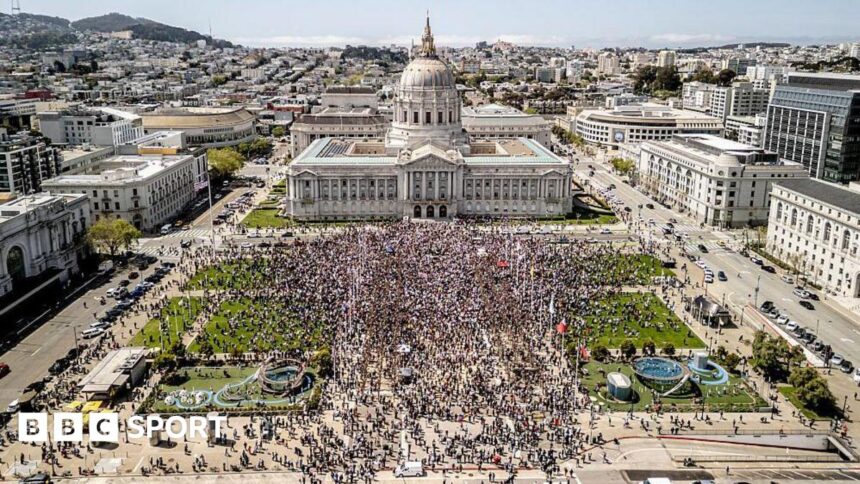
In the heart of San Francisco, where the gilded dome of City Hall has presided over a century of history, a new kind of civic ambition is taking shape—one wrapped in leather gloves and echoing with the roar of a potential world-record crowd. iVisit Boxing (iVB), a disruptive force in live sports entertainment, has announced a seismic event: transforming the iconic Civic Center Plaza into a colossal open-air boxing arena on July 11th with the singular goal of shattering the 82-year-old record for the largest attendance at a boxing match. The target? The hallowed 135,132 mark set in Milwaukee in 1941. This is more than a fight card; it’s a bold civic challenge and a potential watershed moment for the sport.
A Plaza Forged in History, Poised for a New Legacy
San Francisco’s Civic Center Plaza is no stranger to grand gatherings. Conceived in the ashes of the 1906 earthquake and fire and completed in 1911, its Beaux-Arts splendor has been the backdrop for presidential visits, civil rights rallies, and cultural celebrations. It is a space designed for public assembly, yet it has never witnessed an assembly quite like this. iVB’s vision to erect a ring amidst this architectural grandeur is a masterstroke of symbolism. It directly connects the aspirational ethos of a city known for daring re-invention with the raw, primal appeal of pugilism.
“This world-record attempt will belong to San Francisco,” declared iVB chief executive Ed Pereira, framing the event as a communal endeavor. “It belongs to its fans, its fighters and its communities.” This statement underscores a strategic shift from exclusive, high-priced arena events to a monumental, accessible spectacle. By leveraging the public domain and streaming the card globally on YouTube, iVB is democratizing the boxing experience, betting that the allure of history will draw a crowd vast enough to eclipse a record from a bygone era.
The Ghost of Milwaukee: The Record in the Crosshairs
The record iVB aims to topple is a relic of a different America. On August 18, 1941, a crowd of 135,132 spectators packed Milwaukee’s Juneau Park to witness middleweight champion Tony “Man of Steel” Zale defend his title against Billy Pryor. The context is crucial: this was pre-television saturation, a time when major sporting events were truly communal, in-person experiences. The record has stood unchallenged for over eight decades, a testament to the logistical and cultural hurdles of assembling such a throng for boxing in the modern era.
Key factors that made the 1941 record possible:
- Pre-Television Era: Live attendance was the only way to experience a major fight.
- Open Public Space: A free municipal park allowed for massive, low-cost access.
- Post-Depression Era Community: The event offered affordable, collective escapism on the brink of World War II.
iVB’s San Francisco plan cleverly replicates these conditions in a 21st-century framework: a free public plaza, a global free stream, and a post-pandemic hunger for shared, real-world spectacle. The question is whether modern San Francisco can muster the same raw, ticketless turnout as mid-century Milwaukee.
Analysis: The Path to Victory and the Weight of Logistics
Can it be done? The ambition is staggering, but the path is fraught with both opportunity and immense challenge. On paper, the ingredients are there. Civic Center Plaza, combined with adjacent closed streets, offers a massive footprint. The Bay Area boasts a rich, diverse boxing culture and a population of millions within a short radius. The promise of “free” attendance (though likely with premium paid sections) removes the biggest barrier to entry. Furthermore, the narrative of making history in one’s own backyard is a powerful draw.
However, expert analysts point to significant hurdles:
- Modern Comfort & Safety: 1941 crowds tolerated conditions unimaginable today. iVB must provide adequate sightlines, security, sanitation, and crowd control for a six-figure audience, a logistical and financial undertaking of military precision.
- The Competition for Attention: In 1941, the fight was the only show in town. Today, it competes with infinite digital distractions, at-home comfort, and a packed sports calendar.
- The Card Itself: While the record is the main attraction, the quality of the boxing matters. A lineup featuring compelling local heroes alongside recognizable international names will be essential to sustain buzz and justify the crowd’s time.
The YouTube streaming strategy is a double-edged sword. It expands global reach and engagement exponentially, but could it also cannibalize live attendance by offering a perfect, free view from home? iVB is likely betting that the irreplaceable energy of a record-breaking live event will be the ultimate draw.
Predictions: A Win Regardless of the Final Count?
Predicting the final attendance number is a fool’s errand, but we can forecast the outcomes. Even if the event falls short of 135,133, its mere attempt is a resounding victory for boxing’s visibility. It will instantly become one of the most iconic boxing settings ever, with the visual of fighters battling beneath City Hall’s dome destined for highlight reels for generations.
Success, however, could redefine the sport’s business model. A proven blueprint for massive, monetized open-air events would tempt promoters worldwide, potentially shifting the economic axis of boxing away from casino resorts and into the hearts of major cities. For San Francisco, it’s a chance to showcase its capacity for hosting innovative, large-scale events and to claim a unique and gritty piece of sports history, forever linking its civic identity with a night of pugilistic glory.
The most likely scenario is a spectacular, well-attended event that either narrowly misses or narrowly breaks the record—a outcome that will spark debate but undeniable admiration for the scale achieved. The true metric of success may not be the final headcount, but whether the event captures the imagination of the public and proves that boxing, the oldest sport, can still dream the biggest dreams.
Conclusion: Answering the Bell for History
On July 11th, San Francisco’s Civic Center Plaza will transform from a place of governance and protest into a theater of sporting ambition. iVisit Boxing is not just promoting a fight; it is issuing a challenge to a city and to history itself. By aiming a right hook at a record set when Franklin D. Roosevelt was president, they are betting on the enduring power of live, collective experience in a fragmented digital age. Whether the final bell rings with a new record or a valiant effort, the attempt itself is a testament to boxing’s timeless appeal. The world will be watching on YouTube, but the heart of the story will beat in the plaza, where thousands will gather, looking upward at the ring, hoping to be counted as part of something historic. San Francisco, a city built on golden dreams, now has a chance to forge its own in rope and canvas.
Source: Based on news from BBC Sport.