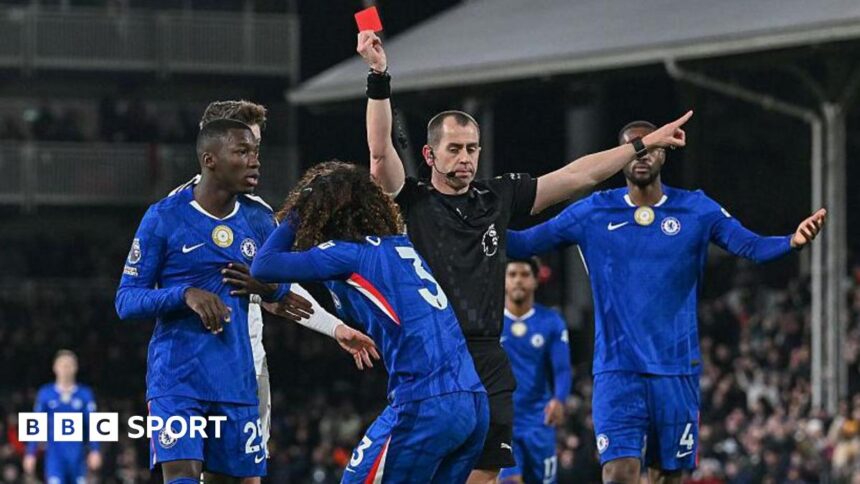
Ifab’s London Summit: Red Card Revolution, VAR Tweaks, and the Offside Debate Reignited
The beautiful game stands on the precipice of another significant evolution. As the International Football Association Board (Ifab) convenes its annual business meeting in London this week, the agenda is packed with proposals that could fundamentally alter the sport’s disciplinary landscape, refine its most contentious technology, and finally settle a long-running offside argument. The outcomes will set the template for the next FIFA World Cup and ripple through domestic leagues worldwide, making this gathering one of the most consequential in recent memory.
The Red Card Reckoning: A Harsher Stance on Denied Opportunities
At the heart of Tuesday’s discussions is a potential seismic shift in disciplinary protocol. Football’s lawmakers are poised to consider a significant expansion of the denial of an obvious goalscoring opportunity (DOGSO) law. The current framework, while clear, often leads to debates about proportionality—is a last-man foul on the edge of the box truly equivalent to a handball on the line? Ifab’s review suggests a move towards a more stringent interpretation.
Expert Analysis: “The principle is moving towards greater punishment for explicit, game-altering fouls that rob a team of a clear chance,” explains a former Premier League referee consulted for this article. “We’ve seen frustrations with players taking a ‘professional’ red card to stop a certain goal. Ifab seems to be asking: if the action is deliberate and kills a clear opportunity, shouldn’t the punishment be more consistently severe, regardless of the perpetrator’s position?”
This could manifest in several key changes:
- Red Cards for Penalty Box Offences: A player who deliberately handles the ball to stop a goal, or commits a cynical foul to deny a striker through on goal, could see a red card even if a penalty is awarded. This closes a perceived “loophole” where a penalty and a yellow card were deemed sufficient.
- Broader Definition of “Opportunity”: The interpretation of what constitutes an “obvious” chance may be widened, potentially encompassing situations further from goal or involving more defenders, if the foul is deemed intentionally destructive to the attack.
- Impact on Game Dynamics: Such a change would force defenders into a radical recalculation. The tactical foul, a staple of the modern game, would carry a far greater risk. This could lead to more open play as defenders hesitate, but also raises concerns about matches being spoiled by early dismissals.
Offside: “Daylight” Dimmed, But a New Clarity Emerges
One of the most anticipated items on the agenda, Arsène Wenger’s proposed “daylight” offside rule—where an attacker would be onside if any part of their body is level with the second-last defender—appears to have been shelved. While philosophically appealing for promoting attacking football, feedback from the football community highlighted a critical flaw: it unfairly disadvantages defenders and could lead to excessively stretched, chaotic games.
Instead, Ifab is expected to champion a different, more defense-friendly concept. The focus is shifting towards simplifying the current “margin of error” approach tied to VAR’s pixel lines. The new proposal likely involves a form of “thicker line” or tolerance zone.
Expert Analysis: “The ‘daylight’ rule was a solution to a problem, but it created a new one,” says a leading tactical analyst. “The emerging consensus is to give the benefit back to the attacker within a defined, measurable margin. Think of it as a ‘buffer’. If the lines are essentially touching or overlapping, the goal stands. It acknowledges the limitations of camera frame rates and human anatomy, reducing those infuriating offside calls where a player’s armpit is ahead of a knee.”
This represents a pragmatic middle ground. It aims to eliminate the microscopic decisions that have caused fan uproar, while maintaining the fundamental integrity of the offside law. The attacker gets a slight, quantifiable benefit, but defenders aren’t forced to hold a line five yards deeper to account for a “daylight” rule.
VAR Refinement and the Crackdown on Temporal Gamesmanship
No Ifab meeting is complete without a deep dive into the Video Assistant Referee. Expect continued refinement rather than revolution. Discussions will center on improving communication, streamlining the check process for subjective decisions like foul intensity in the buildup, and enhancing the in-stadium experience for fans.
Perhaps more impactful for the average viewer will be the parallel talks on goalkeeper tactical timeouts and time-wasting. The six-second rule for keepers holding the ball has been notoriously unenforced. Ifab is now seriously considering a more concrete, basketball-style approach: a goalkeeper possession time limit, after which a free-kick is awarded.
Furthermore, look for directives to encourage referees to more rigorously add time for goal celebrations, substitutions, and other stoppages—a continuation of the policy seen at the 2022 World Cup that led to historically long added times. This, combined with potential sin-bin trials in professional football (likely on the agenda for future discussion), signals a concerted war on delay tactics.
Predictions and The Global Game’s Trajectory
So, what can we expect to see on pitches next season? The DOGSO red card expansion has strong momentum; its philosophical alignment with punishing cynicism makes it a likely candidate for approval. The offside “tolerance zone” is also a probable winner, as it offers a tangible fix to a universally acknowledged problem without radically altering the game’s balance.
The goalkeeper time limit will face more debate—it’s a significant cultural change—but expect at least a trial or a very strict directive to enforce existing laws. VAR changes will be ongoing, but the public will likely notice a continued emphasis on quicker, clearer decisions.
The overarching theme of this Ifab meeting is clarity and consequence. The lawmakers are seeking to remove grey areas: grey areas in offside, grey areas in time-wasting, and grey areas in the punishment of game-killing fouls. They are moving towards a game where the laws are applied with more consistent rigidity, reducing the scope for “game management” by both players and officials.
Conclusion: A Game Recalibrated
The decisions made in London this week will not merely tweak the laws; they will recalibrate risk and reward on the football pitch. Defenders will carry a heavier burden of responsibility, attackers will operate with a sliver of extra freedom, and goalkeepers will have their routines scrutinized by the stopwatch. While Arsène Wenger’s “daylight” may have been extinguished, a new light is being shone on the game’s most contentious areas. The goal is undeniable: to foster a sport that is fairer, flows more freely, and rewards attacking intent, all while leveraging technology as a tool for precision rather than a source of paralysis. The 2024 Ifab summit may well be remembered as the moment football chose to become more decisive, both in its rules and in their application.
Source: Based on news from BBC Sport.