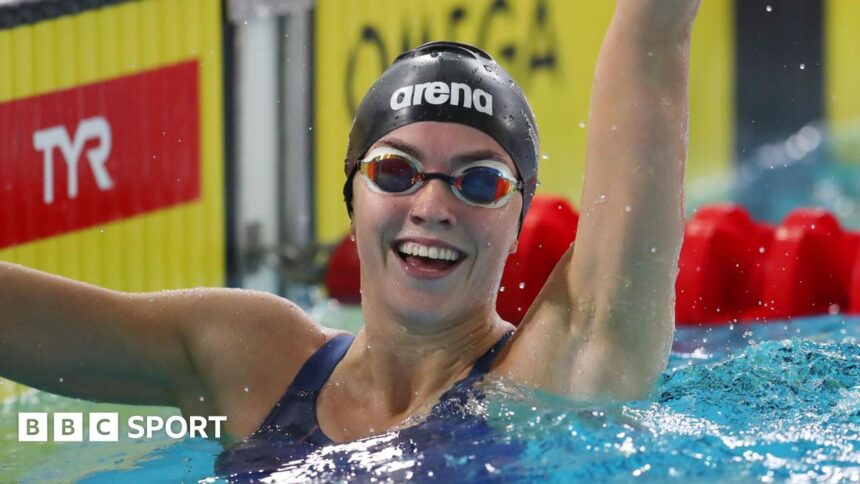
Emily Barclay Dives Into the Deep End: British Swimming Star Joins Controversial Enhanced Games
The landscape of elite sport is fracturing, and the latest crack has just widened with a splash. Emily Barclay, the British freestyle sprinter and 2019 World University Games bronze medallist, has plunged headfirst into the most contentious pool in athletics, becoming the latest high-profile UK athlete to sign for the Enhanced Games. Her decision to join an event that explicitly permits performance-enhancing drugs (PEDs) marks a pivotal moment, not just for her career, but for the escalating battle over the soul of sport itself.
From Razorback Pools to the Vegas Stage: Barclay’s Calculated Gamble
At 28, Emily Barclay is at a career crossroads familiar to many athletes. A winner of 50m freestyle gold at the 2019 British Championships, she honed her craft at the University of Arkansas, competing in the fiercely competitive NCAA system. Yet, like countless talented swimmers, she found herself on the periphery of Olympic glory. The Enhanced Games, with its inaugural competition slated for Las Vegas this May, presents a starkly different path. For Barclay, this isn’t merely a rebellion; it’s a strategic, if radical, career pivot.
“The traditional system has a ceiling, and for many, that ceiling is defined by genetics as much as graft,” notes Dr. Alistair Finch, a sports ethicist. “Barclay’s move is a cold, hard calculation. She’s exchanging the sanctified, but restrictive, arena of ‘clean’ sport for a platform where she can explore her absolute physical potential, unfettered by the World Anti-Doping Agency (WADA) code. It’s a trade of legacy for liberty, and potentially, significant financial reward.”
Barclay now joins a growing British contingent in the Enhanced Games camp, including sprint sensation Reece Prescod and Olympic medallist swimmer Ben Proud. This trend suggests a shifting mindset among a segment of elite athletes.
- Reece Prescod: The former world championship finalist brings explosive track credibility.
- Ben Proud: A world champion in the 50m freestyle, his involvement shocked the swimming establishment.
- Emily Barclay: Represents the cohort of supremely talented athletes just below the absolute pinnacle, seeking a new competitive outlet.
The Enhanced Games Ethos: Revolution or Ruination?
The Enhanced Games, brainchild of Australian entrepreneur Aron D’Souza, operates on a provocatively simple premise: remove the prohibition on PEDs, implement rigorous medical oversight, and let athletes push human limits without fear of sanction. Proponents argue it is a matter of honesty, safety through regulation, and scientific progress. Critics condemn it as a dangerous spectacle that undermines the integrity of sport and athlete health.
“The medical oversight argument is the Games’ most potent shield,” explains performance scientist Dr. Lena Sharma. “They claim to offer safer, monitored environments compared to the shadowy, unregulated doping that undoubtedly exists in mainstream sport. However, ‘regulated’ does not equal ‘safe.’ The long-term effects of pushing the body beyond its natural physiological limits with cocktails of powerful substances are largely uncharted territory. This is an uncontrolled experiment with elite athletes as the subjects.”
The Games also directly challenge the financial model of traditional sport. With promises of substantial prize money and a share of media rights, it appeals to athletes who feel undervalued by rigid amateurism codes and uneven sponsorship deals. For Barclay, whose post-university career path may have seemed limited, the economic incentive is undeniable.
Ripples Through the Sporting World: Predictions for Impact
The involvement of athletes like Barclay, Prescod, and Proud guarantees the Enhanced Games will not be a fringe circus. It will attract media glare and, crucially, viewer curiosity. The predictions for its impact are divisive:
Short-Term (2024-2025): The inaugural Las Vegas event will generate massive controversy and likely strong pay-per-view numbers. Records will be shattered, but they will come with an immediate and permanent asterisk in the public consciousness. Mainstream sports federations will circle the wagons, issuing strong condemnations and potentially lifetime bans for participants.
Mid-Term (2026-2028): The key battleground will be athlete recruitment. If the Games secure consistent funding and a steady stream of big names disillusioned with the Olympic model, they could establish a durable, parallel league. Sports like swimming and athletics, where times and distances are easily measured, are most vulnerable. We may see an era of dual careers: “clean” for traditional events, “enhanced” for this new circuit.
Long-Term (2030+): The greatest impact may be forcing a painful conversation within traditional sport. To stem the flow of talent, bodies like World Athletics and FINA may be pressured to increase prize money, relax some sponsorship rules, or even re-evaluate the status of certain substances. The Enhanced Games, ironically, could become the catalyst for reform in the very systems it seeks to disrupt.
A Line in the Sand or a New Frontier?
Emily Barclay’s dive into the Enhanced Games is more than a personal career choice; it is a symbol of a deepening schism. It forces uncomfortable questions about what we value in sport: Is it the inspiring narrative of human effort against natural odds, or the sheer, awe-inspiring spectacle of extreme performance? Can the ideals of fair play survive in an era of advanced biotechnology and growing athlete empowerment over their own bodies?
The Enhanced Games represents a fundamental challenge to a century of sporting philosophy. For athletes like Barclay, it offers agency, opportunity, and a form of brutal honesty. For the sporting tradition, it poses an existential threat wrapped in the guise of progress. As the starting gun fires in Las Vegas this May, the world will be watching not just to see how fast humans can swim or run when chemically unleashed, but to witness what version of sport’s future ultimately floats to the surface. The ripples from this splash will be felt for generations.
Source: Based on news from BBC Sport.