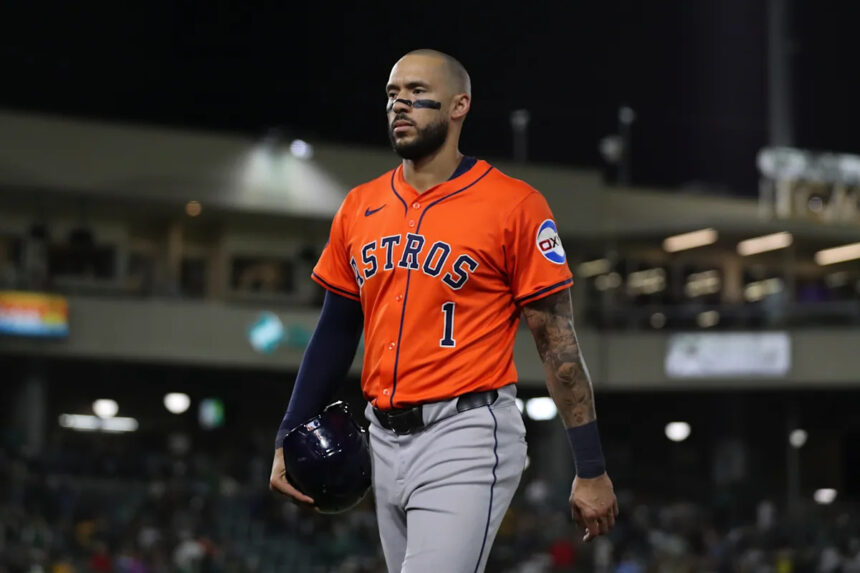
Houston’s Stars Grounded: How Insurance Issues Sideline Altuve and Correa from WBC
The crack of the bat, the roar of a multinational crowd, the pride of playing for one’s country—these are the hallmarks of the World Baseball Classic. For two of baseball’s biggest stars, however, those experiences have been replaced by the cold, hard calculus of risk management. Houston Astros teammates Jose Altuve and Carlos Correa will be conspicuously absent from the upcoming tournament, not due to injury or lack of desire, but because of a failure to secure insurance on their monumental contracts. This development sends a seismic wave through the baseball world, highlighting the escalating financial tensions between the sport’s premier international event and the gargantuan investments tied to its players.
The High-Stakes Dilemma: Protecting Millions on the Line
At its core, this is a story about unprecedented financial scale in Major League Baseball. Carlos Correa, the Minnesota Twins’ superstar shortstop and former Astro, is set to earn $31 million this season. Jose Altuve, the face of the Houston Astros, begins a new five-year, $125 million extension in 2025, with a $33 million salary for 2026. These aren’t just salaries; they are franchise-altering commitments. For players at this earnings tier, obtaining specialized insurance to cover the risk of a catastrophic injury in a non-MLB event is not a mere formality—it is an absolute necessity.
Correa’s candid comments to The Athletic cut to the heart of the frustration: “That’s too big of a risk to take, to play with no insurance.” He revealed the decision was finalized after a conversation with Astros owner Jim Crane, underscoring the organizational stake in the well-being of its cornerstone players, past and present. The mechanism is straightforward: insurers underwrite policies that would pay out the remaining value of a contract if a player suffers a career-ending or major injury during the WBC. When premiums become prohibitively high or insurers refuse to underwrite the policy altogether, the risk becomes untenable.
- Sky-High Premiums: Insurers calculate risk based on player history, contract value, and the event. For contracts approaching or exceeding $300 million in total value, the annual premium for WBC coverage can itself reach millions of dollars.
- Player History a Factor: A player’s injury history, like any pre-existing condition, can drastically increase the cost or lead to outright denial of coverage.
- The Organizational Voice: While player participation is voluntary, clubs wield significant influence. An owner like Jim Crane, who has over $60 million committed to these two players alone, has a vested interest in a cautious approach.
A Systemic Crack in the WBC Dream
The absence of Altuve (Venezuela) and Correa (Puerto Rico) is more than a roster shuffle; it exposes a critical vulnerability in the WBC’s growth trajectory. The tournament has successfully sold itself on the pinnacle of baseball talent, a true “World Cup” moment for the sport. Yet, as MLB contracts continue to inflate—driven by shortstops like Correa, Corey Seager, and Trea Turner signing deals worth over $300 million—the insurance infrastructure supporting the event is struggling to keep pace.
This creates a troubling paradox: the very players the WBC needs most to validate its prestige are the ones becoming increasingly difficult to insure. The tournament finds itself caught between its celebratory mission and the economic realities of modern baseball. For federations like Venezuela and Puerto Rico, losing a player of Altuve or Correa’s caliber is a devastating blow to their championship aspirations and diminishes the product on the field. The fan, hoping to see the best versus the best, is ultimately short-changed.
This isn’t the first insurance-related WBC withdrawal, but it is arguably the highest-profile dual exit. It raises urgent questions for the event’s organizers, MLB, and the MLB Players Association. Is a collective insurance pool feasible? Should the tournament or league help subsidize premiums for elite players? Without systemic solutions, the WBC risks becoming an event where participation is dictated as much by actuarial tables as by national pride.
Ripple Effects: Teams, Tournaments, and the Future
The immediate consequences are twofold. For the Astros and Twins, there is undeniable short-term benefit. Their franchise players will report to Spring Training on a routine schedule, avoiding the accelerated ramp-up and potential fatigue or injury risk of the WBC. Altuve and Correa will have a full, controlled preparation for the grueling 162-game MLB season, a silver lining for their employers.
For the players themselves, the emotional toll is real. Correa spoke of being “definitely upset” after a dedicated offseason preparing for early readiness. Altuve, a veteran leader for Venezuela, loses a chance to captain his national team on a global stage. This professional disappointment can have motivational nuances; some players might channel the frustration into a scorching start to the MLB season, while others could carry a lingering sense of missed opportunity.
Looking ahead, this incident sets a concerning precedent. As the next generation of stars signs ever-larger contracts, will the WBC withdrawal list only grow? The tournament’s success hinges on star power. If the brightest stars are consistently shielded by their financial constellations, the event’s luminosity fades. The 2026 World Baseball Classic is already on the horizon, and these issues demand resolution before then. The model may require reinvention, perhaps with more robust central funding or revised tournament timing, to align with the sport’s economic ecosystem.
Conclusion: A Crossroads for Baseball’s Global Showcase
The sidelining of Jose Altuve and Carlos Correa from the World Baseball Classic is a watershed moment. It is not a simple story of player choice but a complex collision of soaring athlete wealth, cold financial logistics, and sporting passion. It reveals that the tournament’s greatest challenge may no longer be logistical coordination or fan interest, but rather the unintended consequences of the sport’s own economic boom.
While Astros and Twins fans may quietly appreciate the added security for their stars, the broader game suffers. The WBC is designed to be baseball’s grand, unifying festival. For it to truly fulfill that promise, it must ensure that the flags worn on the chest are not overshadowed by the dollar figures on the contract. Finding a way to insure the dreams of players and nations against the risks of the game is the next crucial inning for the World Baseball Classic’s future. The final score of this off-field battle will determine whether the tournament can truly field a roster of all the world’s best, or if its highest-paid talents will forever be watching from the dugout.
Source: Based on news from Yahoo Sports.