Carlos Alcaraz’s Roof Rumble: A Pivotal Protest in the Australian Open Crucible
The Australian Open final is tennis’s ultimate pressure cooker, a stage where legacies are forged in the searing Melbourne heat. But in a seismic 2024 final, a different element intruded upon the epic battle between Novak Djokovic and Carlos Alcaraz: the mechanical whirr of Rod Laver Arena’s retractable roof. What unfolded was a high-stakes drama of sport, psychology, and environmental control, as a frustrated Carlos Alcaraz engaged in a mid-match dispute with tournament officials, creating a controversy that may well have altered the trajectory of the championship.
The Crucible Closes: A Tactical Tipping Point
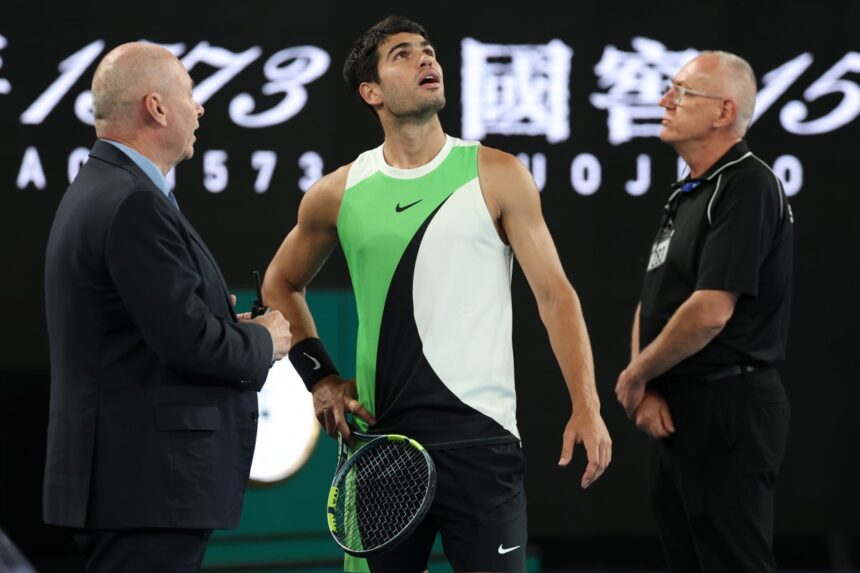
After a dominant first-set display from Djokovic (6-2), Alcaraz mounted a ferocious response, levelling the match with a commanding 6-2 set of his own. The momentum had violently swung. Djokovic, seeking respite, executed a strategic bathroom break. It was during this interlude that the Australian Open organisers, with rain threatening, made the fateful decision to further close the roof, though not completely. Upon returning, Alcaraz was visibly agitated. He approached umpire John Blom and then tournament referee Wayne McKewen, his gestures animated, his complaint clear. The roof closure decision had become an unexpected third player in the final.
This was no minor grumble. For Alcaraz, the change transformed the essential nature of the contest. The shift from open-air conditions to a more enclosed environment has profound tactical implications:
- Ball Speed and Bounce: A closed roof eliminates wind, leading to truer ball flight but also a heavier, slower-playing court. The ball fluffs up, favoring consistent, powerful groundstrokes over unpredictable creativity.
- Humidity and Physicality: Air circulation changes, often increasing humidity, which can affect ball swing and player stamina, making conditions more physically grueling.
- Acoustic Atmosphere: Sound becomes trapped, amplifying crowd noise and creating a more intense, cacophonous arena that can heighten pressure.
Alcaraz, a player whose genius is built on explosive, whip-like power and daring drop shots, thrives in faster, livelier conditions. Djokovic, the master of precision, robotic consistency, and flawless equilibrium, is arguably the greatest indoor player in history. The partial roof closure subtly tilted the chessboard in the Serb’s favor.
Expert Analysis: Psychology, Precedent, and the Pursuit of Edge
From a sporting psychology perspective, Alcaraz’s protest was a double-edged sword. On one hand, it risked appearing like a distraction, a loss of focus on the monumental task of dethroning a king on his most sacred court. On the other, it was a clear signal of his ferocious competitive fire—a willingness to fight for every conceivable advantage, even against tournament decree.
“This wasn’t just about air conditioning,” notes veteran tennis analyst Clara Bennett. “This was a young champion, in the flow of his first Australian Open final, feeling the ecosystem of the match change as he was gathering momentum. He perceived it as an interruption to his rhythm. The question for Novak Djokovic was whether this emotional expenditure from Alcaraz would be a crack he could exploit.”
History is littered with similar disputes. From Stefanos Tsitsipas’s infamous bathroom breaks to Serena Williams’s code violation controversies, grand slam finals often turn on mental as much as physical hinges. Djokovic, a master of leveraging such moments, retreated to regroup. Alcaraz, meanwhile, was left to plead his case. The dynamic was telling: one player manipulating the rules, the other contesting them.
The umpire John Blom and referee Wayne McKewen were bound by a strict protocol. Player preference cannot override safety and scheduling. With rain imminent, their decision was, by the book, correct. Yet, the ambiguity of a “partially” closed roof left room for debate. Did it create an inconsistent hybrid condition? For a player of Alcaraz’s sensitivity, the answer was a resounding yes.
The Aftermath and Future Predictions: A Rivalry Redefined
While Djokovic ultimately prevailed in four sets to claim his historic 25th major, the roof closure controversy will linger as a pivotal “what if.” Did it disrupt Alcaraz’s hard-won momentum? Did it provide Djokovic the perfect, conditions-based reset he needed? The statistics showed a dip in Alcaraz’s winner count and an increase in unforced errors in the third set, as Djokovic reasserted control with clinical precision.
This incident, however, does more than color a single match. It adds a fascinating new layer to the sport’s premier rivalry. We can predict several consequences:
- Strategic Scrutiny: Future matches between these two, especially at slams with retractable roofs (Wimbledon, US Open, Australian Open), will be preceded by intense analysis of weather forecasts and tactical preferences.
- Alcaraz’s Advocacy: The young Spaniard has shown he will not suffer perceived injustices quietly. His team will likely become more vocal in pre-match discussions with officials about conditions.
- Mental Fortitude Test: How Alcaraz processes and moves on from this will define his growth. Will it become a thorn of resentment or a lesson in adapting to all variables?
- Rulebook Review: The ATP and Grand Slam committees may face pressure to clarify protocols for partial roof closures, ensuring minimal disruption during live play.
Conclusion: More Than Just a Roof
The 2024 Australian Open final will be remembered for Novak Djokovic’s relentless pursuit of history. But etched alongside that achievement is the image of Carlos Alcaraz, fists not raised in victory but gesturing in frustration at the steel rafters above. This was not a sore loser’s complaint; it was the raw reaction of a competitor who felt the fundamental terms of a title fight shift at a critical juncture.
The seismic Australian Open final proved that modern tennis battles are fought on multiple fronts: the baseline, the mind, and now, the very environment contained by architecture. Alcaraz’s protest highlighted the relentless pursuit of the finest edge in a sport where milliseconds and millimeters matter. While the roof may have closed partially on Rod Laver Arena, it has blown wide open a new chapter in this epic rivalry—one where conditions, control, and controversy will be as fiercely contested as every break point. The match confirmed Djokovic’s enduring supremacy, but it also announced Alcaraz’s arrival as a sovereign force, unafraid to challenge the establishment, even from the losing side of the net.
Source: Based on news from Yahoo Sports.