NFL Under Scrutiny: Goodell’s Cautious Stance on Giants’ Tisch and Epstein Emails
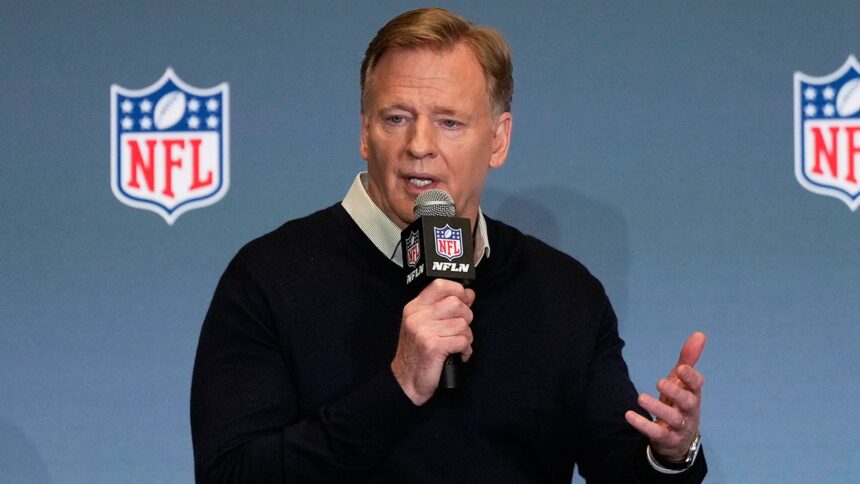
The spectacle of Super Bowl week is a finely tuned machine of football, celebrity, and corporate synergy. Yet, this year in Las Vegas, a shadow from beyond the gridiron pierced the glow of the NFL’s marquee event. At his annual pre-Super Bowl press conference, Commissioner Roger Goodell, typically fielding questions about officiating and international expansion, found himself addressing a far more sinister topic: the connection between a team owner and the late convicted sex offender Jeffrey Epstein.
A Press Conference Interrupted by a Dark Cloud
As reported by Fox News correspondent David Spunt, the latest document release from the Department of Justice related to the Epstein case has rippled into the world of professional sports. The focus landed on Steve Tisch, the co-owner and chairman of the New York Giants. Correspondence between Tisch and Epstein, detailed in the filings, prompted direct questions to Goodell about potential league investigation and discipline. The moment underscored the NFL’s ongoing challenge of managing off-field controversies that threaten its meticulously crafted image.
Goodell’s response was a masterclass in procedural caution. He did not dismiss the issue, nor did he launch into a defensive posture. Instead, he offered a measured, fact-first approach. “Absolutely, we are going to look at all the facts,” Goodell stated. “We are going to look at all the context of those. We’re going to try to understand that and we’ll look at how that falls under the policy. I think we take one step at a time. Let’s get to facts first.” This stance, while prudent legally, places the league in a holding pattern fraught with public relations peril.
Decoding Goodell’s “Facts First” Strategy: Risk and Reward
Goodell’s “facts first” mantra is a deliberate strategy with multiple layers. For the league office, it serves several critical functions:
- Legal Prudence: Rushing to judgment or punishment without complete information could expose the NFL to legal action from Tisch, a powerful and influential owner.
- Policy Navigation: The league’s Personal Conduct Policy applies broadly to owners, employees, and players. Determining how correspondence, without formal charges or convictions, fits into this policy is a complex, uncharted task.
- Institutional Protection: A slow, deliberate process allows the league to gauge public sentiment, media cycles, and the findings of official investigations before committing to a course of action.
However, this strategy is not without significant risk. In the court of public opinion, a slow response can be interpreted as indifference or, worse, protection of the powerful. The Epstein case is uniquely toxic, synonymous with the abuse of power and privilege. Any perceived foot-dragging by the NFL could lead to accusations that the league’s moral compass is subordinate to its financial and ownership loyalties. The question becomes: how long can the league afford to wait for “all the facts” in a case where the central figure is deceased and the full truth may never be fully known?
The Unprecedented Test of the Owner-Governance Model
This situation probes the very foundation of the NFL’s power structure. Goodell is an employee of the 32 team owners. While he wields immense authority over players, coaches, and personnel, disciplining an owner—particularly one from a flagship franchise like the Giants—is an entirely different matter. The Tisch family is embedded in the fabric of the league; Steve Tisch is not just an owner, but the chairman of a storied franchise.
This presents a historic challenge for Goodell’s leadership. The commissioner has levied unprecedented punishments against players for conduct detrimental to the league. Now, he faces a scenario where the same standard must be applied upward, to the boardroom. The league’s credibility on issues of integrity and accountability hinges on this being a consistent standard. Failure to act, or action perceived as too lenient, would shatter the illusion of equitable enforcement and invite scrutiny of every future disciplinary decision.
Key factors the NFL will likely consider include:
- The nature and content of the correspondence: Were they innocuous logistical emails, or do they suggest a deeper, more knowing association?
- Tisch’s own public statements and cooperation with any investigations.
- The potential for ongoing reputational damage to the Giants and the NFL brand.
- Precedent, though scarce, from other professional sports leagues.
Predictions and Potential Outcomes for the League and Giants
Based on Goodell’s history and the NFL’s modus operandi, we can forecast several potential paths forward. The league will almost certainly conduct a quiet, internal review, likely with the help of external counsel. This review will proceed parallel to any federal or civil proceedings related to the Epstein documents.
The most probable outcomes fall into a narrow range:
- Private Reprimand and Quiet Resolution: If the emails are deemed tangential and Tisch fully cooperates, the league may issue a fine or mandatory donation to a related cause, keeping the details private. This is the cleanest, least disruptive outcome for the NFL.
- Public Discipline and a Cloud Over the Giants: If the correspondence reveals more troubling context, the league may feel compelled to issue a public suspension or a significant fine. This would be a seismic event, signaling that no one is above the policy, but would also create a prolonged, ugly storyline for the Giants organization.
- A Protected Legal Standoff: Should Tisch resist any league pressure, this could escalate into a bitter, behind-closed-doors battle among ownership factions, testing Goodell’s authority and the unity of the owners in an unprecedented way.
Regardless of the outcome, the New York Giants brand is now tangentially linked to a global scandal. The team, a pillar of the NFL, must now navigate sponsorship questions, fan sentiment, and a media spotlight that extends far beyond football.
Conclusion: A Defining Moment for the Shield
Roger Goodell’s press conference in Las Vegas was meant to be a celebration of the NFL’s greatest achievement. Instead, it became a stark reminder that the league does not operate in a vacuum. The Epstein documents have touched corners of elite society worldwide, and the NFL, as a cultural and financial titan, is not immune.
Goodell’s initial “facts first” approach is a safe opening gambit, but it is only the beginning. How he and the league’s ownership committee proceed will define the NFL’s moral authority for years to come. This is no longer just about Steve Tisch’s emails; it is a defining test of the NFL’s integrity. The world is watching to see if the league’s famed shield protects the game, or merely the powerful men who run it. The answer will resonate far longer than the final score of any Super Bowl.
Source: Based on news from Fox Sports.