Dust Settles, Drama Begins: The Unfinished Symphony of Milano Santagiulia’s Olympic Debut
The air inside the Milano Santagiulia Ice Hockey Arena was crisp, charged with the electric buzz of a near-capacity crowd and the sharp scent of fresh paint. Just five days earlier, that same air was thick with construction dust and frantic urgency. The opening of this 11,800-seat venue for the Milan-Cortina 2026 Winter Olympics was not a grand, polished unveiling, but a gritty, last-minute touchdown—a testament to the chaotic, passionate, and often messy reality of bringing the Games to life. This arena, one of two brand-new builds for 2026, stands as a powerful symbol: Olympic delivery is never just about the finish line, but the breathless race to cross it.
A Race Against the Clock: From Hard Hat Zone to Hockey Zone
To understand the significance of the arena’s opening whistle, one must rewind to the scene just days before. On the preceding Saturday, the venue was a symphony of construction chaos. Outside, barriers and machinery littered the approach. Inside, workers scrambled over unfinished surfaces; building materials were stacked in corners, and a fine layer of dust coated every surface. The notion that elite Olympic competition could occur here in under a week seemed, to the outside observer, implausible.
Yet, the frantic construction site transformed with astonishing speed. By Thursday, the essential core was operational. The ice sheet was pristine, the boards secure, and the essential lighting and scoreboards functional. The International Olympic Committee (IOC) candidly admitted the venue was not “completely ready,” a rare public acknowledgment of the behind-the-scenes scramble. Missing were the final aesthetic touches—some cladding, perfected signage, the full suite of hospitality fittings. But the skeleton was solid, and the heart—the ice—was beating perfectly. This last-minute building works miracle is a classic, if stressful, Olympic tradition, where deadlines are absolute and flexibility is the most valuable currency.
Vibrant Life in a “Dirty” Shell: The Italian Job
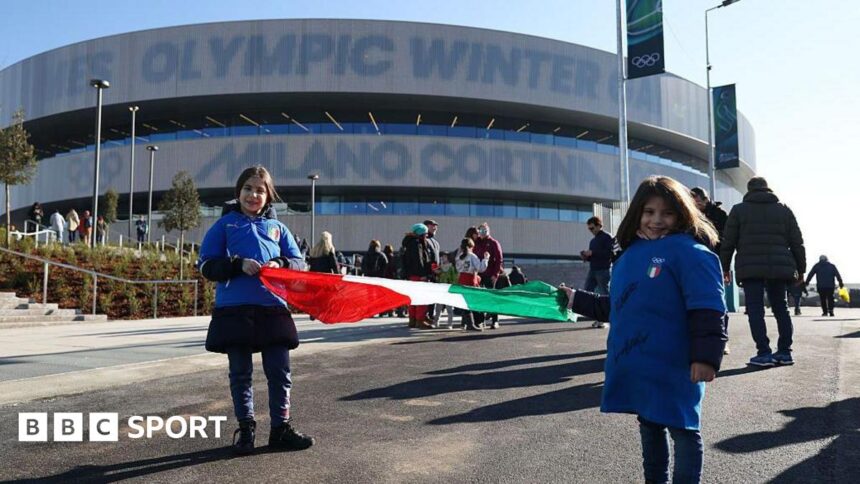
Any concerns about atmosphere evaporating like morning frost were put to rest the moment the Italian team hit the ice. The arena, nearly full for the Group B match between hosts Italy and Olympic debutants France, was a cauldron of noise. The unfinished elements faded into the background, overshadowed by a sea of azure flags and roaring chants. This was the ultimate validation: a venue’s soul is not installed by contractors, but summoned by fans.
The 4-1 victory for the host nation was the perfect narrative catalyst. It transformed the building from a construction project into a cathedral of national pride. The vibrations from the stands, the cheers echoing off the bare concrete, the collective gasp at near misses—these elements completed the construction. The arena, in its partially finished state, proved a crucial point: fan engagement and athletic spectacle can transcend physical imperfections. The passion of the event papered over any remaining cracks, literally and figuratively.
Expert Analysis: The High-Stakes Game of Olympic Logistics
From a logistical and sporting perspective, the saga of Santagiulia is a masterclass in risk management and priority-setting. Experts understand that Olympic delivery operates on a “critical path.” The focus in the final days is not on luxury, but on non-negotiable operational readiness.
- Ice Integrity and Player Safety: This is the absolute priority. The refrigeration system, ice thickness, board rigidity, and glass safety were undoubtedly signed off long before the paint dried on the concourse walls.
- Spectator Safety and Flow: Functional ticketing, security screening, basic concessions, and, most importantly, clear ingress and egress routes are legally mandated and meticulously planned.
- Broadcast Essentials: The world must see the event. Power, camera positions, fiber-optic cables for transmission, and basic lighting are essential infrastructure that cannot fail.
- The “Nice-to-Haves”: The aesthetic finishes, sponsor lounges, and secondary amenities sit lower on this list. They enhance the experience but do not stop the game from being played.
The International Olympic Committee’s public acknowledgment was a strategic move—managing expectations while praising the operational success. It reflects a modern IOC more willing to show the sweat behind the spectacle, understanding that authenticity can be as compelling as perfection.
Predictions: A Legacy Forged in Ice
The true test of any Olympic venue is not its opening day, but its “day after.” The rushed completion of Santagiulia raises valid questions, but also presents unique opportunities for its post-Games legacy.
First, the momentum from a successful Olympic tournament, especially with a passionate home team, creates immediate emotional equity. The memories forged in this “unfinished” arena will make it a beloved landmark for Italian sport. Predictions for its future use are strong:
- Hub for Italian Ice Hockey: It will instantly become the home of the national team and a potential regular season venue for elite club hockey, galvanizing the sport’s growth.
- Multi-Purpose Event Center: Designed for flexibility, the arena is poised to host major concerts, family shows, and other sporting events, ensuring year-round vitality.
- A Story to Tell: Ironically, its chaotic origin story becomes part of its charm. It will be remembered as the arena that came together against the odds, a symbol of Milan’s “can-do” hustle.
The delays and concerns during construction will likely be forgotten, replaced by the legacy of the events held within. The focus will shift from the race to build it, to the races won on its ice.
Conclusion: Perfection in the Imperfect
The Milano Santagiulia Ice Hockey Arena did not open with a whisper, but with a roar—both of machinery and of crowds. Its journey from dusty construction zone to vibrant Olympic stage encapsulates the raw, human endeavor behind the sleek facade of the Games. It is a reminder that the Olympics are not a static exhibition, but a living, breathing, and sometimes messy project of collective will.
In the end, the Olympic debutants France may have lost the game, and the builders may have lost sleep, but the city of Milan won a crucial victory. They demonstrated that readiness is a spectrum, and that the spirit of competition can flourish even amidst the scent of wet paint. As the 2026 Games approach, Santagiulia stands not as a cautionary tale, but as a powerful, dirty, and vibrant promise: the show will go on. It always does. The final buzzer on its construction saga has sounded, and the legacy play has just begun.
Source: Based on news from BBC Sport.