


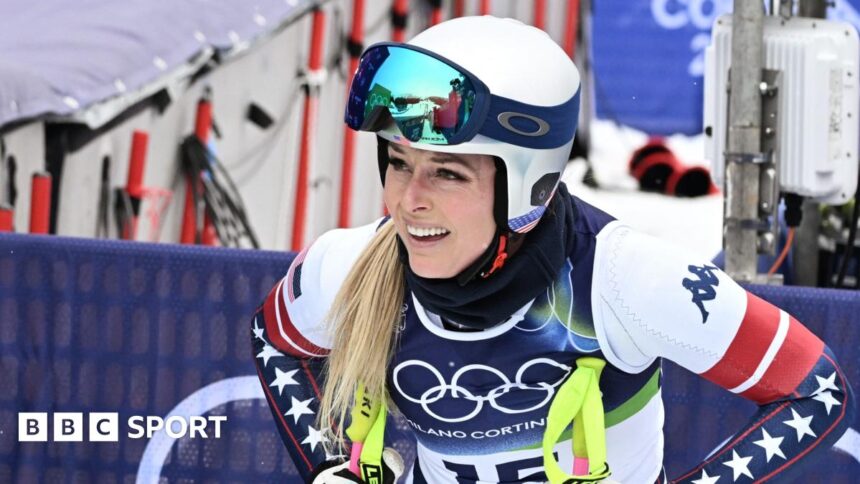
Lindsey Vonn’s Defiant Stand: Disputing the Diagnosis on the Eve of Olympic Glory
The world of alpine skiing is no stranger to drama, but rarely does it unfold in the stark, binary language of medical opinion versus athlete’s truth. As the Winter Games approach, all eyes are on the legendary Lindsey Vonn, not just for her quest for gold, but for a compelling public dispute that cuts to the very heart of athletic resilience. Just one week after a harrowing crash in Switzerland that saw her airlifted from the slope, Vonn has stunned the world by completing two blistering training runs in Cortina. Yet, it is her fierce rebuttal to a doctor’s analysis of her knee injury that has ignited a firestorm of speculation and admiration, framing a narrative of defiance that could define her final Olympic chapter.
The Crash, The Comeback, and The Controversial Claim
The sequence of events reads like a screenplay. During a World Cup downhill training run in St. Moritz, Vonn, the most successful female skier of all time, lost control on a treacherous turn. The result was a catastrophic knee injury, diagnosed as a ruptured anterior cruciate ligament (ACL)—an injury that typically spells the end of a season, if not a career. The images were alarming, the prognosis assumed to be grim for her Olympic ambitions.
Defying every conventional timeline, Vonn was on the snow at the Olimpia delle Tofane course just days later. In weather-disrupted sessions, she didn’t just participate; she dominated, clocking the third-fastest time in a recent training run. This superhuman recovery prompted sports medicine specialist Dr. Brian Sutterer to analyze her crash video publicly. In a social media post that caught Vonn’s attention, he posited a theory: the ACL rupture in Switzerland might not have been a “fresh tear,” suggesting Vonn could have already been competing on a compromised ligament for some time.
Vonn’s response was swift, unequivocal, and dripping with the grit that has defined her career. She asserted that her ACL was not partially torn, but “100% gone,” directly contradicting the implication of a pre-existing condition. This isn’t mere medical semantics; it’s a fundamental clash of narratives about the nature of her pain, her recovery, and her almost mythical capacity to endure.
Expert Analysis: The Anatomy of Defiance
To understand the gravity of this dispute, one must understand the ACL. The anterior cruciate ligament is a critical stabilizer in the knee, especially for skiers who subject it to enormous, multi-directional forces. A complete rupture is a profound structural failure.
- “Fresh Tear” vs. “Chronic Deficiency”: Dr. Sutterer’s hypothesis hinges on a known phenomenon. Athletes can sometimes suffer a “partial tear” or have a ligament so stretched it provides little stability, a condition known as ligamentous laxity. They may learn to compensate with immense muscle strength and proprioception—the body’s sense of its position in space. A subsequent crash then becomes the “final straw” that fully severs it. This scenario can sometimes lead to a less inflamed, quicker return to function, as the body isn’t reacting to a brand-new traumatic event.
- Vonn’s Reality: “100% Gone”: Vonn’s counter-claim is one of total, acute trauma. A full, fresh rupture typically involves significant swelling, intense pain, and major instability. Her ability to ski through this, experts suggest, speaks to two factors: extraordinary pain tolerance and a pre-habilitated body. Vonn’s history—including multiple knee surgeries—means her supporting musculature is arguably among the most robust in sports history. Her brain and muscles may be creating a “pseudo-stability” that bypasses the missing ligament, albeit at high risk.
- The Role of Adrenaline and Mindset: Never underestimate the psychological. For an athlete of Vonn’s caliber, the Olympic stage is a powerful analgesic. The adrenaline of competition, coupled with a lifetime of compartmentalizing pain, can allow for performances that seem medically inexplicable. She is not skiing on a healthy knee; she is skiing in spite of it, using technique, will, and memory to navigate a course at 80+ mph.
What This Means for Cortina: Predictions for the Downhill
Vonn’s training times prove she is a legitimate threat for a medal, a notion that seemed impossible two weeks ago. However, the dispute with the doctor’s claim outlines the extreme risks and variables at play.
The Case for a Podium: Vonn’s vast experience on this course and her unmatched downhill IQ give her a massive advantage. If conditions are hard and icy, favoring technicians over pure gliders, her skill can offset any physical deficit. Furthermore, her mental fortitude is now the stuff of legend, potentially intimidating competitors who know she is operating on sheer will. She isn’t just racing the clock; she’s racing a narrative, a powerful motivator.
The Inherent Risks: Every turn is a gamble. Without an ACL, the knee’s vulnerability to sudden, uncontrolled shifts is exponentially higher. Fatigue becomes a critical factor; the compensating muscles may tire, leading to a catastrophic loss of stability in the final, demanding sections of the course. The margin for error is zero. While a “chronic” knee might be more predictable in its failure, a freshly ruptured one is an unpredictable partner.
Ultimately, her performance will be the final argument in the medical debate. A clean, powerful run may lend credence to the idea of a pre-existing adaptation. A struggle or reinjury would tragically affirm the acute severity of the Swiss crash.
Conclusion: More Than a Medal, A Testament to Will
Lindsey Vonn’s public dispute over the state of her knee is more than a medical disagreement. It is a profound statement of ownership. In asserting her bodily truth against an external analysis, she is reclaiming the narrative of her own career’s finale. Whether the ligament was freshly torn in Switzerland or finally gave way after a long battle is, in many ways, secondary to the astonishing reality she has created: she is on the start gate.
This episode encapsulates the essence of elite sport—the blurry line between medical science and human spirit. Doctors read MRIs and kinematics; athletes read courses and write legacies. Vonn is doing both, under the brightest lights. As she pushes out of the start house for the Olympic downhill, she carries not just the hopes of a nation, but the weight of a defiant truth: her knee may be broken, but her will, unequivocally, is not. Her final Olympic chapter is no longer just about gold; it’s a raw, compelling lesson in the power of refusing to be defined by a diagnosis, a crash, or even a doctor’s claim.
Source: Based on news from BBC Sport.


