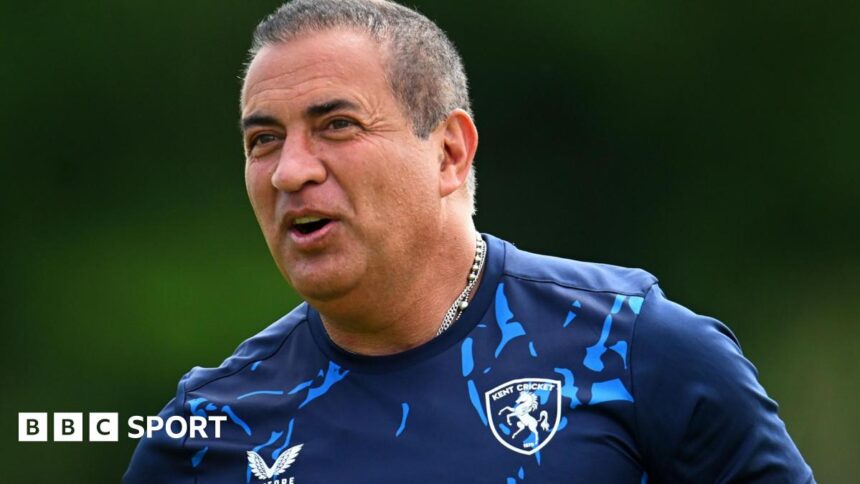
Kent’s Digital Mute Button: Why Adam Hollioake’s “Duty of Care” is a Radical, Necessary Gamble
In the high-stakes world of professional cricket, the line between passionate fandom and toxic vitriol has never been thinner. As social media algorithms amplify anger faster than applause, one of England’s most historic counties has decided to step off the digital treadmill. Kent Cricket has taken the unprecedented step of disabling comment functions across their official social media channels, a move framed not as censorship, but as a “duty of care” to their players.
The decision, announced ahead of a pivotal home clash against Derbyshire, lands like a thunderbolt in the county’s current storm. Under the stewardship of new head coach Adam Hollioake, Kent are a team in crisis. Relegated from Division One in 2024, they finished rock bottom of Division Two in 2025, and as of this week, they are winless in three Championship matches to start the 2026 season, languishing once again at the foot of the second tier.
This is not a PR stunt. This is a survival mechanism. And as a long-time observer of the county circuit, I can tell you: it might just be the smartest play Hollioake has made since taking the reins in December 2024.
The Anatomy of a Crisis: Why Kent hit the Mute Button
To understand the severity of this move, you have to understand the weight of the results. Kent’s decline has been precipitous. From a proud club with a rich heritage to a side that has lost its competitive edge, the numbers are brutal. In 2024, they were outclassed in Division One. In 2025, under a new coach, they failed to bounce back, finishing dead last in Division Two. Now, in 2026, the rot has not stopped.
Adam Hollioake, a former England international and a man known for his no-nonsense, aggressive leadership style, walked into a rebuild project that was already crumbling. He inherited a squad low on confidence, a fractured fanbase, and a social media environment that had become a digital firing squad.
The tipping point? It rarely is one specific post. It is the relentless accumulation of negativity. Every dropped catch, every batting collapse, every loss is met with a flood of comments that range from legitimate criticism to outright abuse. For a young professional athlete, scrolling through a feed after a defeat is no longer a distraction—it is a psychological hazard.
Hollioake’s statement was clear: “This has not been a decision we have taken lightly and we are by no means stopping people voicing their opinions.” He is right. The debate will rage on in forums, in pubs, and on independent fan pages. But the official club channels will no longer be a conduit for that anger.
The “Duty of Care” vs. The Right to Roast
Critics will argue that this is a soft move. That professional athletes are paid handsomely to perform, and that the public has a right to critique. But there is a fundamental difference between critique and abuse. The comment sections of county cricket clubs have, in recent years, become breeding grounds for the latter.
- Performance Anxiety: Players are already under immense pressure. Seeing “You’re not good enough” directly on a club post can shatter fragile confidence.
- Mental Health Toll: The ECB has invested heavily in mental health support. This move is a direct extension of that investment.
- Team Cohesion: A unified squad is hard to build when every player knows the digital mob is waiting for their next mistake.
By disabling comments, Kent are not silencing the fanbase. They are insulating the players. This is a protective measure, not a muzzle. The club is saying: “We hear you, but our primary responsibility is to the human beings wearing the shirt.”
This is a radical shift in modern sports governance. Most clubs are terrified of losing engagement metrics. Comments equal clicks, clicks equal revenue. But Kent have prioritized humanity over engagement. It is a statement that will be watched closely by every other struggling club in the country.
Adam Hollioake: The Architect of a New Culture
Adam Hollioake is not a man who shies away from a fight. As a player, he captained Surrey to multiple titles with an abrasive, win-at-all-costs attitude. As a coach, he has brought that same intensity to Canterbury. But he also understands the modern athlete. He knows that the old-school “sticks and stones” mentality is dead.
When he took over in December 2024, he promised a reset. He promised to build a team that played with “fearless intent.” Fifteen months later, the results have not materialized. But this social media shutdown suggests he is playing a longer game. He is trying to rebuild the internal environment before he can fix the external results.
Think of it this way: You cannot ask a batsman to play with freedom if he is terrified of the backlash after getting out for a duck. You cannot ask a bowler to try a new variation if he knows the internet will crucify him for a boundary. Psychological safety is the bedrock of elite performance, and Hollioake is building that bedrock, brick by digital brick.
“This is a step to protect the mental well-being of our players,” Hollioake stated. “They are young men learning their craft. They need space to fail and learn.”
His prediction? A slow, painful climb. The results against Derbyshire this Friday will not suddenly turn around because the comments are off. But the culture might. And culture eats strategy for breakfast.
Expert Analysis: The Risk vs. The Reward
From a journalistic perspective, this is a double-edged sword. On one hand, it is a masterstroke of crisis management. It removes the immediate flashpoint of online abuse. It shows the players that the club has their back. It buys the coaching staff time.
On the other hand, it risks alienating the very fans who pay the bills. Kent’s attendances have not been stellar. The club relies on a passionate, vocal local following. By closing the digital door, they risk creating a “them vs. us” dynamic between the squad and the supporters.
But here is the key: the fans who are angry enough to post abusive comments are not the fans who are buying season tickets. The silent majority—the families, the pensioners, the kids—just want to see the team win. They don’t need to tag a player in a nasty tweet.
My prediction is that this move will have a short-term negative effect on engagement metrics but a long-term positive effect on player retention and performance. If Kent can scrape a win against Derbyshire—a team they historically struggle against—the narrative will shift from “they muted us” to “they protected the players.”
The Bigger Picture: A Blueprint for Other Clubs?
Kent are not the first sports organization to take this step. Some Premier League football clubs have restricted comments on certain posts. But for a county cricket club, this is uncharted territory. It is a bellwether moment for the sport.
County cricket is a brutal ecosystem. The season is long, the margins are fine, and the scrutiny is intense. Young players are often thrown into the deep end with minimal support. Social media amplifies every failure. By disabling comments, Kent are essentially saying: “We will not be a platform for your anger.”
This could set a dangerous precedent. If every club does it, it could homogenize the fan experience. But if it works—if Kent’s players start performing with more freedom and less fear—it will be copied faster than a Joe Root cover drive.
The ECB will be watching. They have struggled to police online abuse in the professional game. This is a club-led solution that doesn’t require legislation. It is simple, effective, and proactive.
What This Means for Derbyshire and the Season Ahead
Kent face Derbyshire on Friday in a match that feels like a season-defining moment. Another loss would put them in a relegation dogfight that nobody predicted. But with the social media noise turned down, the players have a unique opportunity.
They can focus entirely on the cricket. No need to avoid their phones after a bad session. No need to read the hot takes. Just bat, bowl, and field. Adam Hollioake has effectively created a pressure-free bubble within a high-pressure environment.
Will it work? My gut says yes—but not immediately. Expect Kent to show more fight, more intent. They might still lose because the technical flaws are deep. But the mental errors—the soft dismissals, the dropped catches born of anxiety—should decrease.
Look for a stronger bowling performance from their seam attack. Look for a more resilient batting display. The result might not change overnight, but the process will. And in a long season, process wins.
Conclusion: The Mute Button is a Power Move
In the annals of cricket history, this will not be remembered as a great tactical innovation or a legendary innings. But it should be remembered as a moment of leadership. Adam Hollioake and Kent County Cricket Club have chosen to protect their people over their platform.
Social media is a tool. For too long, clubs have let it control the narrative, control the mood, and control the players. Kent have taken back control. They have said: “We will communicate with you. We will listen. But we will not let you abuse our players on our own channels.”
This is not a sign of weakness. It is a sign of intelligent, modern management. The results on the pitch will ultimately decide if this gamble pays off. But in the court of public opinion, and more importantly, in the dressing room, this move has already won.
Kent are bottom of the table. They are winless. But for the first time in months, they are united. And that, in the brutal world of county cricket, is the only currency that matters.
Prediction for Friday: Kent to draw with Derbyshire in a hard-fought contest. The first step on a long road back to respectability.
Source: Based on news from BBC Sport.