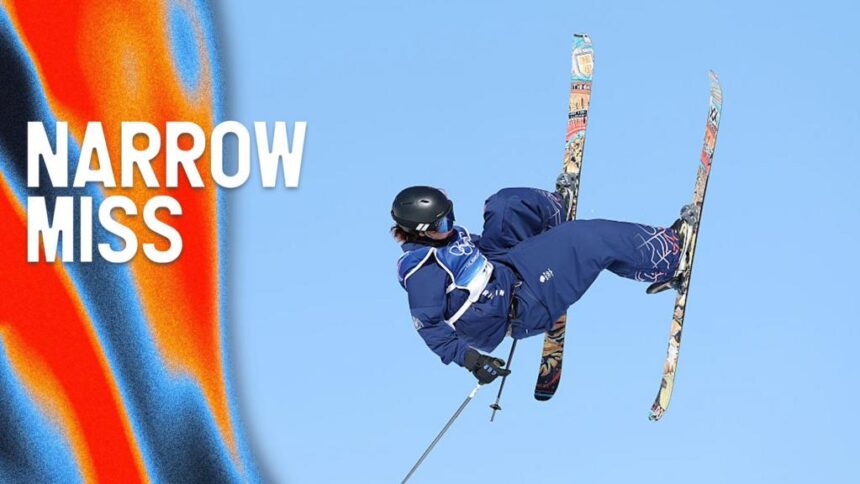
The Agony and the Ecstasy: Kirsty Muir’s Heartbreaking Fourth-Place Finish in Olympic Slopestyle
The thin air of the mountains holds a unique kind of silence, one punctuated by the whoosh of skis on snow and the collective gasp of a crowd. For Team GB’s Kirsty Muir, that silence descended with the weight of a world as the final score flashed on the board. A mere 0.41 points. In the arena of Olympic freestyle skiing, where athletes defy gravity and push creativity to its absolute limit, the margin between immortality and agonizing near-miss can be vanishingly small. Muir’s fourth-place finish in the women’s slopestyle final was not a story of failure, but a brutal, beautiful, and breathtaking narrative of sporting fortune measured in decimal points.
The Cruelest Decimal: Dissecting a 0.41-Point Olympic Margin
To understand the sheer knife-edge of Muir’s result, one must first appreciate the slopestyle discipline. It is a judged sport, a blend of colossal athleticism and artistic expression. Athletes navigate a course of rails, jumps, and obstacles, aiming to land the most technically difficult tricks with flawless style, amplitude, and execution. A single hand drag, a slight loss of momentum on a rail, or a less-than-perfect landing can be the difference.
Muir, a prodigy from Aberdeen who has been turning heads since her early teens, put down a stellar final run. It was packed with high-degree-of-difficulty maneuvers, including:
- Massive amplitude on her jumps, gaining crucial style points.
- A technical rail section showcasing her versatility and control.
- Clean, poised landings that demonstrated her competitive composure.
Yet, in the eyes of the judges, the sum of her extraordinary effort landed at 90.12. The bronze medal score stood at 90.53. This microscopic gap is where Olympic dreams are both made and deferred. It represents less than the impact of a single, almost imperceptible wobble. For the athlete, it is a chasm; for the spectator, a stark lesson in the uncompromising precision of elite sport.
Beyond the Score: Analyzing Muir’s Performance and Future Trajectory
While the headline screams “missed medal,” the expert analysis reveals a far more promising story. At just 19 years old at the time of this competition, Muir was competing in an environment where experience often dictates podium finishes. Slopestyle skiing is as much a mental game as a physical one, requiring the ability to adapt to changing snow conditions, wind, and the escalating pressure of a three-run final.
Muir’s performance demonstrated a critical evolution in her career. She moved from being a promising contender to a consistent, world-class finalist capable of delivering under the brightest lights. Her run construction showed strategic intelligence, and her ability to land a high-scoring run when the pressure was at its peak speaks to a mental fortitude that belies her years. This fourth-place finish, however painful, is a definitive marker on her trajectory. It is the kind of result that forges a champion’s resolve, providing the ultimate motivational fuel for the next four-year cycle.
Her technical toolkit is already among the best in the world. The focus now will shift to refining the nuances of execution and style that sway judges in those infinitesimal scoring brackets. Furthermore, adding one more groundbreaking, signature trick to her repertoire could be the key to converting 90.12 into 91.12 in future competitions.
What’s Next for British Freestyle Skiing and Kirsty Muir?
Kirsty Muir’s near-podium finish is not an isolated event but a beacon for the entire British freestyle skiing program. It proves that athletes from non-traditional winter sports nations can not only compete but genuinely challenge for honors on the world’s biggest stage. Her performance, broadcast globally, will inspire a new generation to take to the slopes, seeing a path paved by a young Scot.
Predictions for Muir’s future are overwhelmingly positive. With this Olympic experience now etched into her competitive DNA, she enters the next World Cup season and the run-up to the Milano-Cortina 2026 Olympics not as a hopeful, but as a proven threat. The podium is now a tangible, realistic target. We can expect to see:
- A more aggressive approach to run difficulty in major competitions.
- Leadership within the Team GB setup, mentoring younger skiers.
- Consistent podium finishes on the World Cup circuit, building ranking points and confidence.
The landscape of women’s slopestyle is fiercely competitive, with veterans and new talents emerging constantly. However, Muir has signaled that she possesses the complete package: the tricks, the mindset, and now, the profound motivation that comes from coming within a whisker of Olympic glory.
The Bittersweet Legacy of Coming So Close
In the immediate aftermath, a fourth-place finish at the Olympics, especially by such a microscopic margin, is a profound heartbreak. There is no sugar-coating the disappointment for the athlete who has dedicated years of their life to a singular goal. Yet, as the dust settles, the narrative around Kirsty Muir’s performance will rightly shift from what she lost to what she gained and what she proved.
She proved that British freestyle skiing is a force to be reckoned with. She proved that composure and talent can coalesce on the Olympic stage. Most importantly, she proved that the difference between an Olympic medal and an Olympic memory can be 0.41 points—a detail so small it is almost abstract, yet so large it defines a career chapter.
This result is not an end, but a compelling new beginning. The agony of 0.41 will fuel the fire. The world of freestyle skiing has been put on notice: Kirsty Muir is not just coming; she is already here, and she is climbing with a purpose forged in the most painful of near-misses. The ecstasy of a future podium, when it comes, will be built upon the foundation of this day’s cruel, clarifying agony.
Source: Based on news from BBC Sport.