Seahawks’ Ruthless Blueprint: How Targeting Patriots’ Rookie Flank Sealed Super Bowl 60
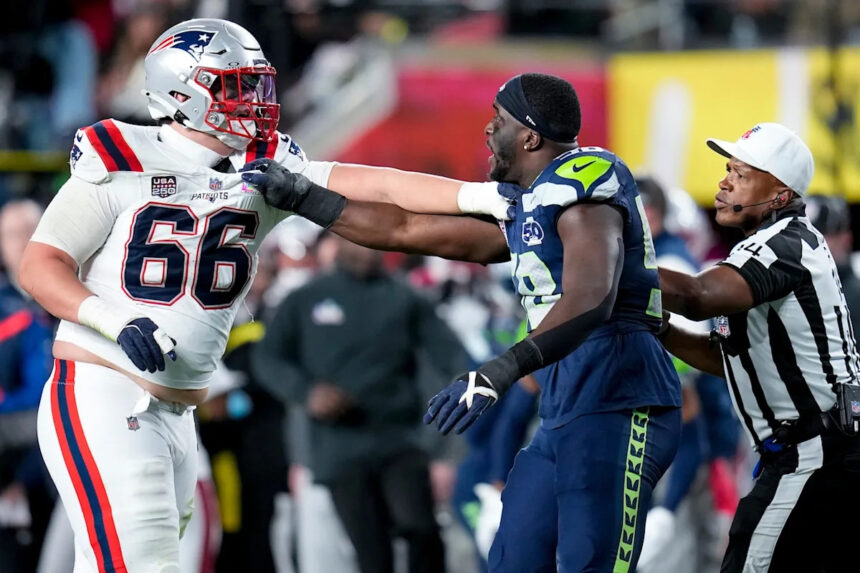
SANTA CLARA, Calif. – In the muted chaos of a losing locker room, beneath the weight of confetti meant for another, truth often comes in blunt, unvarnished clips. For the New England Patriots, a remarkable and unexpected journey to Super Bowl 60 crashed against the relentless, calculating waves of the Seattle Seahawks defense. The final, brutal stat: quarterback Drake Maye sacked a season-high six times, hit on eleven other occasions, a rookie phenom turned into a pinata. While the “why” was a complex wound, veteran right guard Michael Onwenu offered the simplest, most surgical diagnosis: “Obviously, it seemed like they were doing more on the left side. Obviously, it’s a rookie side, stuff like that.” In that admission lies the story of the game—a masterclass in predatory exploitation that delivered Seattle another Lombardi Trophy.
The Calculated Hunt: Seattle’s Game Plan Laid Bare
The Patriots’ offensive line, much improved in 2025, entered the championship with a known but managed vulnerability: its left side. Rookie left tackle Zion Latu and rookie left guard Layden Robinson had grown through the season, their talent evident but their collective experience a thin shield against the brightest lights and most savage pass rushers. Seahawks defensive coordinator Aden Durde, a rising star in coaching circles, did not just notice this; he constructed an entire defensive ecosystem around attacking it.
This was not random pressure. It was a targeted campaign. Seattle’s alignment and play calls consistently created isolated matchups and complex stunts aimed at the left guard-tackle junction. The Seahawks’ famed defensive end, Boye Mafe, along with the versatile and powerful Dre’Mont Jones, became permanent residents in the Patriots’ backfield. They employed a devastating mix of:
- Speed-to-power rushes against the rookie tackle’s outside shoulder.
- Twist and TEX (Tackle-End Exchange) stunts designed to confuse the communication between Latu and Robinson.
- Simulated pressures that showed blitz only to drop into coverage, leaving Maye hesitant and the young linemen processing ghosts.
The result was a cascading failure. Pressure from Maye’s blind side disrupted his footwork and truncated his ability to step into throws downfield. The Patriots’ play-action game, a staple of their playoff run, was neutered because the run threat was irrelevant—Seattle was in the backfield at the snap.
The Domino Effect: How Pressure Crippled the Patriots’ Offense
The impact of targeting the rookie side extended far beyond the sack total. In football, pressure is a psychological weapon as much as a physical one. By establishing dominance on the left so early, the Seahawks manipulated the entire Patriots offensive operation.
First, it forced a protection slide, pulling help from the center and right side toward the embattled left. This, in turn, opened one-on-one opportunities for other Seattle disruptors like linebacker Jordyn Brooks on delayed blitzes. Second, it compressed the playbook. Offensive coordinator Alex Van Pelt was forced to keep tight ends and running backs in to block, stripping Maye of safety valves and limiting the offense to quicker, shorter routes that played into the hands of Seattle’s physical cornerbacks.
Most critically, it got inside the head of a young quarterback in the biggest game of his life. Maye’s internal clock, which had been so precise all postseason, was shattered. The phantom pressure—the fear of it even when it wasn’t there—led to happy feet, rushed throws, and two critical second-half interceptions that felt like inevitable byproducts of the siege. The Seahawks didn’t just beat the Patriots’ offensive line; they weaponized its inexperience to fracture the entire offensive ecosystem.
Historical Context: A Time-Honored Championship Strategy
What Seattle executed is not a novel concept, but it is a hallmark of elite, championship-level defense. It is the football equivalent of probing a healing scar until it splits open. History is littered with examples: the New York Giants targeting the Patriots’ right tackle in Super Bowl XLII, the Tampa Bay Buccaneers exploiting the interior of the Kansas City Chiefs’ injured line in Super Bowl LV.
Great defenses identify the weakest link and turn the game into a referendum on that player’s—or unit’s—ability to survive. The Seahawks, with a veteran-laden defense that has tasted both glory and heartbreak, understood the assignment at a visceral level. They possessed the personnel to execute without needing exotic scheming, allowing them to play fast and violent. This game plan was a sign of supreme confidence and meticulous preparation, a belief that their best-on-best matchup would be a mismatch they could ride to a title.
For the Patriots’ rookies, Latu and Robinson, this was a cruel but invaluable doctoral program in pass protection. The NFL’s law of the jungle was enforced without mercy: in the ultimate game, any perceived weakness will be hunted until it breaks.
The Road Ahead: Repercussions and Predictions for Both Franchises
The fallout from Super Bowl 60 will shape both franchises’ offseasons. For the Seattle Seahawks, the victory validates a defensive philosophy that had come under question in recent years. It cements Durde as a head-coaching candidate and proves that a deep, versatile, and intelligent front can still dominate a pass-happy league. Expect them to reinvest in their defensive line and secondary to maintain this identity.
For the New England Patriots, the path is one of nuanced construction, not demolition. The core of a contender is evident. Drake Maye proved his mettle just by surviving the season. The mission now is to ensure he never has to endure that kind of assault again.
- Offensive Line Investment: The Patriots must add a veteran presence on the left side, either a swing tackle or a guard with playoff experience, to compete with and mentor their young talents.
- Scheme Adjustments: The coaching staff must develop quicker-hitting schemes and more roll-out packages to mitigate pressure and help their young linemen.
- Weapon Prioritization: Giving Maye a true, separation-creating WR1 becomes even more urgent to combat the type of coverage that complements such a fierce pass rush.
Prediction: The Patriots will address the left side aggressively in free agency, seeking a durable veteran lineman. They will return in 2026 with a more balanced and protected offense, using the humiliation of Super Bowl 60 as foundational fuel. The Seahawks, however, have announced their defensive resurgence with authority. The NFC should beware: a defense that can dissect and destroy a specific weakness with such cold efficiency is a defense built for multiple title runs.
Conclusion: The Inevitable Price of Inexperience
In the end, Michael Onwenu’s frank assessment was the epitaph for the Patriots’ season. Super Bowls are won not just by celebrating strengths, but by mercilessly exposing and attacking weaknesses. The Seattle Seahawks, with the clarity of champions, saw a rookie side and made the entire game about it. They turned the left side of the Patriots’ line into a referendum, and the result was a quarterback under siege and a dream dismantled.
For New England, the pain of this loss is the price of a rebuild that arrived ahead of schedule. The foundation is solid, the quarterback is special, but the final, brutal lesson was delivered in Santa Clara: in the NFL’s ultimate game, there are no hiding places. Every weakness is a target, and every target will be fired upon until it breaks. The Seahawks aimed, fired, and lifted the Lombardi Trophy on the ashes of that strategy. The Patriots now head into an offseason with the clearest possible blueprint of what must be fortified.
Source: Based on news from Yahoo Sports.