Cadillac’s Super Bowl Splash: F1’s Newest Team Courts Controversy with Daring Split Livery
The roar of the Super Bowl was momentarily overtaken by the whine of a Formula 1 engine. In a stunning, high-stakes marketing play, the new Cadillac Formula 1 team chose America’s biggest television stage to unveil its challenger, dropping a commercial reportedly worth £7.3 million. But the car itself, revealed in a parallel spectacle in New York’s Times Square, has sparked as much conversation as the price tag. Cadillac didn’t just enter F1; they arrived with a visual paradox: a car with two faces.
A Super Bowl Spectacle and a Times Square Statement
Forget a quiet launch in a factory or a slick online reveal. Cadillac, representing the General Motors powerhouse, went for maximum impact. The synchronized reveal—a glossy advert during the most expensive airtime on the planet and a physical model towering over the crossroads of the world—was a declaration of intent. This was about making noise in a market F1 has long coveted. Cadillac F1 CEO Dan Towriss captured the moment, calling it a “tremendous event for us” and a “momentous day.” The message was clear: Cadillac is here to play at the very pinnacle of global sports marketing, and they’re doing it on their own terms. The choice of venue signals a primary focus on captivating the American audience, leveraging the Super Bowl’s colossal reach to instantly embed the team into the national sports consciousness.
Decoding the Duality: The Livery That Breaks the Mirror
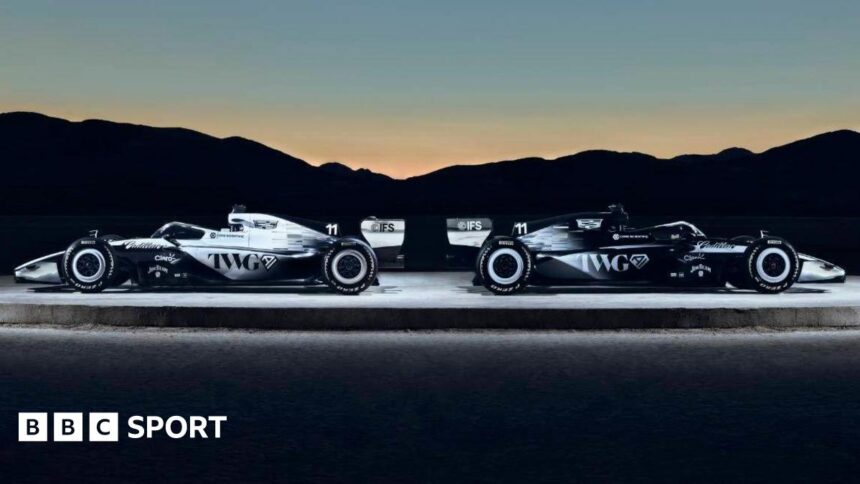
At the heart of the buzz is the Cadillac split livery. One side of the car presents a stark, white-on-black scheme; the other inverts it to a powerful black-on-white. It’s a striking, chessboard-on-wheels effect that is undeniably eye-catching and philosophically bold—representing duality and perhaps the fusion of American racing heritage with F1’s European tradition. However, this design decision has raised eyebrows up and down the F1 paddock. The sport’s sporting regulations, specifically Article 9.1, state that “the colour scheme of the cars… must be presented in a substantially similar manner on both sides of the car.”
The immediate question from rivals and fans alike: does a perfect inversion qualify as “substantially similar”? Cadillac’s leadership, team principal Graeme Lowdon and team manager Pete Crolla, seasoned professionals who know the rulebook intimately, proactively sought clarity. The team’s spokesperson confirmed they engaged with the governing body the FIA for pre-emptive clarification. According to the team, the FIA “indicated this design was within the rules as long as the design and branding was similar from both sides, which we are comfortable and confident it is.” This suggests the FIA’s interpretation hinges on the layout and placement of logos and patterns being mirrored, not the colours themselves.
- Strategic Genius or Regulatory Gambit? The move is a masterclass in garnering free media coverage, ensuring every angle of the car is discussed.
- The “Substantially Similar” Loophole: Cadillac appears to be testing the literal interpretation of the phrase, focusing on design geometry over colour palette.
- Precedent Setting: If unchallenged, this could open the door for more creative, asymmetrical liveries in future seasons.
Paddock Reactions and the Inevitable Scrutiny Ahead
While technically given an amber light by the FIA, the unusual split livery will face its true test when it hits the track for pre-season testing and the first Grand Prix. Other teams, always looking for competitive advantages or violations, will scrutinize the car from every angle. The potential for protest exists if a rival team believes the livery provides a functional advantage—for instance, if the different colours affect pit crew identification under specific lighting or create confusion for officials. More likely, the grumbling will be about the spirit of the regulation. Has Cadillac found a clever loophole, or have they bent a rule meant to ensure simplicity and fairness in identification? This controversy, albeit a stylistic one, is a brilliant distraction. It allows Cadillac to control the narrative around its launch, framing itself as an innovative disrupter rather than just another new team.
Expert analysis suggests this is a calculated risk. Lowdon and Crolla’s decision to seek clarification from governing body the FIA was crucial. It provides a layer of protection against formal protests. However, in the politically charged atmosphere of F1, perceived gamesmanship with the rules can create early friction. The team will need to ensure their on-track performance is as bold as their paint job to back up the bravado.
Predictions: Beyond the Paint, What’s Next for Cadillac F1?
The livery debate is a captivating opening chapter, but the real story for Cadillac is just beginning. Here’s what to watch:
- On-Track Performance: The car’s speed will ultimately define the team’s legacy. A competitive midfield showing will validate the project; struggles will make the splashy launch seem like hollow hype.
- Commercial Impact: The Super Bowl investment must translate into brand value, sponsorship interest, and tangible growth for Cadillac in key markets. The team’s ability to leverage its “disruptor” image will be key.
- Regulatory Ripple Effects: Expect the FIA to potentially tighten the wording of the livery rule for 2025, closing the loophole Cadillac exploited. Their 2024 car may become a collector’s item—the only of its kind.
- Fan Engagement: The split design is a marketer’s dream, encouraging fans to share and compare both sides of the car on social media, effectively doubling its visual footprint.
Conclusion: A Bold Entry in the Modern F1 Era
Cadillac’s Formula 1 debut was anything but timid. By marrying a Super Bowl advert with a Times Square spectacle and wrapping it around a legally contentious, conversation-starting livery, they have executed a launch that perfectly encapsulates the modern, media-savvy era of the sport. They understood the assignment: in a landscape saturated with content, you must break the mold to be remembered. Whether the split livery is a stroke of genius or a regulatory step too far will be debated until lights out in Bahrain. But one thing is undeniable—Cadillac has arrived. They have served notice that they are not just participants but narrators, willing to challenge conventions from their very first lap in the global spotlight. The checkered flag on this particular strategy won’t be shown for months, but for sheer audacity and headline-grabbing power, Cadillac is already on the podium.
Source: Based on news from BBC Sport.