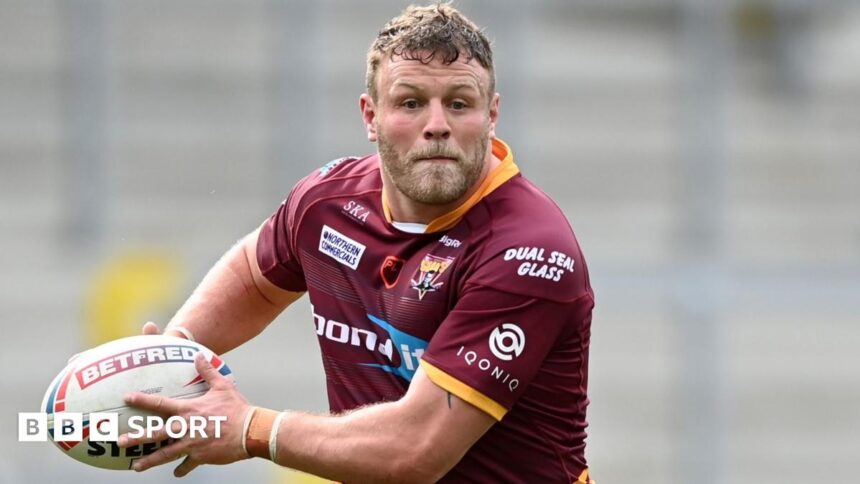
From Tackles to Trauma: Josh Jones’s Harrowing Journey with Rugby’s Concussion Crisis
The roar of the crowd, the brutal poetry of a perfect tackle, the unbreakable bond of the dressing room—for years, this was the world of Josh Jones. Today, that world is replaced by a different, more insidious battle: one against the silent, accumulating damage of countless head impacts. In a revelation that strikes at the very heart of rugby league’s physical culture, the former St Helens, Salford, and Hull FC star has laid bare the devastating mental health consequences he attributes to his career, coming perilously close to suicide and receiving a life-altering diagnosis at just 31 years old.
A Career Cut Short: The Unseen Injury
Josh Jones’s retirement in 2023 was not the celebratory send-off befitting a player of his calibre. It was a medical necessity, forced by concussion-related issues that had begun to dominate his life. The powerful second-rower, who represented England and Great Britain, could no longer ignore the symptoms. What began as standard “seeing stars” after big hits evolved into persistent, debilitating effects that extended far beyond the pitch.
“It’s heartbreaking,” Jones stated, encapsulating the grief of losing not just a profession, but a fundamental part of his identity. His story moves the conversation on head injuries in contact sports from abstract risk to visceral reality. It underscores a critical shift in understanding: the injury isn’t just the momentary knockout; it’s the cumulative toll of sub-concussive impacts, the ones celebrated as “big hits,” that may forge a path to long-term neurological disorder.
The Diagnosis: Living with the Shadow of CTE
The pivotal, frightening turn for Jones came with his diagnosis. While Chronic Traumatic Encephalopathy (CTE) can only be definitively confirmed post-mortem, Jones received a clinical diagnosis based on a battery of cognitive tests and brain scans, becoming one of the youngest former players in the UK to do so. CTE is a progressive brain condition associated with repeated head traumas, with symptoms including:
- Severe depression and anxiety
- Impulse control issues
- Memory loss and cognitive decline
- Emotional volatility
For Jones, these were not just clinical terms. They manifested as a profound mental health crisis. He has spoken openly about the darkest depths of this struggle, revealing he came close to taking his own life. This admission moves the issue from the realm of sports science into urgent public health and duty-of-care territory. The brain injury sustained for entertainment was now threatening his very existence.
Expert Analysis: A Tipping Point for Rugby League?
Sports neurologists and concussion experts view cases like Jones’s as critical data points in an accelerating crisis. “Josh Jones’s experience is a tragic but textbook example of how the neurological sequelae of a contact sports career can present,” explains Dr. Eleanor Vance, a neuroscientist specializing in traumatic brain injury. “The early onset of symptoms and the severity of the psychiatric manifestations are particularly alarming. It forces the sport to ask: are current protocols—focusing largely on identified concussions—enough to protect players from the effects of head injuries that accumulate over a decade-long career?”
The rugby league community is at a crossroads. The sport’s essence is built on toughness and resilience. Jones’s bravery in speaking out challenges that ethos, demanding a re-evaluation of what constitutes acceptable risk. Key areas of focus now include:
- Reducing contact in training to limit lifetime head impact exposure.
- Implementing advanced in-game technology for real-time head impact monitoring.
- Establishing lifelong, sport-funded healthcare pathways for retired players.
- Radically improving mental health support with specialist understanding of neurological trauma.
The Future of the Game: Predictions and Necessary Reforms
The trajectory is clear: player advocacy, led by voices like Jones’s, and mounting scientific evidence will force structural change. We can predict several evolutions in the coming years. Firstly, legal and insurance pressures will mount, potentially mirroring the NFL’s billion-dollar settlement with former players. Clubs and governing bodies will be compelled to demonstrate a higher standard of care.
Secondly, talent development will change. We may see a generation of parents steering children away from the rugby league pathway, impacting the sport’s grassroots. In response, the sport may accelerate modifications for younger age groups, potentially leading to a “two-speed” game where professional rules diverge significantly from amateur play to mitigate liability.
Most importantly, the cultural shift will be profound. The “get up and carry on” mentality, once a badge of honour, is being re-framed as dangerous. The new heroism will be a player leaving the field for a Head Injury Assessment (HIA), or a veteran like Jones using his voice to protect the next generation. This is not about softening the sport, but about smartening it—preserving its fierce competitiveness while refusing to sacrifice players’ minds for entertainment.
Conclusion: Beyond the Final Whistle
Josh Jones’s story is a heartbreaking clarion call. It is a powerful testament that the cost of a career in one of the world’s toughest sports can be counted in more than surgeries and scars. It is measured in silent brain changes, in mental anguish, and in futures forever altered. His openness about suicide and depression linked to his injuries breaks a dam of silence, offering solidarity to other suffering ex-players and providing a human face to the CTE crisis.
The challenge for rugby league is historic. It must reconcile its brutal appeal with a duty of care that extends for decades after the final whistle. It must listen to its fallen warriors, invest in independent science, and implement brave reforms. The goal is no longer just to create great players, but to ensure those players can lead long, healthy lives once the boots are hung up for good. Josh Jones’s battle is no longer on the field; it is in the medical clinics and in the halls of power where the future of the sport will be decided. The game he loved now owes him, and countless others, a debt of protection it must urgently pay.
Source: Based on news from BBC Sport.