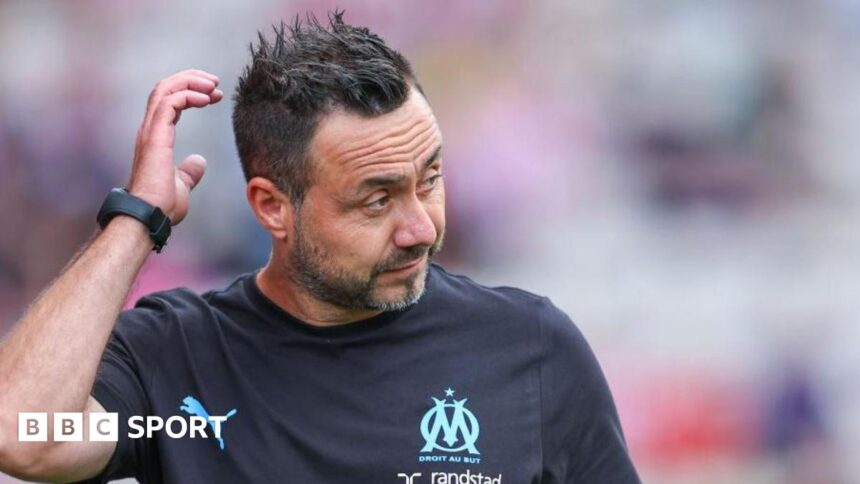
The De Zerbi Era in Marseille Ends: A Sudden Departure and a Club at a Crossroads
The Stade Vélodrome, a cauldron of passion and expectation, is now a theater of uncertainty. In a move that reverberated across European football, Olympique de Marseille and manager Roberto de Zerbi have parted ways by mutual consent. The Italian’s tenure, which began with such fervent hope in the summer of 2024, has concluded abruptly, not with a whimper, but in the echoing silence following heavy defeats. His departure is not merely a managerial change; it is a defining moment that exposes the volatile ambitions and harsh realities of one of France’s most storied clubs.
The official statement spoke of a mutual agreement, the diplomatic language of modern football. But the context is unmistakable. De Zerbi’s exit comes directly on the heels of a traumatic 5-0 demolition by arch-rivals Paris Saint-Germain and a decisive 3-0 loss at Club Brugge that sealed a Champions League group stage exit. For a club where emotion and pride are the currency, these results were a devastating devaluation. The man hailed as a visionary just months ago, after securing a commendable second-place Ligue 1 finish last season, now leaves with Marseille in fourth, a distant 12 points behind the PSG juggernaut.
A Promising Project Unravels: From Brighton to the Vélodrome
Roberto de Zerbi arrived in Marseille as a coveted commodity. His work at Shakhtar Donetsk showcased tactical ingenuity under immense pressure, but it was his revolution at Brighton & Hove Albion that cemented his reputation. At the Amex, he transformed a solid Premier League side into a dazzling, possession-based phenomenon, earning plaudits for a brave, intricate style of play. Marseille’s leadership, eager to marry the club’s passionate identity with a modern, attacking philosophy, saw him as the perfect architect.
Initially, the blueprint seemed sound. Last season’s runner-up finish was a clear success, delivering Champions League football and re-establishing OM as PSG’s primary domestic challenger. However, the cracks began to show under the weight of heightened expectations. De Zerbi’s system, demanding intense technical precision and tactical discipline, can be brittle when confidence dips or personnel aren’t perfectly suited. Key observations from his tenure include:
- Stylistic Rigidity: While beautiful in execution, De Zerbi’s commitment to building from the back was often punished in the high-stakes, high-pressure environment of Marseille, where mistakes are rarely forgiven by the fanbase.
- European Shortfall: Failure to progress in the Champions League, particularly the manner of the exit, was a critical blow. For a club desperate to reclaim continental relevance, the campaign was a disappointment.
- The PSG Benchmark: The 5-0 defeat wasn’t just a loss; it was a humiliation that laid bare the gulf in quality and mentality between first and second in France. It became the symbolic final straw.
Anatomy of a Departure: More Than Just Bad Results
While recent results triggered the decision, experts suggest deeper fissures led to this mutual consent. De Zerbi is a manager with a very specific, uncompromising vision. Reports hinted at frustrations over transfer market control and the squad’s ability to fully execute his complex instructions. Conversely, the Marseille board, sensing the season slipping towards mere top-four scrapping rather than a true title pursuit, may have lost faith in the project’s short-term viability.
The phrase “by mutual consent” often masks a power struggle. In this case, it likely represents a cold, shared realization: the marriage of De Zerbi’s purist ideals with the relentless, win-now demands of Marseille was proving unsustainable. The club’s environment is uniquely intense, where each match is a referendum on the manager’s worth. De Zerbi’s cerebral approach, which requires patience and long-term buy-in, ultimately clashed with the immediate, emotional needs of the club and its supporters.
What’s Next for Marseille and for De Zerbi?
The immediate future for Olympique de Marseille is fraught with critical questions. The search for a new manager will be their most crucial decision in years. Do they double down on a progressive, project-based coach, or seek a more pragmatic, results-oriented leader who can handle the unique furnace of the Vélodrome? Names like Francesco Farioli or Will Still might appeal to the former instinct, while a veteran like Jorge Sampaoli (for a second stint) could represent the latter.
The squad itself, built partially in De Zerbi’s image, now faces another transition. Key players recruited for his system must adapt anew. The club’s stated ambition to challenge PSG now seems more distant than ever, and the primary goal for the remainder of this season will be to secure Champions League qualification—a task that is no longer a guarantee.
For Roberto de Zerbi, the path is intriguingly open. His stock, though dented by this abrupt end, remains high. His philosophy is still admired across Europe’s top leagues. Potential destinations could include:
- A return to the Premier League, where his style is highly valued.
- A project at another major European club seeking a stylistic overhaul.
- A calculated period of sabbatical, awaiting the perfect opportunity that aligns with his methods.
He leaves France with his reputation as a brilliant, if demanding, tactician intact, but with a clear lesson in the cultural complexities of managing a club of Marseille’s immense stature and passion.
A Conclusion of Unfulfilled Promise
The departure of Roberto de Zerbi from Marseille is a story of unfulfilled promise and a stark reminder of football’s impatient timeline. It was a bold, exciting experiment that ultimately succumbed to the relentless pressure of immediate results and a palpable disconnect between a visionary’s process and a giant club’s daily hunger for glory. De Zerbi aimed to build a cathedral, but in Marseille, they often need fortresses, built game by game, under siege.
For OM, the search for an identity continues. For De Zerbi, the quest for a club that can fully embrace his footballing religion goes on. The legacy of his brief tenure will be one of “what if”—a glimpse of a potential future that faded before it could fully materialize. The Vélodrome now turns its gaze forward, its echoes waiting for a new voice to lead the chorus, while one of football’s most interesting minds plots his next move from the sidelines. In the end, this wasn’t just a managerial change; it was the closing of a compelling, flawed, and ultimately unfinished chapter for all involved.
Source: Based on news from BBC Sport.