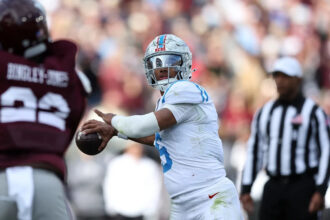
Ole Miss Quarterback Trinidad Chambliss Wins Landmark Case, Granted Sixth Year of Eligibility by State Judge
In a stunning legal and collegiate athletics development, the trajectory of the Ole Miss Rebels’ football program has been dramatically altered. A state judge has granted quarterback Trinidad Chambliss a sixth year of NCAA eligibility, overruling the governing body’s denial and setting a monumental precedent. This decision not only allows the architect of Ole Miss’s greatest season to return for the 2026 campaign but also ignites a fierce debate over athlete welfare, institutional power, and the very authority of the NCAA.
The Ruling That Rocked College Football
On Thursday, the courtroom, not the football field, became the venue for Ole Miss’s most significant victory of the offseason. After a swift legal battle initiated when the NCAA formally rejected his waiver request on January 9, Chambliss and his legal team emerged victorious. The core of the dispute centered on the 2022 season, which Chambliss missed while a student at Division II Ferris State.
The NCAA’s denial hinged on a specific clause: the inability to prove an “incapacitating injury or illness.” Chambliss contended he suffered from severe, documented respiratory issues that prevented his participation. The NCAA, however, deemed the evidence insufficient. Faced with this deadlock, Chambliss took the unprecedented step for an active player of suing the association, leading to the judge’s ruling in his favor.
This move bypasses the traditional, often opaque, NCAA waiver process and places judicial scrutiny directly on its eligibility standards. The immediate effect is seismic for Oxford: Ole Miss will run it back with the iconic leader who just piloted the team to a historic SEC Championship and College Football Playoff appearance.
Trinidad Chambliss: From Obscurity to Ole Miss Legend
To understand the magnitude of this ruling, one must appreciate Chambliss’s improbable journey. His path was not that of a five-star prodigy. After a quiet stint at Ferris State marred by health struggles, he transferred to Ole Miss as a relative unknown. What followed was a storybook ascent that captivated the nation.
Chambliss didn’t just play; he dominated with a style that blended pinpoint accuracy with a gunslinger’s fearlessness. In his lone season as the starter, he shattered school records and led the Rebels to previously unimaginable heights. His connection with star receivers and command of a high-octane offense made him the heart and soul of the team. Key aspects of his impact include:
- Record-Breaking Production: He set single-season Ole Miss records for passing yards and touchdowns, etching his name above Rebel legends.
- Clutch Gene: Time and again, Chambliss engineered fourth-quarter comebacks, displaying a preternatural calm under pressure.
- Cultural Architect: His work ethic and leadership transformed the team’s identity, fostering a belief that they could compete with, and beat, any program in the country.
Losing such a transformative figure would have been a catastrophic blow for a program looking to sustain elite status. His return provides unparalleled continuity and signals that Ole Miss is not just a flash in the pan, but a bona fide national powerhouse.
Expert Analysis: The Legal Precedent and NCAA Implications
This case extends far beyond the gridiron; it is a landmark moment in the evolving power dynamic between the NCAA and its athletes. Legal and collegiate sports analysts are parsing the decision for its broader implications.
“This ruling is a direct challenge to the NCAA’s long-held monopoly on eligibility determinations,” notes Dr. Elena Vargas, a sports law professor. “By taking the case to a state judge and winning, Chambliss’s team has effectively created a new avenue for athletes who feel wronged by the system. The precedent suggests that NCAA eligibility rules are not immune to judicial review, especially when concerning medical issues and athlete health.”
The NCAA’s defense relied on its bureaucratic process and standard for “incapacitating” conditions. The judge’s rejection of that interpretation questions the fairness and flexibility of those very standards. This opens the door for other athletes with complex medical histories—mental health challenges, misunderstood illnesses, or improperly documented injuries—to seek similar redress.
Furthermore, this occurs in the era of NIL (Name, Image, and Likeness) and the transfer portal, where athlete agency is at an all-time high. The Chambliss case adds a powerful legal dimension to that agency. The NCAA now faces a new reality where its final say is no longer quite so final.
Predictions for the 2026 Ole Miss Rebels
With the legal drama resolved, the focus shifts to the field. Chambliss’s return for the 2026 season completely reshapes the national landscape for that year. Ole Miss, which would have been in a rebuilding phase, instantly becomes a preseason Top 5 contender.
The benefits are multifold:
- Offensive Stability: The entire offensive scheme remains intact. Coordinators can build deeper, more complex playbooks rather than starting from scratch with a new quarterback.
- Recruiting Magnet: Elite offensive skill players will be drawn to the opportunity to play with a proven Heisman-caliber quarterback for a championship contender.
- Leadership Incalculable: Having a seasoned, battle-tested leader in the huddle and locker room is an intangible that cannot be overstated, particularly in high-stakes SEC games.
Expectations will be astronomical. The narrative will no longer be about defending a title, but about completing a legacy. The 2026 season will be framed as “The Last Dance” for Trinidad Chambliss, adding a layer of destiny to an already talented roster. The pressure will be immense, but if any player has shown the capacity to handle it, it’s Chambliss.
A Watershed Moment with a Lasting Legacy
The story of Trinidad Chambliss is now two-fold: he is both the legendary quarterback who brought Ole Miss to the pinnacle of college football and the athlete who successfully sued the NCAA for his right to play. This dual legacy ensures his impact will be felt long after his final pass is thrown.
For the Ole Miss program, this is the ultimate gift—more time with a generational talent and the chance to solidify a dynasty. For the NCAA, it is a stark warning that its traditional governance models are increasingly vulnerable in a landscape that demands more fairness and transparency for student-athletes.
As the 2026 season approaches, all eyes will be on Oxford. The Rebels aren’t just getting their quarterback back; they are unleashing a player with a point to prove, backed by a legal victory that echoes across all of college sports. The judge’s gavel has sounded, and in its wake, the roar in Vaught-Hemingway Stadium just grew louder. The Chambliss Era, against all odds, has been granted an unforgettable encore.
Source: Based on news from Fox Sports.