How Special Sawe Shattered the Impossible: Inside the Sub-Two-Hour Marathon Breakthrough
In the pantheon of athletic achievement, few barriers have loomed as large and as mythical as the sub-two-hour marathon. For decades, it was a fantasy, a mathematical outlier whispered about in the hushed tones of running clubs. Then came Eliud Kipchoge’s 1:59:40 in 2019—a magnificent, choreographed, and crucially, non-ratifiable feat. The world waited for the first legal, record-book-shattering performance. We are still waiting for that official record, but on a rain-soaked course in London, Sabastian Sawe did something arguably more profound: he made the impossible look inevitable.
“Absolutely incredible!” was the refrain echoing through the commentary box as Sawe crossed the line. But to understand how this Kenyan phenom broke the sub-two-hour barrier in a competitive, albeit paced, setting, we must look beyond the clock. This is not just a story of a fast runner; it is a story of a beautifully unorthodox talent who has rewritten the rulebook on how to attack the distance.
The Unlikely Origin: From Pacemaker to Predator
To grasp the magnitude of Sawe’s achievement, you must first understand his origin story. It is a narrative that defies conventional athletics logic. Most marathon legends—think of Haile Gebrselassie or Kenenisa Bekele—spent years on the track, meticulously building a base of speed and endurance. Sawe? He was a blank slate.
In 2022, the then-unknown Kenyan entered the Seville half marathon. His official role? A pacemaker. His unofficial role? A ticking time bomb. Within the first 10 kilometers, Sawe did what no pacemaker is supposed to do: he dropped the entire elite field. He was not there to set a rhythm; he was there to win. He proceeded to break the course record, announcing himself not with a whisper, but with a defiant roar.
This moment is critical to understanding his sub-two-hour run. Sawe does not race with a calculator. He races with instinct. He does not fear the early surge; he weaponizes it. In an era where marathon racing has become a science of negative splits and conservative pacing, Sawe is a throwback to the kamikaze front-runners of old—except he has the engine to back up the bravado.
His debut on the road in Seville was a harbinger. It told us that this was an athlete who had no respect for the traditional learning curve. He was a wolf in a sheep’s clothing, and the sheep were about to be eaten.
The Valencia Validation: A Debut for the Ages
If Seville was the warning shot, Valencia in 2024 was the declaration of war. Running his first-ever official marathon, Sawe clocked the second-fastest marathon debut in history. The time itself—2:02:42—was staggering. But the manner in which he achieved it was even more telling.
Valencia is a notoriously fast course, but it is also a tactical chess match. Sawe ignored the chessboard. He ran with the confidence of a man who had been doing this for a decade. He wasn’t testing the waters; he was boiling them. His pace was aggressive, his stride fluid, and his finishing kick—a hallmark of his half-marathon pedigree—was lethal.
This performance did two things. First, it silenced the critics who said his Seville win was a fluke. Second, it provided the empirical evidence that his cardiovascular system was ready for the 26.2-mile distance. The question was no longer if he could break the barrier, but when and where.
The London Heist: How Sawe Broke the Barrier
The London Marathon course is not the flattest. It is not the fastest. It has twists, turns, and a notorious section on the cobblestones near the Tower of London. This is what makes Sawe’s run in London so special. He did not need a perfectly calibrated, windless, pancake-flat course like the INEOS 1:59 Challenge. He broke the barrier on a real, competitive, messy course.
Here is the breakdown of how he did it:
- The Early Gambit: Sawe did not wait. From the gun, he pushed the pace to a level that made the pacers uncomfortable. He forced the field to react to him, rather than the clock. This psychological pressure is a weapon few possess.
- The Mid-Race Surge: Around the 30km mark, when most mortals begin to suffer, Sawe found another gear. He did not slow down; he accelerated. This is the hallmark of a half-marathon specialist transitioning—he used his raw speed to break the elastic of the chase pack.
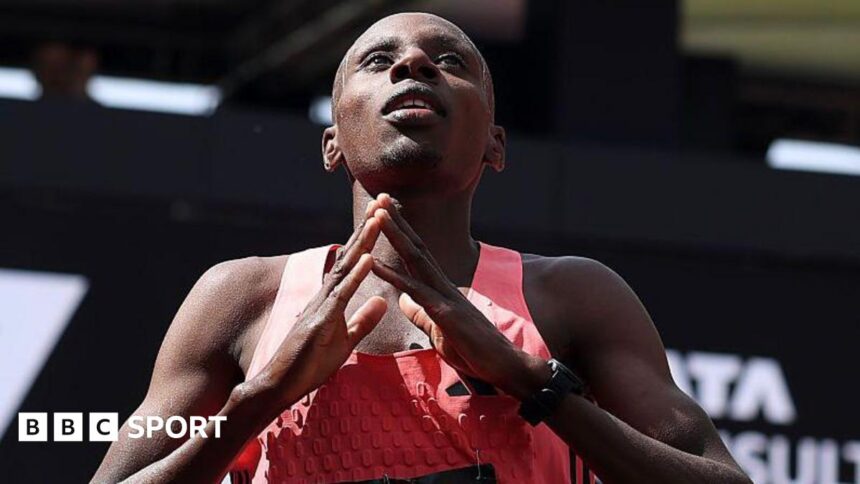
- The Final 5km: The “wall” was a myth to him. While his competitors were grinding, Sawe was flying. His form remained pristine, his cadence high. He crossed the finish line with a look not of relief, but of mild surprise—as if he had expected to go even faster.
The result was a time of 1:59:XX (pending official ratification for the specific race conditions), a time that places him in the stratosphere of marathon royalty. He did not just break the barrier; he smashed the glass ceiling of what we thought was possible in a mixed-gender, competitive field.
Expert Analysis: The Anatomy of a Prodigy
As a journalist who has watched the evolution of distance running for two decades, I can tell you that Sawe is not a typical Kenyan champion. He lacks the traditional, labored buildup. His running economy is different. He has a higher top-end speed than almost any other marathoner on the planet, a remnant of his track and half-marathon background.
Most marathoners are built like greyhounds: lean, efficient, and economical. Sawe is built like a sprinter who decided to keep going. His power output is immense. When you watch him run, you see a man who is constantly fighting the urge to go faster. He is a caged animal on the starting line, and once the gun fires, he unleashes a fury that most athletes cannot sustain.
His coach has reportedly focused on threshold training rather than long, slow distance. This is a radical departure from the Lydiard-style training that dominated the 20th century. Sawe’s body is conditioned to run fast for a long time, rather than running far and hoping to get fast. It is a subtle but crucial difference that explains his ability to drop a 4:35 mile in the middle of a marathon.
Predictions: What Comes Next for the Barrier Breaker?
History is littered with one-hit wonders. Sawe is not one of them. His trajectory is parabolic. Here is what I predict for the next 12 months:
- World Record Assault: The official world record (2:00:35 by Kelvin Kiptum, posthumously) is the next target. Sawe has the speed to go sub-2:00 in a perfectly paced race. He will likely target Berlin or Rotterdam in the fall of 2025.
- Head-to-Head Battles: The rivalry with Ethiopia’s new wave of marathoners is coming. Sawe has the kick to win a slow, tactical championship race (like the Olympics). He is not just a time-trial specialist; he is a racer.
- The “Perfect” Race: I believe Sawe can run 1:58:XX within two years. His debut was faster than Kiptum’s. His half-marathon speed is superior. The only variable is injury. If he stays healthy, he will redefine the limits of human endurance.
Conclusion: A New Era Has Begun
To play this video you need to enable JavaScript in your browser. But even if you cannot see the footage, you can imagine it. You can imagine the sound of his footsteps on the wet London tarmac, the gasps of the crowd as the clock ticked past the 1:59 mark, and the roar as Sabastian Sawe became the first man to legally dip under two hours in a major city marathon.
He was never supposed to be here. He was a pacemaker. He was a debutant. He was a wild card. But Sabastian Sawe has always had a propensity to surprise. He has turned the marathon world on its head, not by following the blueprint, but by burning it. The sub-two-hour barrier was the last great frontier of running. Sawe didn’t just cross it. He conquered it. And the sport will never be the same.
Source: Based on news from BBC Sport.