Dolphins Release Tyreek Hill in Stunning Cap Purge, Signaling New Era in Miami
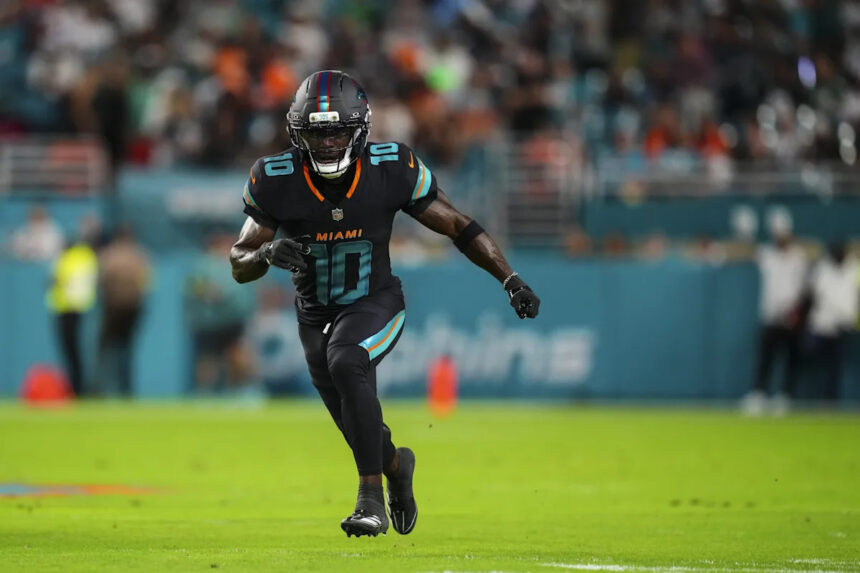
The Miami Dolphins, a franchise that has spent recent years in a high-stakes pursuit of an elusive championship, officially hit the reset button in the most dramatic fashion possible Monday morning. In a one-two punch that reverberated across the NFL, the Dolphins began a necessary but painful salary cap purge by releasing star linebacker Bradley Chubb and, in a move that defines franchise-altering, eight-time Pro Bowl wide receiver Tyreek Hill. The decisions, the first major moves by new General Manager Jon-Eric Sullivan, mark the end of an explosive but ultimately unsustainable era and the sobering start of a financial reckoning in South Florida.
The Financial Imperative: A Cap House of Cards Collapses
For years, the Dolphins operated under a “win-now” mantra, aggressively restructuring contracts and pushing massive cap charges into the future to assemble a roster around quarterback Tua Tagovailoa. That strategy created a thrilling product but also a financial time bomb. Heading into Monday, Miami was projected to be a staggering $17 million over the 2025 salary cap, a untenable position that demanded immediate and ruthless action.
The release of Tyreek Hill, while shocking in its impact on the field, was a mathematical inevitability. Hill was scheduled to account for a colossal $51.1 million against the 2025 cap. By designating him a post-June 1st release, the Dolphins create $22.9 million in immediate breathing room. The cost, however, is severe: $28.2 million in “dead money”—cap space consumed by a player no longer on the roster. This is the bill coming due for past aggressiveness. Combined with the Chubb move, these cuts flip the Dolphins from $17 million over to approximately $13 million under the cap, a necessary first step toward solvency.
- Pre-Monday Cap Status: ~$17 million OVER the cap
- Tyreek Hill’s 2025 Cap Hit: $51.1 million
- Cap Savings from Hill’s Release: $22.9 million
- Dead Money Incurred: $28.2 million
- New Projected Cap Status: ~$13 million UNDER the cap
The End of the Cheetah Era: Injury and Inevitability
Tyreek Hill’s four seasons in Miami were nothing short of spectacular from a statistical standpoint. Acquired in a blockbuster trade with the Kansas City Chiefs, he instantly transformed the Dolphins’ offense, providing Tagovailoa with a historically dynamic weapon. In 58 games, he caught 340 passes for 4,733 yards and 27 touchdowns. His 2023 season was a masterpiece, leading the NFL in both receiving yards (1,799) and touchdown receptions (13).
Yet, the 2025 season brought a cruel and abrupt halt. In Week 4 against the New York Jets, Hill suffered a catastrophic knee injury—a dislocation accompanied by multiple torn ligaments. At 31, recovering from such a devastating injury to return to his peerless, speed-dependent form is a monumental challenge. This injury, combined with his astronomical cap number, made the business decision clear for Sullivan. The Dolphins could not afford to tie up over $50 million in a receiver facing a grueling rehab with an uncertain outcome. The devastating knee injury effectively accelerated a parting of ways that the cap sheet had already dictated.
Jon-Eric Sullivan’s Daunting Task: Building a Sustainable Winner
The architect of this new, fiscally responsible path is first-year GM Jon-Eric Sullivan. His mandate is clear: dismantle the cap-strangled roster he inherited and build a deeper, more balanced, and sustainable contender. The releases of Chubb and Hill are not isolated moves; they are the opening salvos in a broader campaign. Veteran cornerback Jalen Ramsey, with a $27.7 million cap hit, and pass-rusher Jaelan Phillips are among other high-priced players whose futures will be scrutinized for potential restructures, extensions, or releases.
Sullivan’s philosophy will be tested immediately. Can he find value in the draft and shrewd mid-level free agents to replenish talent? The Hill move leaves a gaping void at wide receiver, thrusting Jaylen Waddle into the undisputed WR1 role and demanding rapid development from younger players. More importantly, it places immense pressure on quarterback Tua Tagovailoa, who just signed a massive extension himself. Tua must now prove his success was not solely a product of Hill’s otherworldly talent, but of his own growth as a franchise quarterback.
What’s Next for the Dolphins and Tyreek Hill?
For the Dolphins, the immediate future is about damage control and strategic rebuilding. The $13 million in cap space is just a start; more moves are guaranteed. The focus will shift to the NFL Draft, where Miami must hit on cost-controlled talent. The 2025 season becomes a transition year, evaluating which core pieces (like Tagovailoa and Waddle) can be true centerpieces of the next contender.
For Tyreek Hill, the path is fraught with questions but will be fascinating to watch. When healthy, he remains one of the most feared players in football. His release will likely spark interest from contenders who believe they are one explosive piece away from a Super Bowl, especially if they can structure a incentive-laden deal that accounts for his rehab. Teams like the New York Jets, Carolina Panthers, or even a return to the Kansas City Chiefs could emerge as speculative destinations, but his health is the ultimate variable.
Predictions for the Dolphins’ 2025 Season:
- The offense will regress statistically, becoming more methodical and less explosive.
- Tua Tagovailoa will face the greatest scrutiny of his career as he adapts to a new offensive reality.
- Miami will prioritize defense and the running game in the draft and remaining free agency.
- The team will be competitive but is likely to take a step back in the win column as the roster churns.
Conclusion: The Price of Ambition
The release of Tyreek Hill is more than a transaction; it’s a stark lesson in NFL economics and team building. The Dolphins’ all-in approach delivered breathtaking highlights and playoff appearances, but it failed to deliver the ultimate prize and left the franchise in cap purgatory. Jon-Eric Sullivan’s unenviable task is to clean the slate, a process that began with one of the hardest decisions a front office can make: parting with a future Hall of Famer in his prime due to financial constraints.
The “Cheetah” era in Miami is over, its legacy a blend of exhilarating highlights and unfinished business. The new era, defined by fiscal prudence and long-term planning, begins today. For Dolphins fans, it’s a bittersweet goodbye to a superstar and a hopeful, if anxious, look toward a future built on a more stable foundation. In the high-stakes calculus of the modern NFL, even the fastest man can’t outrun the salary cap.
Source: Based on news from Yahoo Sports.