The Bill Comes Due: Rams Absorb $9M in Dead Money as Veteran Contracts Void
The Los Angeles Rams’ front office, led by General Manager Les Snead, has long been celebrated for its aggressive, “F them picks” approach to team building. This philosophy extends beyond the draft and into the complex world of NFL salary cap management, where creative accounting is often the key to retaining a championship core. But in the NFL’s financial ecosystem, every maneuver has a consequence. This week, a significant and long-anticipated consequence of past deals has officially hit the Rams’ books, providing a masterclass in the cost of doing business in a hard-cap league.
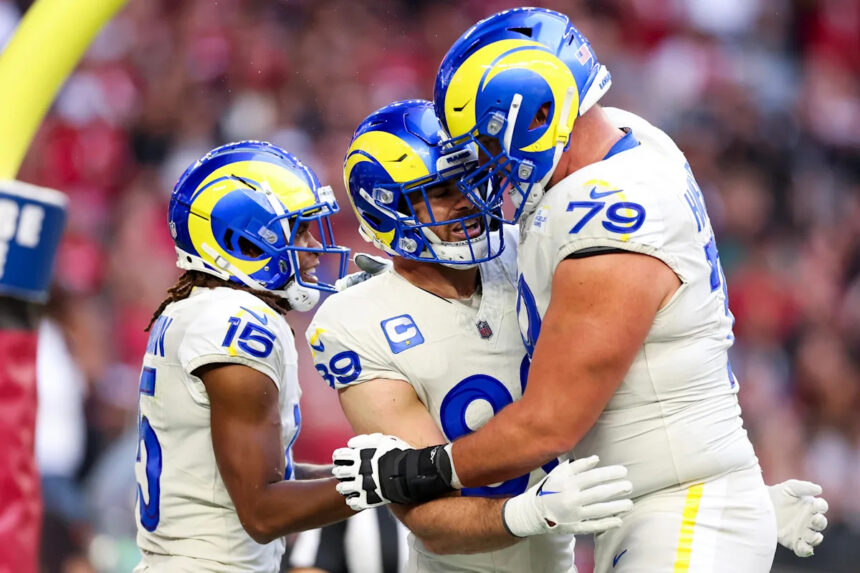
The contracts of two foundational veterans—right tackle Rob Havenstein and tight end Tyler Higbee—have officially voided, triggering dead money charges totaling $9.07 million for the 2025 season. This isn’t a surprise, nor is it a mistake. It’s the deliberate fallout from a strategic decision made years ago, a bill that the Rams knowingly deferred to keep their Super Bowl LVI window wide open. As the team navigates a critical offseason, understanding this financial ripple effect is crucial to forecasting their next moves.
The Anatomy of a Void Year: Kicking the Can Down the Road
To comprehend why the Rams are paying millions for players no longer under contract, you must understand the mechanism of void years. This is a common cap management tool, especially for teams pushing for a title. When the Rams extended Tyler Higbee and Rob Havenstein in recent years, they didn’t just structure the deals for their active years. They added extra, phantom years onto the end of the contracts—years the players and team never intended to play under.
The magic lies in the signing bonus. A player’s signing bonus is prorated evenly over the life of a contract for cap purposes. By adding void years, the Rams could spread that proration over five or six years instead of three or four. This dramatically lowered the players’ annual salary cap hits during the competitive window, freeing up immediate cash to sign other key contributors.
The trade-off is simple and inevitable: when the contract automatically voids, all the remaining prorated bonus money that was pushed into those future years accelerates onto the team’s salary cap all at once. This accelerated sum is what we call dead money—cap space occupied by players no longer on the roster. It’s the price of earlier flexibility.
- Rob Havenstein’s Charge: $6.97 million. The stalwart right tackle’s retirement made for a poignant story, but his financial impact was set in stone the moment his last extension was signed. This charge was hitting the Rams’ 2025 cap whether he retired, left in free agency, or re-signed.
- Tyler Higbee’s Charge: $2.1 million. Higbee is currently a free agent recovering from a significant knee injury. His future, whether it’s a return to the Rams or elsewhere, is separate from this dead money. This is payment for past performance, a final cap hit from his previous deal.
Context is King: Rams’ Cap Health Remains Strong
While $9 million in unusable cap space sounds alarming, context is critical. This is not a catastrophic cap penalty crippling the franchise. In fact, it’s a textbook example of planned cap management. The Rams knew this day was coming and have positioned themselves accordingly.
According to Over The Cap, the Rams’ total dead money for 2025 now sits at approximately $9.77 million. To put that in perspective, that ranks just 19th-highest in the NFL. Multiple teams are carrying dead cap figures exceeding $40 million for 2025. The Rams’ charge, while notable, is a manageable slice of their overall financial picture.
More importantly, the team’s overall cap space remains robust. Even after absorbing these void year charges, the Rams are estimated to have around $46.44 million in effective cap space. That ranks eighth-most in the league, giving Snead and Head Coach Sean McVay significant ammunition to attack free agency, re-sign their own key players, and perhaps even execute another signature “all-in” trade.
The Rams’ strategy has always been about timing and windows. They used void years to maximize their cap during their peak contention years, accepting that the 2025 offseason would be a period of some financial reckoning. The fact they still maintain top-10 cap space after that reckoning speaks to shrewd long-term planning.
Strategic Implications and Offseason Predictions
So, what does this mean for the Rams’ 2025 offseason? The dead money from Havenstein and Higbee is a sunk cost; it doesn’t hinder their ability to operate, but it does inform their priorities.
1. The Offensive Line Rebuild Continues: Havenstein’s void charge underscores the finality of his departure. The right tackle job is now fully in the hands of a new generation, likely making it a top draft priority. Protecting Matthew Stafford’s blindside remains paramount, and investing draft capital here is a near certainty.
2. Tight End in Transition: The $2.1 million charge for Higbee is a reminder of his past value, but the position is clearly evolving. With the emergence of second-year star Davis Allen and the reliable presence of Hunter Long, the Rams may be inclined to look for a dynamic, pass-catching tight end in the draft to complete the room, rather than splurging in free agency.
3. Aggressive in Free Agency, But Selective: With $46+ million in space, the Rams will be players. However, expect them to be strategic. They are more likely to pursue one or two high-impact veterans—perhaps a premier cornerback or pass rusher—to fill specific holes rather than a spending spree. Their history suggests they prefer to build through the draft and use cap space to retain their own (like extending star defensive tackle Kobie Turner) and for targeted acquisitions.
4. The Stafford Restructure Looming: The elephant in the room is Matthew Stafford’s contract, which currently carries a massive $58.9 million cap hit for 2025. A simple restructure could free up over $20 million in immediate space with the click of a mouse. The Havenstein and Higbee dead money is a footnote compared to the flexibility Stafford’s deal can provide. An extension or restructure is the single biggest financial lever the Rams will pull this offseason.
The Cost of Doing Business: A Conclusion on Cap Philosophy
The Los Angeles Rams’ $9 million dead cap charge is not a story of mismanagement, but a case study in modern NFL economics. It is the definitive receipt for the financial engineering that helped them hoist the Lombardi Trophy in 2022 and remain perennial contenders. The front office consciously borrowed from the future to pay for the present, a gamble that yielded the ultimate payoff.
This moment reveals the core of the Rams’ philosophy: cap space is a tool to be used, not hoarded. The goal is not to have the cleanest cap sheet at the end of the season, but to have the best possible roster on the field each Sunday. Dead money is often framed as a failure, but in this context, it is simply the amortized cost of championship-level talent. It’s the interest paid on a loan that bought a ring.
As the Rams move forward with a young, talented core and a veteran quarterback still playing at an elite level, they do so with their eyes wide open. The bill for past glory has been paid. With a top-10 war chest of cap space still in hand and their signature aggressiveness intact, Les Snead and Sean McVay are now fully financed to write the next chapter. The void years are closed; the window, remarkably, remains very much open.
Source: Based on news from Yahoo Sports.